North Korea Amends Constitution to Define Southern Border with South Korea and Assign Nuclear Command to Leader Kim Jong Un
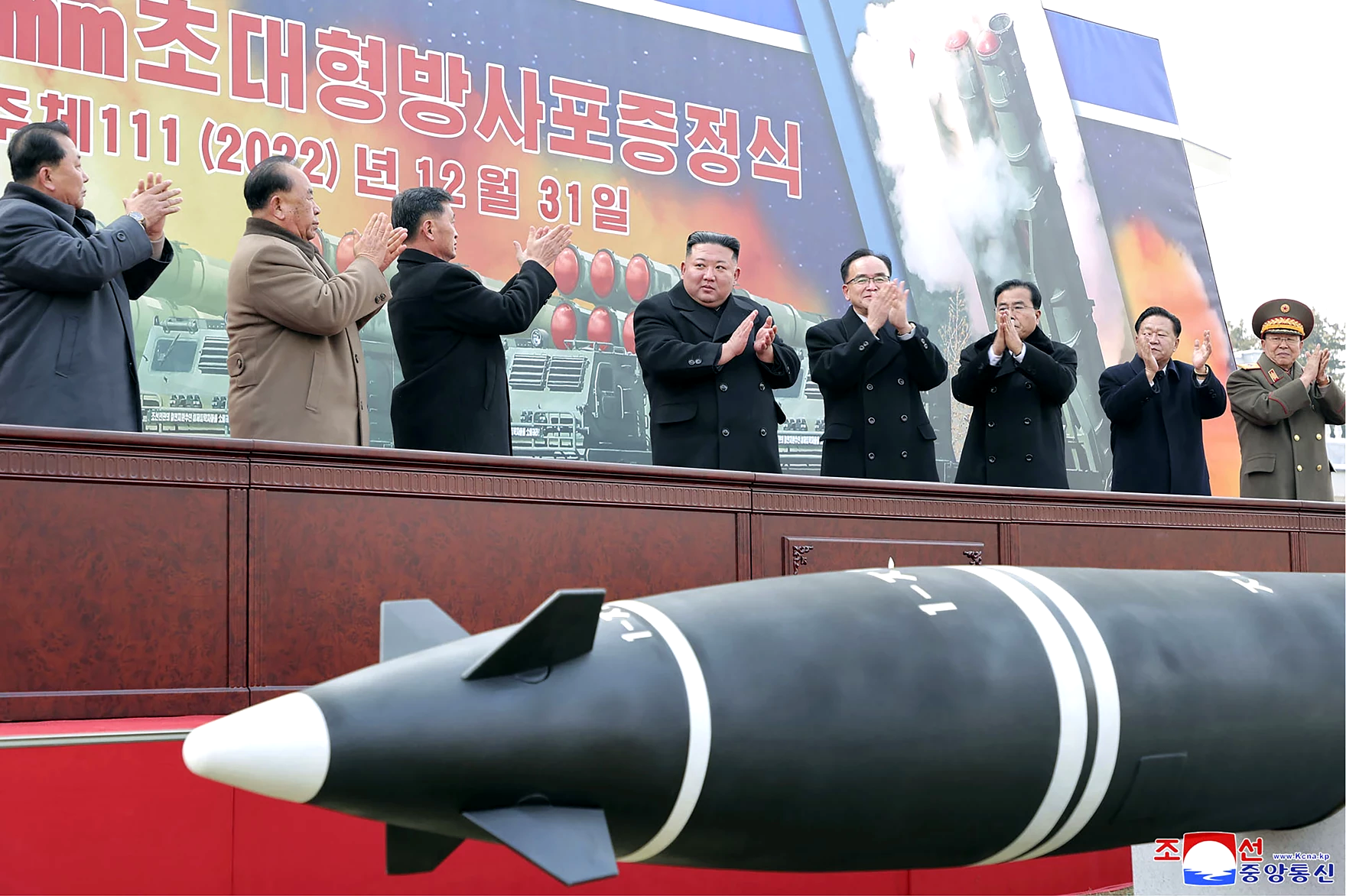
Image: North Korea Amends Constitution to Define Southern Border with South Korea and Assign Nuclear Command to Leader Kim Jong Un Credit: Defcon Level analysis
KOREAN PENINSULA, North Korea has amended its Socialist Constitution to introduce the country’s first explicit territorial definition while removing all references to reunification, national unity, and the achievements of Kim Il-sung and Kim Jong-il. The amendments assign command authority over nuclear forces to the Chairman of the State Affairs Commission and allow delegation of that authority to a national nuclear warfare command organization.
Kim Jong Un was re-elected president of the State Affairs Commission during the same session. South Korea’s National Intelligence Service and Blue House have since assessed the changes, clarifying the existence of two separate states on the peninsula while noting the absence of hostile language toward the South. These changes carry implications for nuclear command continuity in potential crisis scenarios and for the formal recognition of a two-state reality on the peninsula.
The revisions build directly on the 2022 Act on Nuclear Forces Policy, which already outlined conditions for nuclear use, by elevating the command structure to constitutional status without adding new operational triggers for automatic retaliation. Official North Korean reporting on the session agenda confirmed the focus on constitutional revision and leadership elections but released no full English-language text of the amended provisions.
South Korea’s National Intelligence Service briefed the National Assembly intelligence committee on May 7, 2026, that the changes clarify the existence of two separate states on the peninsula while containing no hostile language directed at the South. The Blue House said on May 8 that the government would review the amendments and continue its policy of peaceful coexistence.
Territorial Definition and Policy Revisions
The amended constitution adds a new clause in Article 2 that defines Democratic People’s Republic of Korea territory as land bordering the People’s Republic of China and the Russian Federation to the north and the Republic of Korea to the south, along with corresponding territorial waters and airspace. This marks the first time North Korea has specified its borders in the constitution. The text states that North Korea “will never tolerate any infringement” of its territory.
The revisions delete prior language about achieving “the complete victory of socialism, and to realize national reunification on the principles of independence, peaceful reunification, and great national unity.” The preamble now describes the country as a “people-centered socialist state” that “represents the interests of the Korean people and struggles for the socialist cause.”
Nuclear Command Provisions
A new provision explicitly states that the Chairman of the State Affairs Commission commands the nuclear forces of the Democratic People’s Republic of Korea and may delegate that authority to the national nuclear warfare command organization.
The constitution further describes North Korea as a “responsible nuclear weapons state” that will advance nuclear development to safeguard national survival, deter war, and protect regional and global peace and stability.
The clause formalizes at the constitutional level authority already exercised by Kim Jong Un; it does not alter the automatic nuclear response provisions contained in the 2022 Nuclear Forces Policy Act.
Assessment: The command clause reduces ambiguity around succession and continuity of nuclear operations by placing authority squarely with the State Affairs Commission chairman and providing an explicit delegation mechanism. Combined with the territorial definition, the amendments align constitutional text with the two-state policy announced in 2023 and eliminate any legal basis for claims over the entire peninsula.
South Korean Government Response
The National Intelligence Service stated during its May 7 closed briefing that the revisions establish the two-state approach while significantly reducing hostile language toward the South. The agency noted the nuclear command clause serves as a clear declaration that North Korea will not abandon its nuclear arsenal.
The Blue House reported on May 8 that Seoul would conduct a comprehensive review of the constitutional trends and would consistently pursue its Korean Peninsula peaceful coexistence policy.
Unification Ministry officials presented a detailed review of the draft text at a briefing on May 6-7 featuring Seoul National University professor Lee Jung-chul.
Assessment: South Korean officials have identified no immediate changes in how they deter threats or conduct operations because of the amendments. The new text contains no hostile phrasing toward the Republic of Korea, though the explicit nuclear command provisions and territorial demarcation show Pyongyang’s commitment to maintaining its current nuclear posture.
Implications
The constitutional changes eliminate previous references that treated the entire Korean Peninsula as a single national entity under eventual unification. By naming the Republic of Korea as the southern border, the document removes any constitutional claim to sovereignty over the South and aligns legal text with operational policy shifts observed since late 2023.
The nuclear command provisions, paired with the territorial clause, create a clearer framework for continuity of command in any scenario affecting leadership.
The delegation mechanism supports existing conditions for nuclear use outlined in the 2022 Act on Nuclear Forces Policy, particularly in situations where the command-and-control system faces danger from what the law terms hostile forces. No new triggers for nuclear use appear in the amendments beyond those already established in 2022 legislation.
No public statements from U.S. government agencies or U.S. Indo-Pacific Command on the revisions have been released.
What to Watch
- North Korean authorities publish the full revised constitution text or official channels issue further commentary on the nuclear doctrine provisions.
- South Korea’s Ministry of National Defense or Blue House comments on adjustments to deterrence posture or inter-Korean policy following the review.
- U.S. Indo-Pacific Command or Department of Defense mentions the changes in upcoming posture reviews or congressional testimony.
- North Korean media frames missile or nuclear-related activity as showing command continuity under the new provisions.
Full Report & Analysis
The full report includes expert analysis and risk assessment.
Full Report & Analysis →