Iran Rejects U.S. Ceasefire Plan, Demands Hormuz Sovereignty as 82nd Airborne Deploys to Gulf
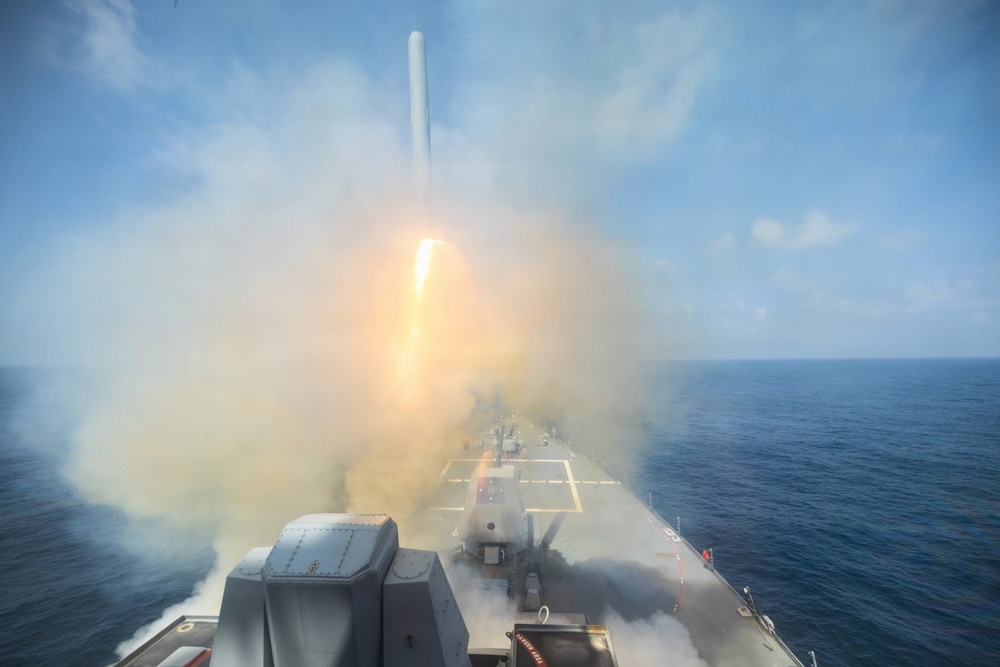
USS Spruance (DDG 111) fires a Tomahawk Land Attack Missile in support of Operation Epic Fury, February 28, 2026. (U.S. Navy / NAVCENT Public Affairs) Credit: U.S. Navy / NAVCENT Public Affairs
MIDDLE EAST — Iran formally rejected the United States’ 15-point ceasefire proposal on March 25 and issued five counterdemands, including a claim of sovereignty over the Strait of Hormuz. The rejection came as a Pentagon spokesperson confirmed elements of the 82nd Airborne Division, approximately 2,000 paratroopers, are deploying to the U.S. Central Command (CENTCOM) area of responsibility.
Pakistan’s Foreign Minister and Deputy Prime Minister Ishaq Dar confirmed on March 26 that Pakistan is serving as the primary intermediary between Washington and Tehran, conveying messages between the parties. Dar noted that “the US has presented 15 points which Iran is currently reviewing,” with Turkey and Egypt providing supporting roles.
CENTCOM Commander Admiral Brad Cooper reported in a March 25 video update that U.S. forces have struck more than 10,000 Iranian targets since Operation Epic Fury began on February 28, nearly doubling the 5,500 figure reported on March 11. Cooper added that 92 percent of Iran’s largest naval vessels have been destroyed and over two-thirds of its missile, drone, and naval production facilities have been damaged or degraded.
Iran’s Ceasefire Counterproposal and Hormuz Sovereignty Demand
Iran’s five counterdemands include a halt to the killing of Iranian officials, safeguards against future attacks on Iran, reparations for the war, an end to hostilities across all fronts including allied groups, and Iran’s “exercise of sovereignty over the Strait of Hormuz.”
The Hormuz demand carried specific language: “Iran’s exercise of sovereignty over the Strait of Hormuz is and will remain Iran’s natural and legal right, and it constitutes a guarantee for the implementation of the other party’s commitments, and must be recognized.” The official added that “Iran will end the war when it decides to do so and when its own conditions are met.”
Iranian Foreign Minister Abbas Araghchi confirmed that no direct negotiations with the United States are planned or underway. Iran characterized the U.S. 15-point plan as “maximalist” and “unreasonable.”
On March 26, President Trump announced a 10-day extension of the pause on strikes against Iranian energy infrastructure, pushing the deadline to April 6 at 8 p.m. Eastern Time. Trump stated Iran had requested the extension and that Tehran had allowed several oil tankers through the Strait of Hormuz, which he characterized as a signal of engagement.
Assessment: The Hormuz sovereignty demand goes beyond standard ceasefire terms. Iran is attempting to convert a military conflict into a permanent legal concession over the waterway that handles roughly 20 percent of global oil transit, according to the U.S. Energy Information Administration.
The demand functions as both a negotiating anchor and a signal that Tehran views the current conflict as leverage for long-term strategic gains, not merely a war to be ended.
The April 6 deadline creates a defined window for diplomatic progress. Iran’s request for the extension, despite publicly rejecting the 15-point plan, indicates Tehran is maintaining a back channel even as it postures publicly.
The reparations demand is also novel and has no precedent in recent Middle Eastern ceasefire negotiations.
Pakistan Confirms Lead Mediation Role
Foreign Minister and Deputy Prime Minister Ishaq Dar confirmed Pakistan’s mediation role in a statement on March 26. “Pakistan is playing a crucial mediatory role by conveying messages between the parties,” Dar stated.
He described the effort as dismissing “unnecessary media speculation” about the status of talks and added that “negotiations and diplomacy are the only paths to ensure lasting peace.”
Dar specified that Turkey and Egypt, along with other states, are providing “full support” in a supporting capacity. This is the first public, named confirmation that indirect U.S.-Iran talks are underway through a specific intermediary.
Assessment: Pakistan’s role as lead mediator rather than Egypt shifts the diplomatic dynamic. Islamabad maintains working relationships with both Tehran and Washington, and Pakistan’s nuclear-armed status gives it a different weight at the table than Cairo. The fact that Dar made a public statement suggests Pakistan wants credit for the mediation effort, which may indicate the channel is producing enough progress to be worth claiming.
82nd Airborne Deployment and Kharg Island as Possible Objective
A Pentagon spokesperson confirmed on March 25 that elements of the 82nd Airborne Division headquarters, division enablers, and the 1st Brigade Combat Team (BCT) are deploying to the CENTCOM area of responsibility. The deployment involves approximately 2,000 paratroopers drawn from the Immediate Response Force (IRF), a quick-reaction element of the division’s 3,000-soldier ready brigade with an 18-hour deployment capability, according to defense officials.
The force comprises two battalions of approximately 800 soldiers each, according to defense officials, plus division commander Major General Brandon Tegtmeier and supporting staff. The deployment follows earlier reinforcements including the USS Boxer and the 11th Marine Expeditionary Unit (MEU, a ship-based Marine force).
Alex Plitsas, a fellow at the Atlantic Council, assessed the force size and noted that the deployment “is not sufficient for a major invasion nor to hold a single city,” adding that it “says limited/targeted ops only.” Plitsas identified two possible objectives consistent with a limited-force deployment: supporting operations to open the Strait of Hormuz and a potential seizure of Kharg Island, a Persian Gulf facility that handles 90 percent of Iranian oil exports.
Assessment: The 82nd Airborne’s IRF has previously deployed as a rapid-response force for contingency operations, including the 2022 deployment to Europe during the Ukraine crisis and the 2021 Afghanistan embassy evacuation. The deployed force cannot hold a city, as Plitsas noted, but it could execute a seizure-and-hold operation on an island the size of Kharg.
The timing, within 24 hours of Iran’s ceasefire rejection, positions the deployment as either a pressure tool or preparation for escalation if diplomacy fails.
CENTCOM: 10,000 Targets Struck, 92% of Naval Fleet Destroyed
Admiral Cooper declared on March 25 that “we hit the 10,000th Iranian target just hours ago,” adding that “if you combine what we’ve accomplished with the success of our Israeli ally, together we have struck thousands more.” The 10,000 figure represents a near doubling from the 5,500 targets reported on March 11, a progression of approximately 320 targets per day.
Cooper reported that 92 percent of Iran’s largest naval vessels have been destroyed. “They’re not sailing, and my operational assessment is that they’ve now lost the ability to meaningfully project naval power,” Cooper assessed. He added that over two-thirds of Iran’s missile, drone, and naval production facilities have been damaged or destroyed, and that drone and missile launch rates have dropped more than 90 percent from their peak, according to CENTCOM operational data.
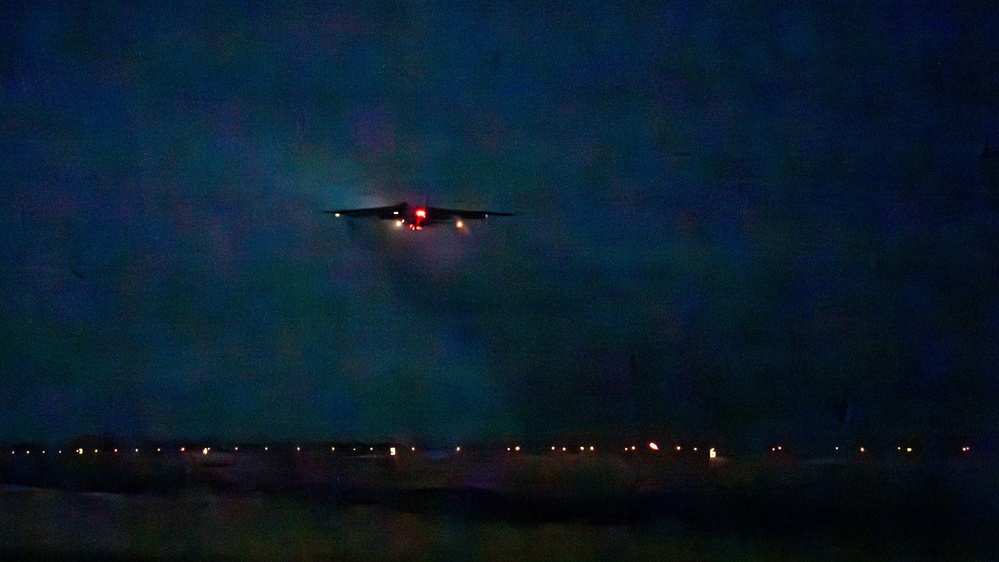
The CENTCOM commander noted that B-52 bombers are executing strikes carrying up to 70,000 pounds (approximately 31,750 kilograms) of munitions per mission, with more than 10,000 combat flights completed. Cooper confirmed that more than 50,000 American service members are deployed for Operation Epic Fury and added: “We’re not done yet. We are on a path to completely eliminate Iran’s wider military manufacturing apparatus.”
In a separate development on March 26, Israel confirmed it killed IRGC Navy commander Alireza Tangsiri in an airstrike on Bandar Abbas. Israeli Defense Minister Israel Katz stated Tangsiri was “directly responsible” for mining and blocking the Strait of Hormuz. The strike also killed IRGC Navy intelligence head Behnam Rezaei, according to IDF confirmation.
Assessment: The March 25 figures represent a shift from the March 11 snapshot. The 92 percent naval destruction figure, if accurate, means Iran has lost its conventional naval deterrent in the Persian Gulf. The 90 percent reduction in launch rates indicates that Iranian missile and drone production is being degraded faster than Tehran can replenish.
The killing of Tangsiri removes the operational commander most directly associated with Iran’s Hormuz blockade strategy, compounding the 92 percent naval vessel losses reported by CENTCOM.
Cooper's reported 50,000+ service members deployed to the region represents the largest U.S. force concentration in the Middle East during the current operation, according to CENTCOM figures.
Iran’s Cluster Warhead Campaign Against Israel
The Israel Defense Forces (IDF) reported that Iran has fired approximately 300 missiles at Israel since February 28, with roughly half carrying cluster warheads, according to IDF figures cited by Israeli media. Cluster munitions scatter submunitions across a wide area, complicating interception by missile defense systems because each warhead disperses into multiple objects after separation.
The cluster warhead ratio, approximately 150 out of 300 missiles based on IDF figures, indicates a deliberate effort to overwhelm Israeli air defenses. Iran has conducted repeated drone and missile campaigns targeting Israel, Jordan, Iraq, and Gulf states hosting U.S. military installations since the conflict began.
Assessment: The shift to cluster warheads in half of Iran’s missile salvos changes the defensive calculus for Israel. Standard interceptors engage one warhead per missile; cluster munitions multiply the number of objects that defense systems must track after warhead separation. The IDF has not published interception rates against cluster-equipped missiles specifically, which is itself an intelligence indicator.
Israel extended the closure of Ben Gurion International Airport through April 16, a closure now extending beyond three weeks, according to the Israeli Transport Ministry.
Lebanon Front: Hezbollah Operations and IDF Ground Casualties
Hezbollah has conducted sustained operations against Israel since joining the fighting on March 2. The IDF has reported approximately 3,500 attacks, while the Alma Research and Education Center, an Israeli defense research organization, counted 975 “attack waves” through its March 25 daily report.
The difference in figures reflects different counting methodologies: the IDF counts individual projectile launches and incidents, while Alma counts coordinated launch events.
Alma’s weapon-type breakdown from its March 25 daily report indicates rockets and missiles account for approximately 60 percent of attacks, unmanned aerial vehicles (UAVs) for approximately 30 percent, and anti-tank missiles for approximately 10 percent, according to Alma’s categorization.
Staff Sergeant Ori Greenberg, 21, from Petah Tikva, was killed in an exchange of fire with Hezbollah in southern Lebanon on March 26, the IDF confirmed. Greenberg served in the Golani Brigade Reconnaissance Battalion, operating under the 36th Division.
The engagement occurred at approximately 2:10 a.m. local time when soldiers identified armed individuals in their operational area. Greenberg was the third IDF soldier killed in Israel’s renewed ground offensive against Hezbollah in Lebanon.
Assessment: The Greenberg engagement is the first confirmed close-quarters clash between IDF ground forces and Hezbollah in the current offensive phase in Lebanon. Three IDF fatalities in the ground campaign indicate Hezbollah retains the ability to contest Israeli forces in southern Lebanon at close range, not only through standoff rocket and drone attacks.
Alma recorded 105 attack waves on March 25, the highest single-day rate since Hezbollah entered the conflict, nearly doubling the 60 waves recorded the previous day.
Kuwait Airport Strike and Gulf Cooperation Council Response
Kuwait’s Defense Ministry reported that air defense systems detected 20 ballistic missiles and nine hostile drones over a 24-hour period on or around March 25. Kuwaiti air defenses intercepted 13 of the missiles and six of the drones, the ministry reported. Two drones struck a fuel tank at Kuwait International Airport, and four additional fires were caused by falling debris at separate locations.
Abdullah al-Rajhi, spokesperson for Kuwait’s Directorate General of Civil Aviation (DGCA), confirmed that “according to initial reports, the damage is limited to material losses, with no casualties reported.”
Kuwait’s Foreign Ministry summoned Iran’s ambassador for the third time since February 28 and delivered a formal protest note characterizing the attack as a “grave violation” of international humanitarian law. Kuwait invoked Article 51 of the United Nations Charter, which recognizes the right of self-defense.
Assessment: The Kuwait airport strike is the first confirmed attack on civilian aviation infrastructure in a Gulf Cooperation Council (GCC) member state during this conflict. Kuwait’s invocation of Article 51 is a legal threshold that could justify military response under international law.
The interception rate of 65 percent for missiles (13 of 20) and 67 percent for drones (six of nine) suggests Kuwaiti air defenses were partially effective but not comprehensive against a combined missile and drone attack.

F-18 Near-Miss at Chabahar: IRGC Claim Versus CENTCOM Denial
The Islamic Revolutionary Guard Corps (IRGC) stated on March 25 that it struck a U.S. F-18 aircraft, according to Iranian state media. The footage released allegedly showed a jet hit by air defense fire and crashing into the Indian Ocean.
U.S. Central Command rejected the claim in a statement: “This information is false. No U.S. fighter aircraft have been shot down by Iran.”
The Aviationist, a specialized military aviation analysis outlet, conducted an open-source analysis of the available footage and geolocated the incident to Chabahar, in Iran’s Sistan and Baluchestan Province, near IRGC Naval Base Imam Ali at approximately 25.33 degrees north, 60.60 degrees east. The analysis determined the weapon was a man-portable air defense system (MANPADS, a shoulder-fired anti-aircraft missile).
The F/A-18 Super Hornet was conducting a low-altitude strafing run with an M61 20-millimeter cannon when targeted. The Aviationist assessed the footage as showing a near-miss based on the “elongated flame on the missile trajectory,” noting that a direct hit would produce a wider explosion pattern.
The aircraft executed a left-hand turn and “flew away apparently unscathed” with no countermeasures observed.
Assessment: The Aviationist analysis resolves the IRGC claim as a near-miss, not a shootdown. The engagement profile, a low-altitude gun run against a port facility, is consistent with strafing operations rather than standard medium-altitude strike missions.
MANPADS are most effective against low-flying aircraft, and this engagement demonstrates that Iranian ground forces retain some capacity to threaten aircraft operating at low altitude even as Iran’s larger air defense systems have been degraded by U.S. strikes.
Iranian Deterrence Signals: Ghalibaf’s Island Warning and Houthi Chokepoint Threat
Iranian Parliament Speaker Mohammad Bagher Ghalibaf warned on March 26: “Based on intelligence reports, our enemies are preparing to occupy one of the Iranian islands with support from a regional state.” Ghalibaf added: “If they take any step forward, all of the vital infrastructure of that regional country will come under unrelenting attacks without any restriction.”
The “regional state” was not named. Analyst assessments point to the United Arab Emirates (UAE) as the implied target based on the UAE’s hosting of U.S. military forces and its geographic proximity to Kharg Island.
Ghalibaf’s statement followed the Pentagon spokesperson’s announcement of the 82nd Airborne deployment by less than 24 hours.
Separately, Mohammed al-Bukhaiti, a member of the Houthi political bureau, announced on or around March 20 that the Houthis are “weighing the possibility of blocking the Bab al-Mandab Strait” to vessels from countries engaged in hostilities against Iran, Lebanon, Palestine, or Iraq. Al-Bukhaiti specified that any closure would be “limited to targeting ships linked to countries engaged in hostilities,” not a total blockade.
The Bab el-Mandeb Strait handles approximately 8.8 million barrels per day and 10 to 12 percent of international maritime trade, according to the U.S. Energy Information Administration.
Assessment: Ghalibaf’s statement is a deterrence signal aimed at any state that might support a Kharg Island operation. The threat to “vital infrastructure” of the unnamed regional country, combined with the Houthi threat to the Bab el-Mandeb, creates a dual-chokepoint scenario: Iran threatens Hormuz from the north while Houthi forces threaten Bab el-Mandeb from the south.
If both chokepoints were closed or contested simultaneously, approximately 30 percent of global seaborne oil trade would be at risk, based on U.S. Energy Information Administration transit volume data.
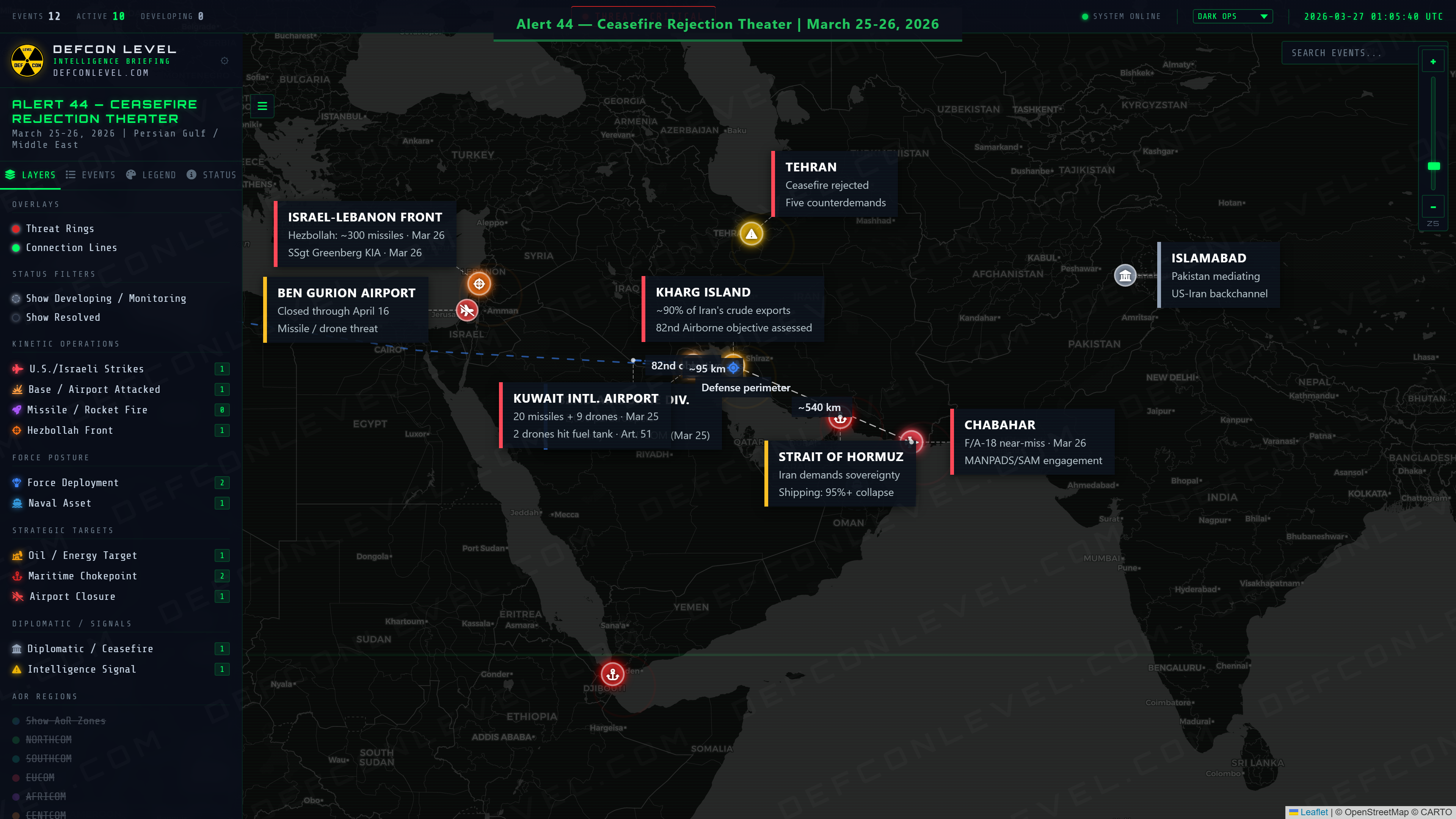
The convergence of Iran’s ceasefire rejection, the 82nd Airborne deployment, CENTCOM’s reported destruction of 92 percent of Iran’s naval fleet, and Ghalibaf’s island seizure warning indicates both sides are positioning for the next phase of the conflict rather than moving toward negotiated resolution. The April 6 deadline for the energy strike pause will test whether diplomatic channels through Pakistan can produce results before military options narrow further.
Full Report & Analysis
The full report includes expert analysis and risk assessment.
Full Report & Analysis →