Putin Sets Nuclear and Air-Defense Priorities and Denies Plans to Attack Europe
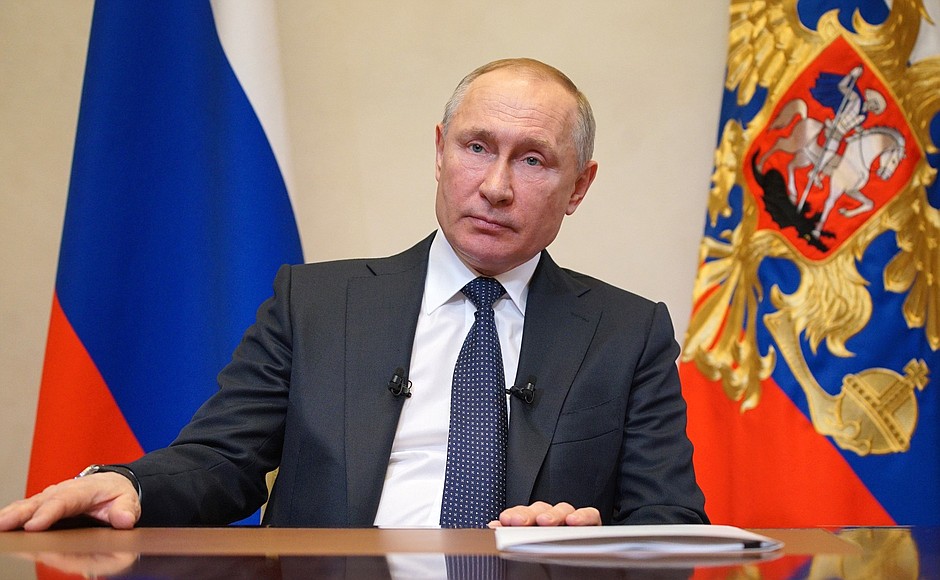
Russian President Vladimir Putin Credit: Credit: kremlin.ru
EUROPE — Russian President Vladimir Putin told the Military-Industrial Commission in the Kremlin on September 18 that a new State Armament Program and a companion defense-industry program will set what the army and other security services design and build in series. In the same session he said Russia has no plans to attack Europe.
The session opened in public and then moved into a closed portion. He listed six program lines: the nuclear triad; air defenses meant to stop aircraft, missiles, and other airborne and space weapons; unmanned robotic systems; precision munitions; a finished orbital satellite group; and further work on digital systems and artificial intelligence. He put Strategic Missile Forces modernization at 92 percent.
On September 17, Polish Prime Minister Donald Tusk told the Sejm that allied intelligence predicts drone and missile attacks on Ukraine’s supporters, including Poland, as part of Russia’s plan for the coming months.
He said Moscow would present those hits as accidents so that NATO states would hesitate before treating an attack on one ally as an attack on all under Article 5. He also said there was nothing to suggest an invasion. The Sejm record lists that address as an out-of-agenda statement by the prime minister on sitting 65.
Latest Developments
-
NATO chiefs of defense meeting in Copenhagen on September 19 elected German General Carsten Breuer as the next Military Committee chair, Admiral Giuseppe Cavo Dragone said, with the handover set for summer 2027.
-
Russian Central Election Commission Chair Ella Pamfilova said on September 19 that a polling station in the Zaporizhzhia Region should carry Yelena Astanina’s name, and that a second commission colleague wounded in the same September 15 strike was recovering.
-
On September 18 in Ukraine, Tusk said Poland had joined the anti-ballistic missile coalition and had prepared a new support package for Kyiv.
-
Kursk plant press secretary Alexander Prytkov said on September 18 that there had been no attack and that operations were normal, after the IAEA disclosed the cooling-tower hit.
-
On September 18, Putin set the nuclear triad, air defense, unmanned systems, precision munitions, a completed orbital group, and digital systems including artificial intelligence as the lines of a new State Armament Program.
-
The same day he stated that Russia has no plans to attack Europe, is ready to restore relations with European neighbors, and will answer Baltic drills that practice taking civilian ships if those drills continue.
-
On September 18 the IAEA disclosed the early-September 17 Kursk cooling-tower hit and Grossi said attacks on nuclear sites are unacceptable.
-
On September 17 Tusk told the Sejm that intelligence assessments point to drone and missile hits on Ukraine’s supporters, including Poland, framed as accidents to weaken Article 5, and that nothing suggested an invasion.
-
On September 16, Lithuanian President Gitanas Nauseda said the drone NATO aircraft destroyed over Lithuania the day before was a Gerbera and was most likely aimed at Ukraine and pushed off course.
-
On September 16, in the Foreign Ministry English transcript of the Yekaterinburg panel, Lavrov said Russia does not intend to attack Europe and that a European attack on Russia would produce a different and much shorter war.
Locations Affected
-
Moscow, Russian Federation: Kremlin session of the Military-Industrial Commission on September 18. Seat of the draft State Armament Program discussion.
-
Kursk Nuclear Power Plant (original RBMK site), Kurchatov, Kursk Oblast, Russia: 51.6764 N, 35.6064 E. About 25 miles (40 km) west of Kursk city and roughly 56 miles (90 km) from the Ukraine border. Operator records list RBMK units 1-4 here.
-
Kursk NPP-2 (VVER-TOI site), near Kurchatov, Kursk Oblast, Russia: approximately 51.688 N, 35.573 E, west of the original plant. Rosatom press-service reprints name Unit 1 here as the cooling-tower site. The IAEA notice said “Kursk Nuclear Power Plant” and did not publish a unit number. VVER-TOI Unit 1 has been in commercial operation since May 1.
-
Warsaw, Poland: Sejm chamber, sitting 65, September 17. Tusk’s intelligence briefing to parliament on hybrid strikes against Ukraine’s supporters, including Poland.
-
Western Ukraine, Carpathian Eight summit: Tusk-Zelenskyy meeting on September 18 at which Poland said it had joined the anti-ballistic missile coalition.
-
Oktyabrskoye (Zhovtneve), Tokmak municipal district, Zaporizhzhia Region: Precinct election commission chairwoman Yelena Astanina killed in a drone strike on September 15, per Russia’s Central Election Commission. Coordinates and independent confirmation of the strike’s author have not been published by a body with standing outside the Russian account.
-
Pratkunai area, Kaunas County, Lithuania: NATO fighter aircraft destroyed a drone that entered Lithuanian airspace from Belarus shortly after midnight on September 15, Lithuanian President Gitanas Nauseda and the National Crisis Management Center said. On September 16 Nauseda said the airframe was a Gerbera and was most likely aimed at Ukraine and pushed off course. No finished wreck report naming the last control link has been published by Vilnius.
-
Copenhagen, Denmark: NATO Military Committee conference, September 18-19, under Admiral Giuseppe Cavo Dragone, with NATO’s Supreme Allied Commander Europe, General Alexus G. Grynkewich, and Supreme Allied Commander Transformation, Admiral Pierre Vandier, attending as listed on the alliance event page.
-
Yekaterinburg, Russian Federation: International Youth Festival panel where Lavrov spoke on September 16.
Official Statements
-
Admiral Giuseppe Cavo Dragone, Chair of the NATO Military Committee, September 19: “Your operational judgement, your deep familiarity with this Alliance and your leadership of the German Armed Forces will serve NATO well.”
-
Cavo Dragone, same announcement: “The Chiefs of Defence have placed their trust in you at a demanding moment for Euro-Atlantic security.”
-
Ella Pamfilova, Chair of the Central Election Commission of the Russian Federation, September 19: “I think that one of the polling stations in the Zaporizhzhia Region, we will hold elections, life there is getting back on track, we will name it after her. And we want to wish our second colleague, who was wounded there, a recovery, a speedy recovery.”
-
Polish Prime Minister Donald Tusk, September 18: “From today, Poland is part of this major project ... we agreed on the forms and frameworks of this cooperation.”
-
Tusk, same day: “No one will change my opinion that Poland has to support Ukraine in its war against Russian aggression.”
-
Alexander Prytkov, press secretary of the Kursk Nuclear Power Plant, September 18 (translated from Russian): “No attack. Everything is routine... Everything is normal with us, everything is calm.”
-
Rosatom press service, as reprinted September 18 (translated from Russian): “On September 17, as it fell on the cooling tower of power unit No. 1 of Kursk NPP-2, an enemy unmanned aerial vehicle detonated.”
-
Rosatom press service, same reprint (translated from Russian): “The minor damage that resulted did not affect the operation of the plant, the power unit is operating at full capacity. The safety of the NPP is ensured, the radiation background did not change and corresponds to natural values.”
-
Russian President Vladimir Putin, Military-Industrial Commission, September 18: “Today, we will talk about the new draft State Armament Programme and the defence industry development programme. They will become the backbone for designing and serial production of modern weapons systems and hardware for our army and other defence and law enforcement agencies for them to be ready for a rapid and effective response to potential external threats.”
-
Putin, same session: “As you know, such threats are not abating. NATO is “swelling” and expanding and has now extended its reach to other regions of the world. Certain European leaders are openly declaring that they are preparing for war with Russia. In my view, they are merely trying to salvage their plummeting approval ratings by concealing the failures of their economic and social policies.”
-
Putin, same session: “I want to say this again: Russia has no aggressive intentions regarding Europe or European countries. We simply have no reasons for this. We are ready for cooperation and restoring relations with our European neighbours.”
-
Putin, same session: “I want to point out that hardly any nuclear country can boast such figures as, for example, those of our Strategic Missile Forces – 92 percent modernisation, that is, modern armaments.”
-
Putin, same session: “Another priority area of the new state programmes will be the improvement of the air defence system. It has to ensure destruction of any means of air and space attack.”
-
Putin, same session: “Let’s live in harmony instead; otherwise, we’ll have to respond too. This should be obvious for everybody, a clear truism. It won’t be otherwise.”
-
IAEA, September 18: “The IAEA has been informed that the cooling tower of a reactor unit of the Kursk Nuclear Power Plant in the Russian Federation was hit by a drone early on Thursday. It was reported that the unit was operating at the time, but its operating mode did not change and there was no fire.”
-
IAEA Director General Rafael Mariano Grossi, same notice: “all attacks on nuclear facilities are unacceptable as they could endanger nuclear safety and security, irrespective of where they occur.”
-
Polish Prime Minister Donald Tusk, Sejm, September 17: “In the Russian plan, according to intelligence assessments, there are also hybrid drone and missile strikes on countries supporting Ukraine, including Poland.”
-
Tusk, same sitting: “There is a real risk that drones or other types of missiles may fly into the territory of one or more NATO countries on the eastern flank, even cause destruction.”
-
Tusk, same sitting: “These potential strikes would be quote-unquote ‘accidental’ in nature, intended to paralyse or at least weaken the resolve of NATO states to invoke the relevant NATO provisions in the event of aggression against a member country.”
-
Lithuanian President Gitanas Nauseda, September 16: “Most likely, it was a Russian drone intended for Ukraine that was diverted from its course by Ukrainian electronic warfare measures and entered our territory, where it was shot down.”
-
Nauseda, same remarks: “Based on the information currently available, it was a Gerbera-type drone.”
-
Russian Foreign Minister Sergey Lavrov, Yekaterinburg panel, Foreign Ministry English transcript, September 16: “We have repeatedly made it clear that we have no intention of attacking Europe. Recently, President Vladimir Putin once again addressed this issue in detail, stressing that we have no interest whatsoever in doing so. However, if Europe, which never stops speaking about preparing for war against Russia, attacks the Russian Federation, it will be a completely different war. A very short one. I hope European capitals and the entities that are now trying to portray themselves as united Europe heard this warning.”
-
Lithuanian President Gitanas Nauseda, September 15: “A drone that just entered Lithuanian airspace was destroyed by NATO fighter jets.”
Full Report & Analysis
The full report includes expert analysis and risk assessment.
Full Report & Analysis →