USS John F. Kennedy Completes Sea Trials, CENTCOM Chief Ends Middle East Trip, Lincoln Rotation Confirmed
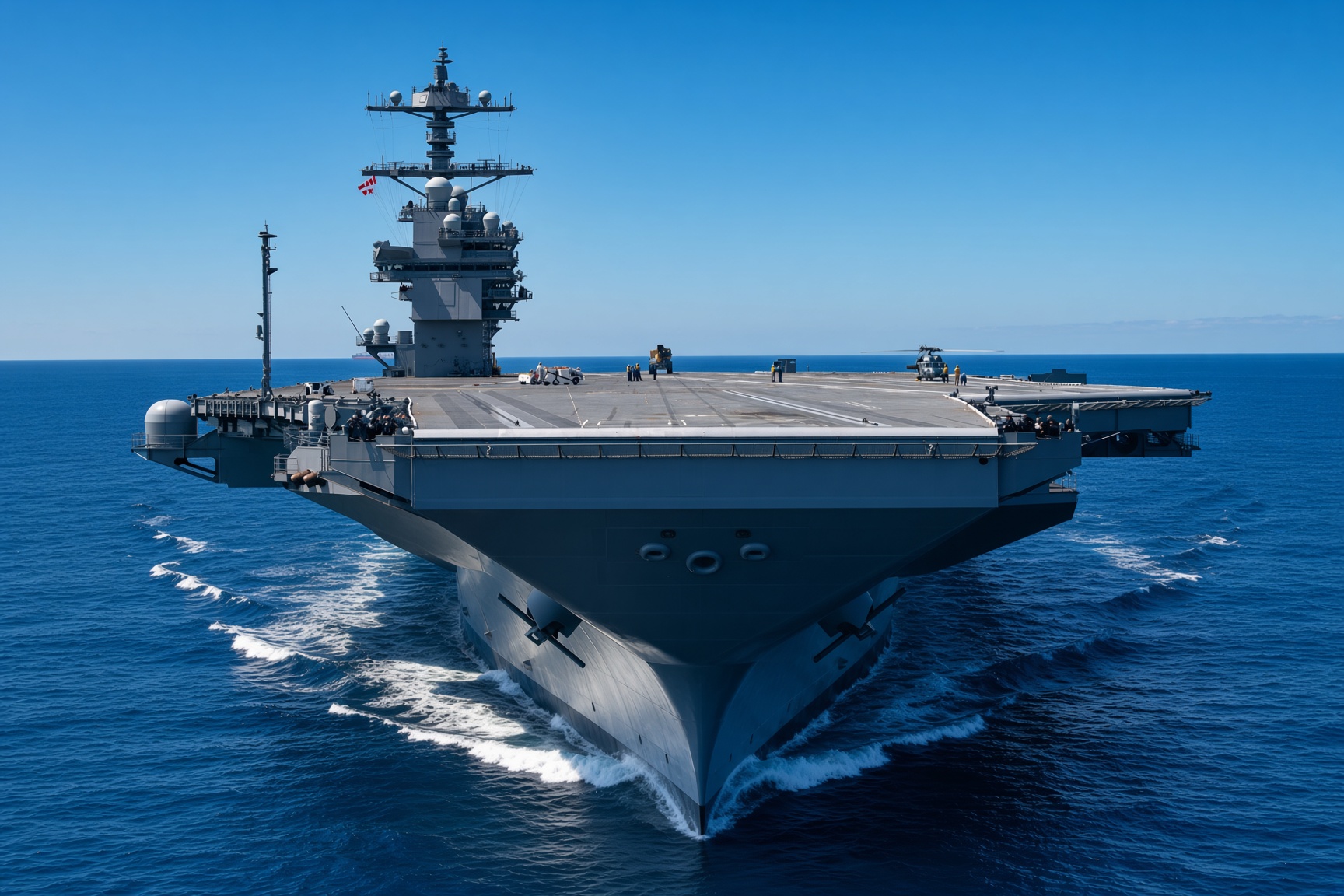
NEWPORT NEWS AND ARABIAN SEA — HII Newport News Shipbuilding completed acceptance sea trials of the future USS John F. Kennedy (CVN 79) on August 15, with the ship returning to the yard after testing key systems at sea.
On the same date, Adm. Brad Cooper, commander of U.S. Central Command, concluded a 10-day trip to the Middle East that included a visit to USS Abraham Lincoln (CVN 72) in the Arabian Sea.
Acting Secretary of the Navy Hung Cao stated on August 14 that USS Abraham Lincoln will return home soon as part of a planned rotation. The second Gerald R. Ford-class carrier has now completed the acceptance phase that follows builder’s sea trials.
The CENTCOM commander’s itinerary included meetings in six partner nations and direct contact with the strike group that has sustained combat flight operations and blockade enforcement.
The planned rotation of Abraham Lincoln sets the formal end state for a deployment that began in November 2025.
CENTCOM Commander Middle East Trip
Adm. Brad Cooper completed a 10-day trip to the Middle East on August 15. He met senior civilian and military leaders in Bahrain, Iraq, Israel, Jordan, Saudi Arabia, and the United Arab Emirates and spent time with deployed U.S. service members.
More than 50,000 American service members are operating across the Middle East supporting various missions.
Ashore, Cooper recognized exceptional performers, reenlisted troops, and oversaw the Combined Joint Task Force - Operation Inherent Resolve leadership transition on August 11 in Jordan, where Maj. Gen. Kevin Lambert transferred authority to Rear Adm. Liam Hulin.
At sea, Cooper visited USS Abraham Lincoln (CVN 72) for the second time in 2026. He previously visited in February with U.S. Special Envoy for Peace Missions Steve Witkoff and Jared Kushner.
On this trip he addressed the entire Lincoln team, thanked the crew for dedication and courage, met junior service members, and awarded individuals.
He stated the Lincoln Carrier Strike Group is “a strong team of high-achieving Americans standing tall with immense, justified pride in everything they accomplished” and that “History will record this deployment as one of the most operationally intense and consequential of the modern era.”
Blockade enforcement continued in parallel. As of August 14 CENTCOM reported 62 commercial vessels redirected, 3 disabled, and 2 boarded. Preceding daily updates listed 55 redirected as of August 11 and 59 as of August 12.
CVN 79 Acceptance Trials
HII Newport News Shipbuilding announced successful completion of acceptance sea trials for John F. Kennedy (CVN 79).
The carrier returned to the shipyard after further testing and evaluation of important ship systems and components at sea. Builder’s sea trials had been completed earlier in the year between January 28 and February 4.
Derek Murphy, Newport News Shipbuilding vice president of new construction aircraft carrier programs, stated: “It is an honor to take Kennedy to sea to demonstrate the quality work and commitment by our shipbuilders. This critical set of sea trials is a testament to the entire nuclear shipbuilding enterprise and the work of thousands across our country to prepare CVN 79 to join the fleet.”
The trials assembled Newport News Shipbuilding personnel, John F. Kennedy sailors, and Navy personnel. With acceptance trials complete, the next step is preliminary acceptance enabling the Navy to begin underway test and evaluation of the ship’s unique systems.
CVN 79 is the second Gerald R. Ford-class nuclear-powered aircraft carrier. Portfolio Acquisition Executive Maritime and Acting Secretary of the Navy Hung Cao both noted the milestone on August 15-16.
The carrier departed Newport News Shipbuilding on August 12 to begin the acceptance sea trials. No public Board of Inspection and Survey summary of discrepancies or technical findings has been released by the Navy as of August 16.
CVN 79 Fact Sheet
The future USS John F. Kennedy (CVN 79) is the second ship of the Gerald R. Ford class. Official Navy acquisition reporting and shipbuilder statements provide the following verified status as of the completion of acceptance sea trials.
-
Percent complete: 97 percent as of April 2026 (U.S. Navy Selected Acquisition Report).
-
Current cost baseline: Raised in December 2025 from $12.936 billion to $13.529 billion.
-
Builder’s sea trials: Conducted 28 January – 4 February 2026. Successfully exercised propulsion, navigation, combat systems (including the Enterprise Air Surveillance Radar), medical spaces, galley, and other habitability areas.
-
Acceptance sea trials: Completed on August 15. The ship returned to Newport News Shipbuilding after testing and evaluation of key systems and components at sea.
-
Advanced Weapons Elevators: Seven of eleven elevators completed. These seven provide access to all weapons magazines and support continued crew training and certification while the remaining four are finished.
-
Key systems still receiving upgrades: Component upgrades to the Advanced Arresting Gear and to the jet blast deflector emergency lowering systems.
-
Radar configuration: Equipped with the Enterprise Air Surveillance Radar (AN/SPY-6(V)3), which was exercised during builder’s trials.
-
Next formal step: Preliminary acceptance by the Navy, after which the Navy begins its own underway test and evaluation of the ship’s unique systems.
-
Projected delivery: March 2027 (fiscal year 2027).
-
Public discrepancy list: No Board of Inspection and Survey summary of findings from the acceptance trials has been released by the Navy as of August 16.
Force Posture Indicators
-
Confirmed: CVN 79 returned to Newport News Shipbuilding after acceptance sea trials, per HII announcement dated August 15.
-
Confirmed: Adm. Brad Cooper completed the 10-day Middle East trip on August 15, including the Abraham Lincoln visit, per U.S. Central Command release.
-
Confirmed: Abraham Lincoln Carrier Strike Group recorded more than 260 days at sea, 10,000 aircraft flights, and 1.5 million pounds of ordnance expended, per U.S. Central Command statement of August 13; refined by Acting Secretary of the Navy Hung Cao on August 14 to 266 days deployed and 200 days in a combat zone.
-
Confirmed: As of August 14, CENTCOM forces had redirected 62 commercial vessels, disabled 3, and boarded 2 under the naval blockade against Iran.
-
Confirmed: Acting Secretary of the Navy Hung Cao stated on August 14 that USS Abraham Lincoln will return home soon as part of a planned rotation.
-
Ongoing: Abraham Lincoln Carrier Strike Group remains in the Arabian Sea conducting flight operations in support of the naval blockade against Iran and related missions pending the planned rotation.
Official Statements
-
Derek Murphy, Vice President of New Construction Aircraft Carrier Programs, Newport News Shipbuilding (HII), August 15: “It is an honor to take Kennedy to sea to demonstrate the quality work and commitment by our shipbuilders. This critical set of sea trials is a testament to the entire nuclear shipbuilding enterprise and the work of thousands across our country to prepare CVN 79 to join the fleet.”
-
Adm. Brad Cooper, Commander, U.S. Central Command, August 15: “The Lincoln Carrier Strike Group is a strong team of high-achieving Americans standing tall with immense, justified pride in everything they accomplished. History will record this deployment as one of the most operationally intense and consequential of the modern era.”
-
Acting Secretary of the Navy Hung Cao, August 14: “The USS Abraham Lincoln crushed their deployment and will return home soon as part of a planned rotation. Details will come but let me be clear: the safety and security of our Sailors and Marines always comes first. ... 266 days deployed. 200 days in a combat zone. 10,000+ sorties. 1.5M lbs. of ordnance dropped. And retention rates on the ABE are amongst the highest of all carriers. ... A small number of mental health cases were treated with no loss of life. Meal plans were adjusted when fresh resupply was unavailable, without a single meal being missed. ... The Lincoln was extended because the mission demanded it.”
Full Report & Analysis
The full report includes expert analysis and risk assessment.
Full Report & Analysis →