
U.S. Raises Ceuta to Level 3 as Migrant Arrivals Trigger Spanish Military Deployment
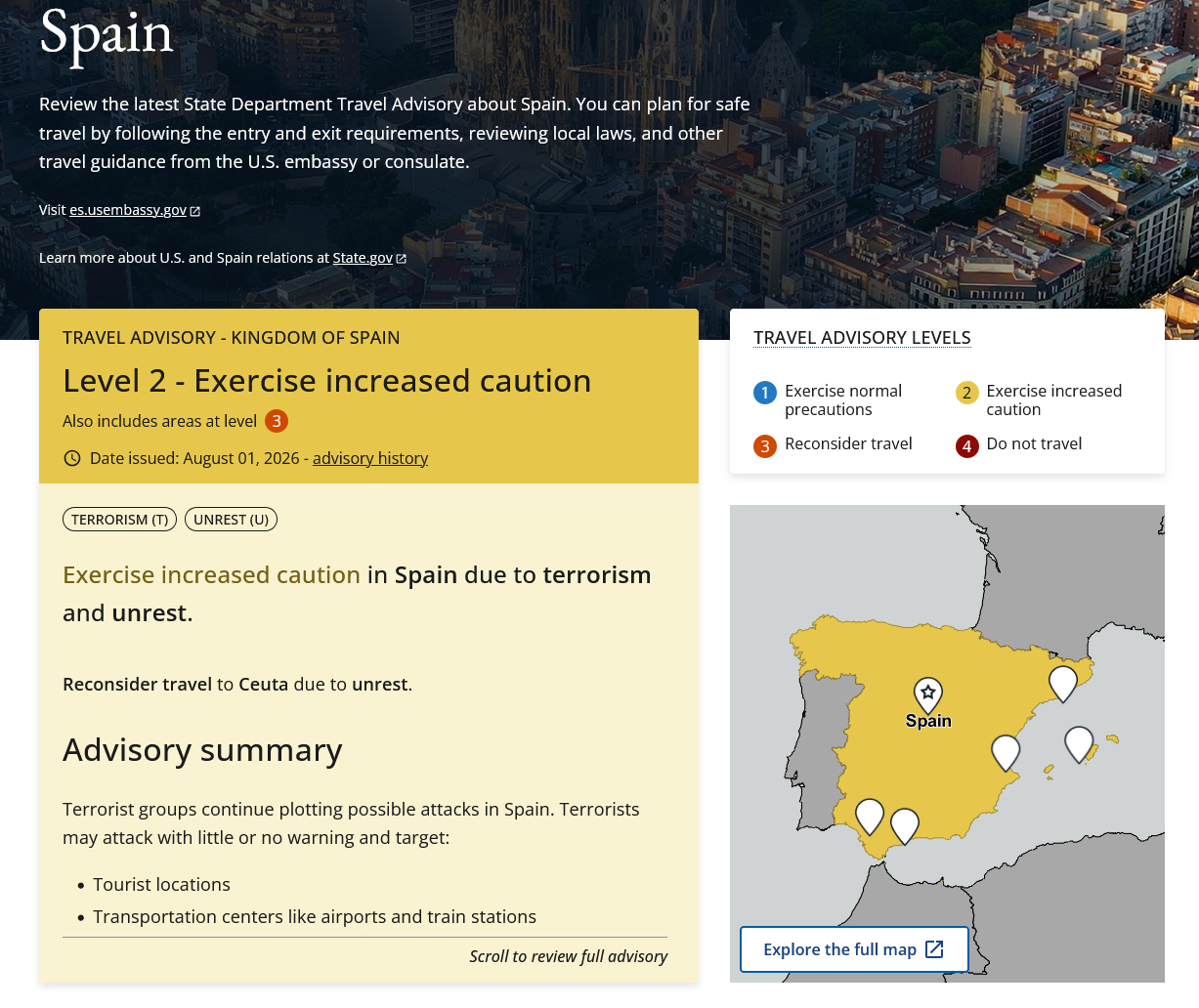
CEUTA, SPAIN — The U.S. Department of State on August 1 updated its Travel Advisory for Spain, raising Ceuta to Level 3 - Reconsider Travel due to unrest.
The overall advisory for Spain remains Level 2 - Exercise Increased Caution due to terrorism and unrest. No subsequent U.S. Embassy Madrid or State Department revision to that Level 3 rating has been issued.
The U.S. Embassy in Madrid on July 31 issued a Security Alert stating that the arrival of thousands of migrants from Morocco to Ceuta and hundreds to Melilla in the prior 24 hours may lead to unpredictable and dangerous situations. Spain deployed the Spanish military, Spanish National Police, and Guardia Civil to contain the situation.
Spanish Interior Minister Fernando Grande-Marlaska stated on August 1 that Ceuta had suffered an attack that constitutes a serious violation of Spain’s territorial integrity.
He confirmed the deployment of a reinforced device including the National Police, Guardia Civil, and the Spanish Army.
Advisory and Alert Status
-
United States (August 1, 2026): Spain overall Level 2 - Exercise Increased Caution (terrorism and unrest); Ceuta Level 3 - Reconsider Travel (unrest). No further change has been recorded.
-
United States Embassy Madrid (July 31, 2026): Security Alert for Ceuta and Melilla; do not travel to the affected areas at this time.
-
Spain (August 1, 2026): Interior Minister Grande-Marlaska described the events as a serious violation of territorial integrity and confirmed ongoing reinforcement of security forces and installation of containment barriers.
-
United Kingdom FCDO (latest update July 24, 2026): No change specific to Ceuta or Melilla; general Spain advice focuses on wildfires in Madrid and Ávila areas.
-
Canada (last updated July 29, 2026): Exercise a high degree of caution due to the threat of terrorism; no specific Ceuta or Melilla update.
-
Australia DFAT/Smartraveller (as of late July 2026): Exercise normal safety precautions; no specific Ceuta or Melilla update.
Who Is Affected
U.S. citizens and other travelers currently in or planning to enter Ceuta face elevated risks of unpredictable security situations tied to the migrant arrivals and the resulting Spanish security force deployment.
The U.S. Embassy explicitly advised against travel to the affected areas. Mainland Spain remains under the lower Level 2 advisory. Melilla was referenced in the July 31 Embassy alert for hundreds of arrivals but was not elevated to Level 3 in the August 1 advisory update.
Spanish authorities reported that the large majority of those who entered Ceuta had returned to Morocco by the evening of July 31, with Interior Ministry figures placing the number of returns at approximately 48,300 out of an estimated 50,000 crossings since the morning of July 30. Ceuta’s local president estimated the peak inflow at as many as 60,000.
Residual presence and the continued deployment of forces maintain the security posture that underpins the U.S. Level 3 rating.
No public Spanish authority has published an update on the number of migrants remaining inside Ceuta after the evening of July 31.
What To Do
-
Do not travel to the affected areas at this time (U.S. Embassy Madrid, July 31).
-
Avoid any demonstrations which may become violent (U.S. Embassy Madrid, July 31; U.S. Travel Advisory).
-
Follow instructions of local authorities if you are in Ceuta and Melilla (U.S. Embassy Madrid, July 31; U.S. Travel Advisory).
-
Be aware of your surroundings (U.S. Travel Advisory).
-
Monitor updates in local media and Spanish government sources (U.S. Embassy Madrid, July 31; U.S. Travel Advisory).
-
Notify friends and family of your safety (U.S. Embassy Madrid, July 31).
-
Check local media for breaking events and be prepared to adjust plans (U.S. Travel Advisory).
Embassy Operational Status
U.S. Embassy Madrid remains open and operational.
-
Emergency contact: +34-915-872-200.
-
U.S. Consulate General Barcelona: +34-932-802-227.
-
State Department Consular Affairs: +1-888-407-4747 or +1-202-501-4444.
No reduction, suspension, or ordered departure has been announced. Enroll in the Smart Traveler Enrollment Program for updates.
Airport and Border Status
Ferries between Ceuta and mainland Spain are currently still operating, according to the U.S. Embassy Madrid Security Alert of July 31.
Updated schedules are available from the Port of Ceuta authority. No official confirmation of airport closures or full border sealings has been issued by U.S. or Spanish authorities in the available records. Ceuta’s primary passenger link to the Spanish mainland is by ferry.
Spanish Interior Ministry personnel on August 1 supervised the installation of a 500-meter pneumatic containment barrier at the Tarajal breakwater, with a surface height of 30 to 70 centimeters and a submerged section of up to one meter.
The measure is intended to limit further sea approaches along that sector of the perimeter. No later status update on barrier completion has been published by Spanish authorities.
Affected Locations
-
Ceuta (Spanish autonomous city on the North African coast, bordering Morocco): primary focus of the Level 3 advisory and the bulk of reported migrant arrivals. Security forces remain reinforced and barrier installation is underway at Tarajal.
-
Melilla (Spanish autonomous city on the North African coast, bordering Morocco): referenced in the July 31 U.S. Embassy alert for hundreds of arrivals; Spanish reporting indicated 300 to 400 crossings; not elevated to Level 3.
Official Statements
-
Fernando Grande-Marlaska, Spanish Interior Minister, August 1, 2026: “Ceuta has suffered an attack that constitutes a serious violation of Spain’s territorial integrity. We have responded with firmness, determination and with the deployment of a powerful device, with the reinforcement of the Police, Civil Guard and Army.”
-
Fernando Grande-Marlaska, Spanish Interior Minister, August 1, 2026: “It is an unacceptable human tragedy, which must shake us and, at the same time, drive us to continue working even harder on the dismantling of the mafias.”
Prime Minister Pedro Sánchez, during his July 31 visit to Ceuta, characterized the influx as a violation of Spain’s territorial integrity and attributed the surge to trafficking networks that took a self-serving interpretation of a recent Spanish Supreme Court ruling restricting summary returns of migrants intercepted at sea.
Full Report & Analysis
The full report includes expert analysis and risk assessment.
Full Report & Analysis →