U.S. Issues Worldwide Caution on Iran Conflict and Risks to American Interests
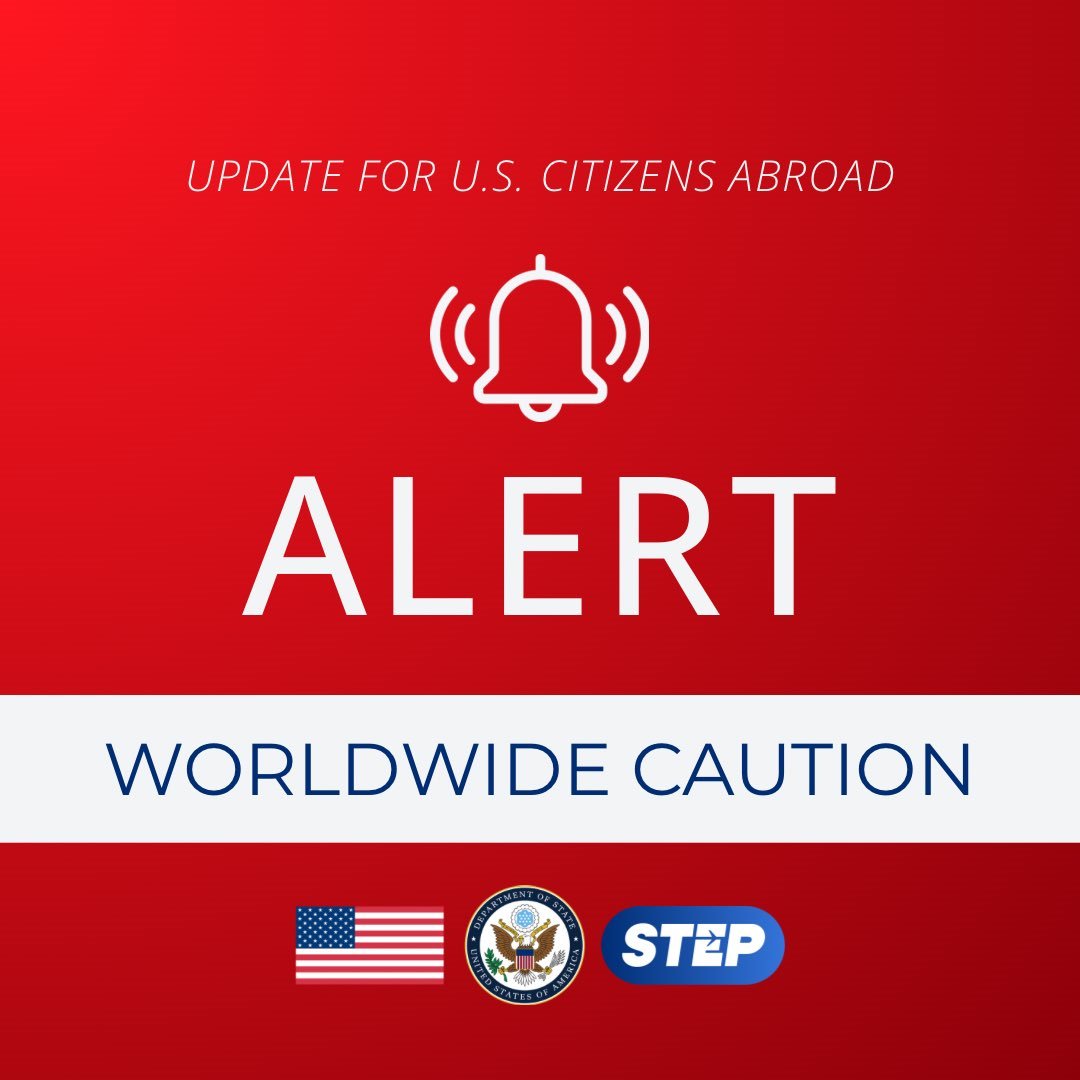
MIDDLE EAST — The U.S. Department of State issued a Worldwide Caution on July 18 advising Americans worldwide, and especially in the Middle East, to exercise increased caution due to heightened tensions.
The alert states that the security environment remains complex with potential for unforeseen escalation, that U.S. diplomatic facilities including those outside the Middle East have been targeted, and that groups supportive of Iran may target other U.S. interests overseas or locations associated with the United States and Americans throughout the world.
U.S. Central Command stated that U.S. forces began launching new airstrikes against Iran on July 18 at the direction of the Commander in Chief. The strikes aim to further degrade Iran’s ability to threaten commercial shipping in the Strait of Hormuz and respond to attacks by Islamic Revolutionary Guard Corps forces against American service members in Jordan. CENTCOM also stated the seventh consecutive night of strikes on July 17 and continued enforcement of a naval blockade, with multiple commercial vessels redirected or disabled.
Iran remains under a Level 4: Do Not Travel advisory. Multiple Gulf countries including Bahrain, Kuwait, Oman, Qatar, Saudi Arabia, and the United Arab Emirates remain under Level 3: Reconsider Travel advisories.
U.S. embassies in the region, including the Virtual Embassy Iran and Embassy Kuwait, issued parallel security alerts on July 17 that repeated the caution text and advised Americans to leave Iran, know the location of the nearest shelter, monitor news, and follow local guidance.
Allied governments including the United Kingdom, Australia, and Canada maintain parallel highest-level advisories against travel to Iran, citing the volatile security situation, risk of further military exchanges, and limited consular support.
Worldwide Caution and Specific Threat Guidance
The July 18 alert release by the U.S. Department of State Travel states that flight cancellations and periodic airspace closures may cause travel disruptions.
It directs Americans abroad to follow guidance in security alerts from the nearest U.S. embassy or consulate and to review Travel Advisories and country information on the State Department travel advisory site.
Parallel embassy alerts from July 17 emphasize that Americans should not travel to Iran, should leave if present, and should exercise caution at locations publicly associated with the United States.
A separate Middle East security update on July 18 stated the complex security environment and advised Americans traveling in or through the region to check flight schedules with carriers and reconsider travel to or through the Middle East.
The alert also directs enrollment in the Smart Traveler Enrollment Program to receive the latest security alerts.
Assessment:The repeated reference across State Department channels to targeting of diplomatic facilities outside the Middle East and to groups supportive of Iran expands the geographic scope of the stated risk beyond the active combat theater.
The guidance prioritizes monitoring of breaking developments and enrollment in the Smart Traveler Enrollment Program for direct updates from embassies. No independent confirmation of specific planned attacks outside the region appears in current official releases.
Military Operations and Strait of Hormuz
CENTCOM stated on July 18 that U.S. forces began launching new airstrikes against Iran. The statement said the strikes are designed to further degrade Iran’s ability to threaten commercial shipping in the Strait of Hormuz and to punish IRGC forces for attacks on American service members in Jordan the previous night.
On July 17 a round of strikes occurred for the seventh consecutive night. Earlier in the month strikes hit coastal defense systems, missile and drone sites, air defense systems, and small boats following Iranian attacks on commercial vessels in the Strait of Hormuz.
Ongoing naval blockade enforcement continued, with vessels redirected, disabled, or boarded.
On July 16 U.S. forces destroyed the Chah Bahar Shahid Kalantari Port surveillance tower, part of a maritime surveillance network along Iran’s Gulf of Oman coastline used by the IRGC to track and target commercial vessels.
The statement said the destruction directly degrades the IRGC’s ability to coordinate attacks on civilian crew members and protects freedom of navigation except for vessels attempting to violate the naval blockade.
As of July 18 five commercial vessels had been redirected and one disabled under the naval blockade.
During the first three days of renewed implementation four commercial vessels were redirected, one was disabled, and one was boarded.
On July 16 U.S. Marines from the 11th Marine Expeditionary Unit conducted a verification boarding aboard M/T Wen Yao in the Gulf of Oman, according to CENTCOM.
Iranian statements, including from the IRGC and Iranian officials, have described U.S. actions as aggression and stated responses against U.S. bases and regional energy infrastructure.
Iranian state media claims of tanker explosions in the Strait of Hormuz were denied by CENTCOM as false.
Travel Advisories and Regional Posture
Iran’s Level 4: Do Not Travel advisory cites risks of terrorism, civil unrest, kidnapping, arbitrary arrest of U.S. citizens, and wrongful detention.
The advisory notes there is no U.S. Embassy in Iran and that the Swiss Foreign Interests Section provides limited emergency services. Level 3 advisories for several Gulf states state serious risks to safety and security linked to the regional conflict.
Embassy alerts urge Americans in the region to maintain low profiles, avoid demonstrations, monitor local media, and confirm flight status directly with carriers.
The United Kingdom Foreign, Commonwealth and Development Office advises against all travel to Iran. British and British-Iranian dual nationals face a significant risk of arrest, questioning, or detention, with a British passport or perceived connections to the UK cited as potential grounds for detention by Iranian authorities.
The Foreign, Commonwealth and Development Office states the situation remains unpredictable and attacks could resume at short notice, with limited UK government support available in Iran.
Australia’s Smartraveller service maintains a “Do not travel” advisory for Iran, last updated July 14 and still current as of July 19. It cites an extremely volatile security situation due to military strikes and reprisal attacks, armed conflict, civil unrest, terrorism, and high risk of arbitrary detention.
Australia continues to advise do not travel to Iran, Iraq, Lebanon, Palestine, Syria, and Yemen, and reconsider the need to travel to Bahrain, Israel, Kuwait, Qatar, and the United Arab Emirates.
The advice notes that conflict may cause flight disruptions and airspace closures, and that the “reconsider” level also applies to transit.
Canada’s travel advice for Iran is “Avoid all travel.” Canadians in Iran are advised to leave now if they can do so safely.
The advisory cites the volatile security situation in the region, notes that military activity could resume on short notice and cause travel disruptions including flight cancellations, and states that Canada’s ability to provide consular services is extremely limited.
Official Statements
-
U.S. Department of State Worldwide Caution, July 18: “The Department of State advises Americans worldwide to exercise increased caution. Location: Worldwide. Event: Due to heightened tensions in the Middle East, the security environment remains complex with the potential for unforeseen escalation. We remind Americans in the region of the continued need for caution and encourage them to monitor the news for breaking developments. The Department of State advises Americans worldwide, and especially in the Middle East, to exercise increased caution. Americans abroad should follow the guidance in security alerts issued by the nearest U.S. embassy or consulate. Flight cancellations and periodic airspace closures may cause travel disruptions. U.S. diplomatic facilities, including outside the Middle East, have been targeted. Groups supportive of Iran may target other U.S. interests overseas or locations associated with the United States and/or Americans throughout the world. Enroll at step.state.gov to receive the latest security alerts. When planning travel, carefully read the Travel Advisory and detailed information for your destination, and any recent alerts at travel.state.gov/destination.”
-
U.S. Central Command, July 18: “Today at 6 p.m. ET, U.S. forces began launching new airstrikes against Iran at the Commander in Chief’s direction. The strikes are designed to further degrade Iran’s ability to threaten commercial shipping in the Strait of Hormuz and swiftly punish Islamic Revolutionary Guard Corps forces who launched attacks against American service members in Jordan last night.”
-
U.S. Central Command, July 18: “American forces continue to strictly enforce the ongoing naval blockade against Iran. As of July 18, CENTCOM has redirected 5 commercial vessels and disabled 1.”
-
U.S. Central Command, July 16: “On July 16, U.S. forces successfully destroyed the Chah Bahar Shahid Kalantari Port surveillance tower, part of a maritime surveillance network along Iran’s Gulf of Oman coastline used for decades by the Islamic Revolutionary Guard Corps (IRGC) to track and target commercial vessels transiting the Strait of Hormuz. The destruction of the tower directly degrades IRGC’s ability to coordinate attacks on innocent civilian crew members. Furthermore, the strike protects freedom of navigation in regional waters for all vessels, except for ships attempting to violate the ongoing U.S. naval blockade against Iran.”
-
U.S. Virtual Embassy Iran Security Alert, July 17: “Due to high tensions in the Middle East, the security environment remains complex with the potential for unforeseen escalation. We remind Americans in the region of the continued need for caution and encourage them to monitor the news for breaking developments. Americans traveling in or through the region should also check with their air carriers to make sure their flights are still scheduled. Americans should not travel to Iran and reconsider travel to/through the Middle East. U.S. citizens should leave Iran now and should know the location of the nearest shelter in the event of hostilities.”
-
United Kingdom Foreign, Commonwealth and Development Office: “FCDO advises against all travel to Iran. British and British-Iranian dual nationals are at significant risk of arrest, questioning or detention. Having a British passport or connections to the UK can be reason enough for the Iranian authorities to detain you. The situation remains unpredictable and attacks could resume at short notice.”
-
Australian Department of Foreign Affairs and Trade via Smartraveller, updated July 14: “Do not travel to Iran. The security situation in Iran is extremely volatile. The situation in the Middle East region remains unpredictable. The risk of attacks and escalation continues. We continue to advise you do not travel to Iran, Iraq, Lebanon, Palestine, Syria and Yemen. We continue to advise reconsider your need to travel to Bahrain, Israel, Kuwait, Qatar and the UAE.”
-
Government of Canada travel advice: “Avoid all travel to Iran due to the volatile security situation in the region. If you’re in Iran, you should leave now if you can do so safely. The security situation remains volatile following recent military activities in the region. Military activity in the region could resume on short notice and cause travel disruptions including flight cancellations. Our ability to provide consular services is extremely limited.”
-
Iranian Foreign Ministry, July 13: “The Ministry of Foreign Affairs of the Islamic Republic of Iran strongly condemns the United States acts of aggression against the Islamic Republic of Iran over the past 24 hours. These brutal attacks constitute not only a flagrant violation of the fundamental principles of the United Nations Charter, particularly Article 2(4), but also a serious threat to international peace and security, rendering futile all efforts made over the past several months to reduce tensions and restore stability in the West Asia region.” (translated from Persian)
Full Report & Analysis
The full report includes expert analysis and risk assessment.
Full Report & Analysis →