Hormuz Traffic Collapses More Than 95 Percent as Trump Extends Energy Strike Deadline; Strikes Hit Power Plants Across Iran
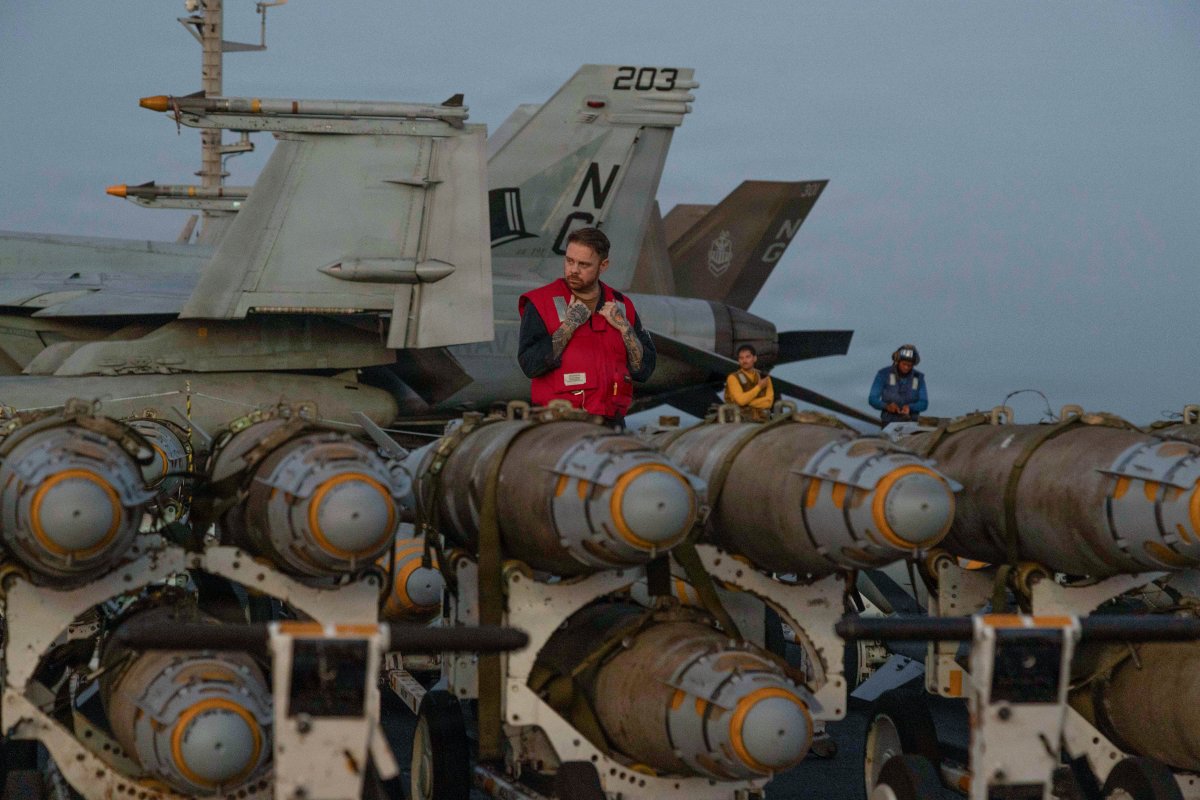
Ordnance handlers stage munitions on USS Abraham Lincoln during Operation Epic Fury, Feb. 27, 2026 Credit: U.S. Navy
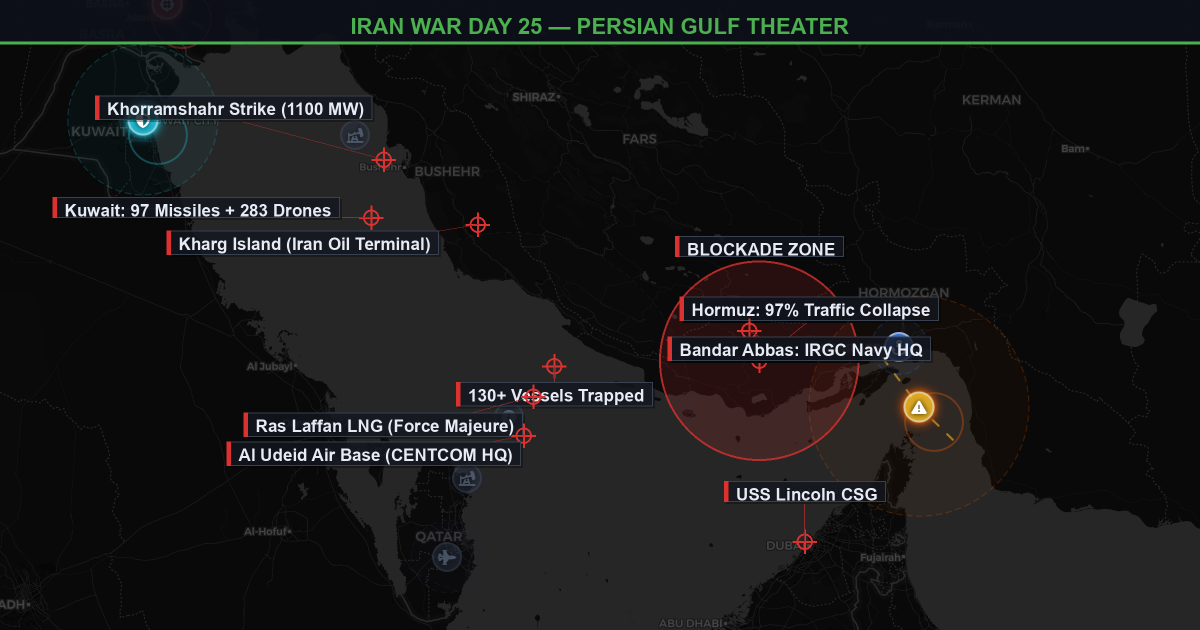
MIDDLE EAST — Iran’s selective enforcement blockade of the Strait of Hormuz has reduced transit traffic by more than 95 percent, trapping more than 130 container ships inside the Persian Gulf and stranding approximately 40,000 sailors, according to vessel tracking data compiled by maritime intelligence firms.
The International Energy Agency (IEA) assessed the disruption as the largest supply disruption in the history of the global oil market, with Persian Gulf production flows collapsing from roughly 20 million barrels per day to a fraction of prewar volume.
Operational Situation Map
President Trump extended his 48-hour deadline to strike Iranian power plants by five days on March 23, stating that the United States and Iran had engaged in “productive” conversations covering 15 points of agreement.
Iranian officials denied any negotiations had taken place, with IRGC (Islamic Revolutionary Guard Corps) and parliamentary leaders calling the claims “fake news” and characterizing them as fabrications.
A senior Iranian official separately acknowledged indirect message exchanges through intermediaries, with Pakistan emerging as a potential go-between for in-person talks.
On March 24, U.S. and Israeli forces struck the Isfahan and Khorramshahr power plants in Iran, with combined generation capacity exceeding 3,600 megawatts. Iranian forces responded with at least eight separate missile launches at Israel, striking four sites including central Tel Aviv and injuring at least six people.
Gulf states continued absorbing Iranian strikes, with Kuwait having intercepted 97 ballistic missiles and 283 drones since operations began on February 28.
Assessment: The five-day extension of the energy strike deadline creates a defined window closing approximately March 28. Whether the extension reflects genuine diplomatic progress through intermediaries or a pause for force repositioning remains unverified by any named official on either side.
The more than 95 percent reduction in Hormuz traffic, which the IEA characterized as the largest supply disruption in the history of the global oil market, indicates that economic pressure on energy-importing nations will intensify regardless of the military trajectory. Japan imports 90 percent of its crude from the Middle East; South Korea sources 70 percent from the region.
Hormuz Blockade: Selective Enforcement, Not Total Closure
Iran’s IRGC-controlled corridor through Iranian territorial waters operates as a selective enforcement mechanism rather than a total closure.
Ships from China, India, and Turkey have been allowed passage, along with agricultural products bound for Iran and Iranian energy exports. Vessels flagged to belligerent nations, including the United States, United Kingdom, Israel, and coalition partners, are blocked.
Despite the selective approach, the operational impact has been severe. Vessel tracking data shows 62 ships waiting outside the strait for safe passage confirmation, with 22 crude, LPG (liquefied petroleum gas), and LNG (liquefied natural gas) tankers anchored in the strait itself.
The Center for Strategic and International Studies (CSIS) noted that even Chinese-flagged vessels are experiencing difficulties, with 55 Chinese ships trapped inside the Gulf despite China’s nominally friendly status with Tehran.
Brent crude surpassed $100 per barrel on March 8, peaked near $120 per barrel, and remains above $100. Asian LNG spot prices doubled to $25.40 per million British thermal units as of March 4. QatarEnergy declared force majeure at the Ras Laffan LNG plant, the world’s largest LNG facility.
Assessment: Japan imports 90 percent of its crude oil from Middle Eastern producers, with the majority transiting Hormuz. South Korea sources 70 percent of its crude from the region, with 95 percent of that volume passing through the strait.
The selective enforcement model gives Iran leverage over energy-dependent Asian economies while maintaining commercial relationships with China and India, though CSIS reporting on trapped Chinese vessels suggests the selectivity is not functioning as cleanly as Tehran intends.
Full Report & Analysis
The full report includes expert analysis and risk assessment.
Full Report & Analysis →