Trump Issues 48-Hour Power Plant Ultimatum; Iran Strikes Near Dimona After Second Natanz Attack

Satellite imagery of Iran's Natanz nuclear facility, one of the country's primary uranium enrichment sites, located approximately 220 kilometers southeast of Tehran. Credit: NASA LANCE FIRMS
MIDDLE EAST — President Donald Trump threatened on March 22 to “hit and obliterate” Iran’s power plants, starting with the largest, if the Strait of Hormuz is not fully reopened within 48 hours. Iran’s military responded that the strait would be “completely closed” if the United States carries out the threat, setting up a direct collision over the waterway through which approximately 20% of global oil transits.
The ultimatum followed two days of nuclear-adjacent escalation on both sides. On March 21, U.S.-Israeli forces struck Iran’s Natanz uranium enrichment facility for the second time since Operation Epic Fury began.
Hours later, Iran fired two intermediate-range ballistic missiles at the joint U.S.-UK base at Diego Garcia, 4,000 kilometers away, demonstrating intercontinental reach for the first time.
Iran then launched retaliatory missile salvos at the Israeli cities of Dimona and Arad, wounding more than 180 people near Israel’s primary nuclear research center.
The IAEA confirmed no increase in off-site radiation at Natanz but warned of “limited changes in radiation levels within the facility’s boundaries.”
Director General Rafael Mariano Grossi reiterated that the presence of over 400 kilograms of uranium enriched to 60% at affected Iranian facilities makes a radiological release “credible, not theoretical” with each successive strike.
More than 1,330 people have been killed in Iran since the war began, including at least 200 children, according to the United Nations.
Assessment: Three converging escalation tracks define the current phase. First, tit-for-tat targeting near nuclear facilities on both sides: Natanz struck by the U.S.-Israel coalition, Dimona struck by Iran. Neither side has hit an active reactor, but the proximity signals willingness to escalate toward radiological consequences.
Second, Trump’s 48-hour power plant ultimatum creates a hard deadline on a conflict that had been grinding without clear endpoints. Iran’s counter-threat to seal Hormuz entirely raises the stakes for global energy markets.
Third, Iran’s 4,000-kilometer Diego Garcia missile attempt demonstrated reach that puts Western European capitals within theoretical range, altering NATO member state calculations about the conflict’s containment.
Watch: Trump’s 48-hour deadline expiration (approximately March 24). Iranian Hormuz closure actions. IAEA inspector access to Natanz underground halls.
Trump Ultimatum and Hormuz Standoff
President Trump posted on Truth Social at approximately 23:44 GMT on March 22 that “if Iran doesn’t FULLY OPEN, WITHOUT THREAT, the Strait of Hormuz, within 48 HOURS from this exact point in time, the United States of America will hit and obliterate their various POWER PLANTS, STARTING WITH THE BIGGEST ONE FIRST!” The ultimatum creates a hard deadline of approximately March 24.
Iran’s military declared it is prepared to close the Strait of Hormuz indefinitely if the United States carries out the threat. Iran also warned it would target U.S. infrastructure and energy and desalination facilities across the Gulf states in retaliation.
The strait has already seen severely reduced transit volumes since the conflict began, with Iranian naval attacks and mine-laying disrupting commercial shipping.
Assessment: The power plant ultimatum represents a qualitative escalation beyond military infrastructure. Iran’s civilian electrical grid supports hospitals, water treatment, and food supply chains for a population of approximately 93 million. Destroying it would accelerate a humanitarian crisis the UN has already flagged.
Iran’s counter-threat to seal Hormuz entirely would remove approximately 20 million barrels per day of crude oil and petroleum products from global oil markets, triggering immediate price shocks and potential fuel rationing in Asia-dependent import economies.
Dimona and Arad: Iran Retaliates Near Israel’s Nuclear Center
The Islamic Revolutionary Guard Corps (IRGC) launched missile salvos at the southern Israeli cities of Dimona, Arad, Eilat, Beersheba, and Kiryat Gat on March 21, framing the attacks as a response to the Natanz strike.
At least 180 people were wounded across the targeted cities: 116 in Arad (7 serious) and 64 in Dimona. Israeli Prime Minister Benjamin Netanyahu condemned the strikes.
Dimona is the site of Israel’s Shimon Peres Negev Nuclear Research Center, which houses the country’s unacknowledged nuclear weapons program.
While no damage to the nuclear facility has been confirmed, the deliberate targeting of cities surrounding it mirrors the tit-for-tat nuclear-adjacent escalation pattern: the U.S.-Israeli coalition struck Iran’s Natanz enrichment complex, and Iran struck near Israel’s equivalent.
Assessment: Iran’s targeting of the Dimona area appears calibrated to signal capability without crossing the threshold of directly striking a nuclear facility.
The IRGC framed the strikes as targeting “military installations and security centers,” but the geographic concentration around Israel’s nuclear complex is not coincidental. This creates a dangerous symmetry: both sides have now demonstrated willingness to operate in proximity to the other’s most sensitive nuclear infrastructure.
Natanz Facility and Nuclear Implications
Natanz, located approximately 220 kilometers southeast of Tehran, is one of Iran’s most important uranium enrichment installations. The Shahid Ahmadi Roshan facility houses both above-ground infrastructure and underground enrichment halls where centrifuges process uranium hexafluoride gas.
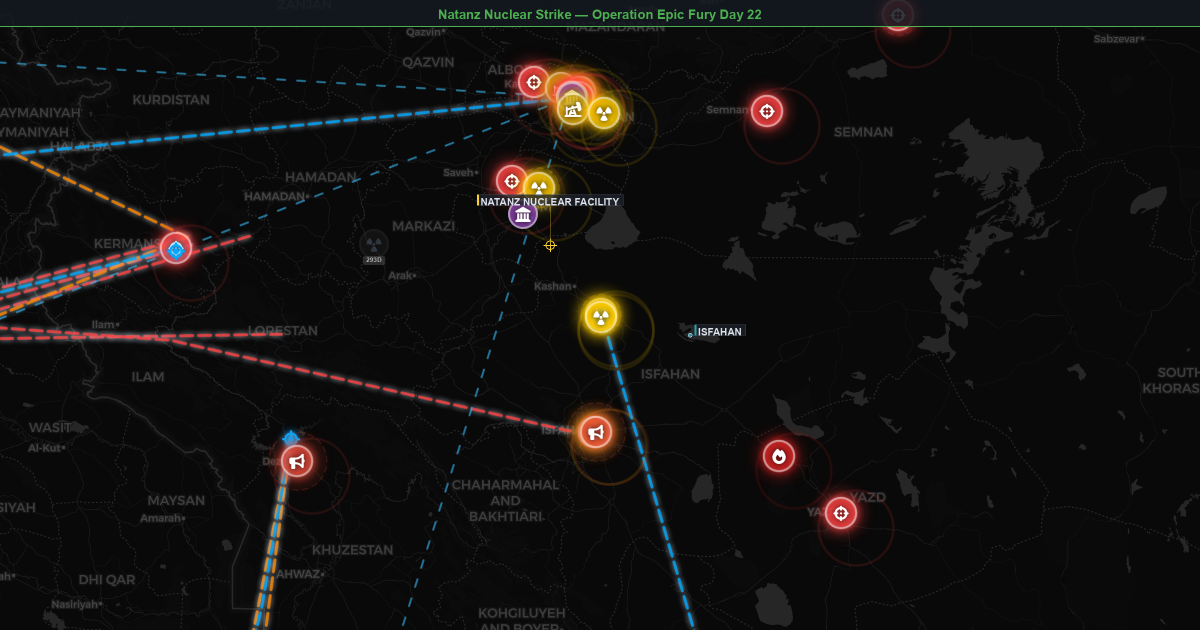
The facility was previously struck during the opening week of Operation Epic Fury, with IAEA satellite imagery confirming on March 3 that entrance buildings sustained visible damage, though the underground fuel enrichment plant itself showed no additional impact at that time.
Iran’s Atomic Energy Organization stated that “according to the results of the technical assessment, there was no leakage of radioactive materials, and there is no danger to the residents of the surrounding areas.”
The organization called the attack a violation of international law and the Treaty on the Non-Proliferation of Nuclear Weapons (NPT). Russia condemned the strike as “a blatant violation of international law.”
Assessment: The second strike on Natanz within three weeks signals that eliminating Iran’s enrichment capability remains a primary U.S.-Israeli objective, consistent with stated war aims. However, IAEA Director General Grossi has cautioned that military action cannot eliminate Iran’s nuclear knowledge or fully destroy its enrichment capacity.
In a March 22 television interview, Grossi said that even after the conflict ends, Iran will retain “the inventory of enriched uranium at 60%, which is very close to the degree you need to make a bomb,” and that the centrifuge expertise “cannot unlearn what you’ve learned.” The IAEA has reported that over 400 kilograms of uranium enriched to 60% requires verification at affected facilities.
IAEA Response and Radiation Status
The IAEA stated it is “closely assessing the situation” following Iran’s notification. In his March 2 statement to a special session of the Board of Governors, Grossi reported that as of that date, “we have no indication that any of the nuclear installations, including the Bushehr Nuclear Power Plant, the Tehran Research Reactor or other nuclear fuel cycle facilities have been damaged or hit.”
That assessment changed after satellite imagery revealed structural damage at Natanz entrance buildings by March 3.
Grossi has consistently warned of the risk of a radiological incident, stating that “we cannot rule out a possible radiological release with serious consequences, including the necessity to evacuate areas as large or larger than major cities.”
The IAEA has also faced communication difficulties, noting that “efforts to contact the Iranian nuclear regulatory authorities through the IEC continue, with no response so far” during the early days of the conflict. IAEA inspectors remained in Iran throughout the hostilities but have been unable to access damaged facilities while active strikes continue.
Regarding the handling of enriched material at Natanz, Grossi emphasized in his March 22 interview the “extreme difficulty of safely handling uranium enriched to this level without causing a major nuclear accident.” The facility contains cylinders of uranium hexafluoride gas enriched to 60%, and any removal or relocation operation would be, in Grossi’s words, “very challenging.”
Assessment: The absence of off-site radiation following two strikes on Natanz suggests the underground enrichment halls have not been fully breached, or that the damage has been limited to surface infrastructure.
However, the presence of 60%-enriched uranium hexafluoride at the site means each successive strike increases the probability of an uncontrolled radiological release. Grossi’s public warnings indicate the IAEA considers this a credible, not hypothetical, risk.
Full Report & Analysis
The full report includes expert analysis and risk assessment.
Full Report & Analysis →