Projectile Destroys Structure 350 Meters from Iran's Bushehr Nuclear Reactor; Russia Begins Third Staff Evacuation
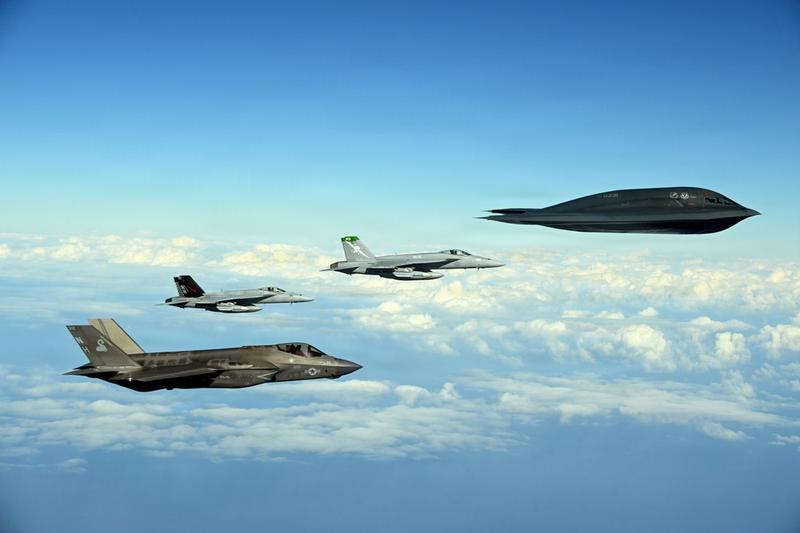
A B-2 Spirit stealth bomber flies in formation with an F-35C Lightning II and an F/A-18F Super Hornet. B-2 bombers delivered GBU-57 Massive Ordnance Penetrators against Iranian nuclear facilities during both the June 2025 strikes and Operation Epic Fury. Credit: U.S. Air Force / Katie Archibald
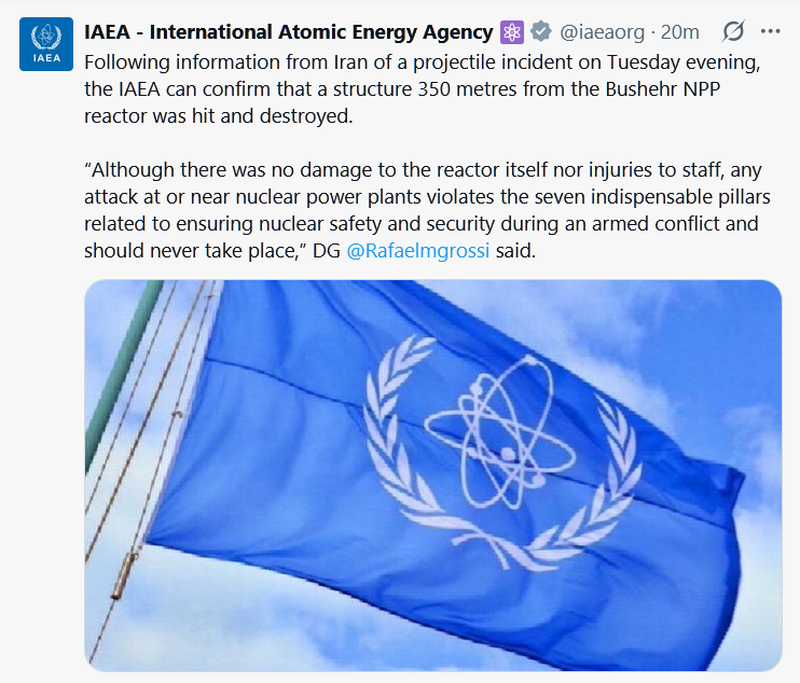
MIDDLE EAST — The International Atomic Energy Agency confirmed on March 18 that a projectile struck and destroyed a structure 350 meters from the reactor at Iran's Bushehr Nuclear Power Plant on Tuesday evening.
IAEA Director General Rafael Grossi reported no damage to the reactor itself, no injuries to staff, and no elevation of radiation levels, but warned that “any attack at or near nuclear power plants violates the seven indispensable pillars related to ensuring nuclear safety and security during an armed conflict.”
Russia's state nuclear corporation Rosatom identified the target area as near the facility's metrological service building and confirmed that 480 Russian employees remain at the plant. Rosatom CEO Alexei Likhachev announced preparations for a third evacuation phase, condemning the strike as “a flagrant disregard for the key rules and principles of international security.”
The strike marks the first direct hit on Iran's only operating nuclear power plant since Operation Epic Fury began on February 28. All five of Iran's declared nuclear facilities have now sustained damage or been rendered inaccessible during the broader U.S.-Israeli military campaign.
Situation at a Glance
- What: Projectile destroyed a structure 350 meters from the Bushehr nuclear reactor on March 17 at approximately 19:00 Iran Standard Time
- Reactor status: No damage to the VVER-1000 reactor (915 MWe, operational since 2011); no radiation release; plant continues operating
- Attribution: Unattributed; Grossi indicated damage appeared consistent with a drone; neither the United States nor Israel has claimed responsibility
- Russian presence: 480 Rosatom employees on-site; third evacuation phase now in preparation (down from approximately 730 before the conflict)
- IAEA response: Grossi invoked the “seven indispensable pillars” of nuclear safety; called for “maximum restraint during the conflict to prevent risk of a nuclear accident”
- Nuclear monitoring: IAEA has had zero access to any of Iran's four enrichment facilities since June 2025; agency cannot account for Iran's highly enriched uranium stockpile
- Regional risk: Persian Gulf neighbors, including the UAE (four Barakah reactors), within potential radiological consequence zone
Nuclear Safety Threshold Crossed in Active Conflict Zone
HIGH (Unchanged). The Bushehr strike represents a qualitative escalation within Operation Epic Fury. Previous strikes targeted enrichment and research facilities that were either non-operational or contained no nuclear material at the time of impact.
Bushehr is an operating reactor with active fuel assemblies, Russian technical staff, and a direct connection to Iran's civilian electrical grid. A radiological incident would affect not only Iran but multiple Persian Gulf states downwind.
First Strike on an Operating Nuclear Power Plant
Iran's Atomic Energy Organization confirmed the strike and warned it was “contrary to all international regulations regarding the immunity of nuclear facilities from military attack,” adding that it “could have irreparable consequences for the entire region, including the countries bordering the Persian Gulf.” The AEOI reported no financial, technical, or human casualties.
Grossi told journalists the damage appeared to have been caused by a drone and “doesn't seem to be very significant.”
He noted that there was no indication of elevated radiation levels at the site or in bordering countries. However, his formal statement carried a sharper tone, invoking the IAEA's nuclear safety framework by name and emphasizing that attacks near nuclear power plants “should never take place.”
The gap between the physical damage assessment and the institutional response is itself significant. Grossi's invocation of the seven pillars, originally developed for the Zaporizhzhia crisis in Ukraine, signals the IAEA now views the Iran conflict through the same nuclear safety lens. Bushehr and Zaporizhzhia are both Russian-built VVER reactors in active conflict zones, both with IAEA monitoring concerns, and both now subject to the same safety framework.
Russia's Deepening Nuclear Exposure
Rosatom's response was immediate and direct. CEO Likhachev condemned the strike and called on “all sides in the conflict to use every effort to de-escalate the situation around the Bushehr nuclear power plant.” Rosatom confirmed radiation levels at the site are normal and that no Russian personnel were harmed.
The third evacuation phase marks a continued drawdown from the approximately 730 Russian nationals stationed at Bushehr before the conflict. The remaining 480 staff include reactor operators and technical specialists whose departure would raise questions about continued safe operation of the plant.
Russia is now managing nuclear safety crises at two power plants simultaneously. At Zaporizhzhia in Ukraine, IAEA inspectors have maintained a continuous presence since September 2022. At Bushehr, Rosatom staff have replaced that role by default, as IAEA access to Iranian facilities has collapsed.
If Russia completes its evacuation, Bushehr's operational safety oversight falls to Iranian regulators alone. Those regulators have not responded to IAEA communications since the conflict began.
Iran's Nuclear Facilities: Cumulative Damage Assessment
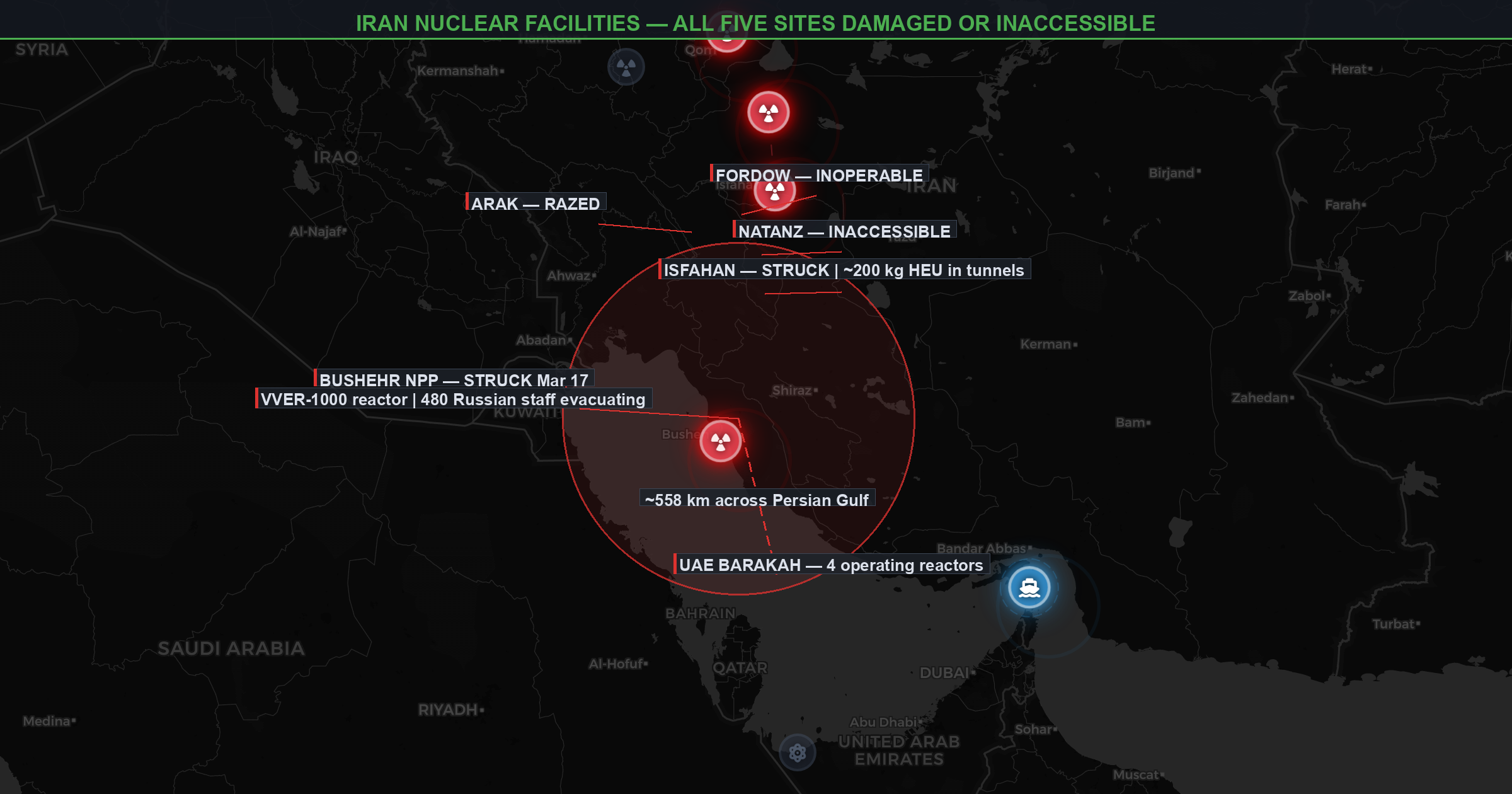
The Bushehr strike completes a pattern that now spans all five of Iran's declared nuclear sites. Natanz, the primary enrichment facility, had its underground plant targeted by GBU-57 Massive Ordnance Penetrators in June 2025. During Operation Epic Fury, entrance buildings sustained further damage on March 3, rendering the facility inaccessible.
Fordow, buried inside a mountain, was assessed as inoperable after 12 GBU-57 strikes targeted its ventilation shafts in June 2025. The Arak heavy water reactor was razed during the earlier campaign; it was not operational and contained no nuclear material.
Isfahan's Nuclear Technology Center was struck during both the June 2025 and February 2026 campaigns. The IAEA has separately revealed that Iran constructed a new underground facility at Isfahan that inspectors have never visited and cannot confirm is operational. Grossi assessed that approximately 200 kilograms of 60 percent enriched uranium remains stored in an underground tunnel complex at the site.
The cumulative effect is a monitoring collapse without precedent in the IAEA's history. The agency cannot verify Iran's enrichment status, cannot access struck facilities, and cannot confirm whether covert enrichment is occurring at Isfahan's new underground site.
The last verified Iranian stockpile of 440.9 kilograms of 60 percent enriched uranium, enough fissile material for an estimated five to ten nuclear weapons if further enriched, was measured in June 2025. Nine months later, that figure is unverifiable.
Nuclear Threat Note
Article 56 of Additional Protocol I to the Geneva Conventions specifically prohibits attacks on nuclear electrical generating stations when the attack “may cause the release of dangerous forces and consequent severe losses among the civilian population.”
This protection applies to operating power plants but does not extend to enrichment facilities, reprocessing plants, or research reactors. Bushehr, as Iran's only operating nuclear power plant, falls directly under this protection.
The IAEA's seven indispensable pillars for nuclear safety during armed conflict require that physical integrity of nuclear facilities be maintained, all safety systems remain functional, operating staff work free of undue pressure, off-site power supply remain secure, logistical supply chains continue uninterrupted, radiation monitoring systems function effectively, and reliable communications with regulators be maintained.
The Bushehr strike, combined with the broader conflict's disruption of Iranian infrastructure, has placed multiple pillars under strain simultaneously.
Official Statements
- IAEA Director General Rafael Grossi, March 18: “Although there was no damage to the reactor itself nor injuries to staff, any attack at or near nuclear power plants violates the seven indispensable pillars related to ensuring nuclear safety and security during an armed conflict and should never take place.”
- Rosatom CEO Alexei Likhachev, March 18: “We categorically condemn what has occurred and call on all sides in the conflict to use every effort to de-escalate the situation around the Bushehr nuclear power plant.”
- Atomic Energy Organization of Iran, March 18: The AEOI stated the strike was “contrary to all international regulations regarding the immunity of nuclear facilities from military attack” and warned it “could have irreparable consequences for the entire region, including the countries bordering the Persian Gulf.”
Analysis: The absence of any claim of responsibility for the Bushehr strike, combined with the IAEA's characterization of the projectile as likely a drone, leaves open whether this was a deliberate targeting decision or an errant munition in a conflict zone. Regardless of intent, the strike has crossed a threshold that both international humanitarian law and the IAEA's safety framework were designed to prevent. With 480 Russian nuclear workers preparing to evacuate, the question of who maintains reactor safety at Iran's only operating nuclear plant is no longer theoretical.