Iran Mines Hormuz, Gulf Refineries Under Siege, Trump Warns of ‘Death, Fire, and Fury’
MIDDLE EAST / INDIAN OCEAN - Iran has begun laying mines in the Strait
of Hormuz, the world’s most critical oil transit choke-point carrying
approximately 20% of global crude supply, according to U.S. intelligence
reporting.
The U.S. military responded by destroying 16 Iranian mine-laying vessels near the strait on March 10, according to CENTCOM.
The mine-laying campaign comes as Iranian retaliatory strikes have forced the shutdown of major energy infrastructure across the Gulf: Bahrain’s Bapco Sitra refinery (405,000 barrels per day) declared force majeure on March 9 after a drone attack, the UAE’s Ruwais refinery (922,000 bpd) was shut on March 10 following a drone-caused fire, and Saudi Arabia’s Ras Tanura refinery (550,000 bpd) and Qatar’s LNG production facilities were halted earlier in the conflict.
President Trump responded to the mine-laying reports with a warning that the U.S. would hit Iran “twenty times harder” and that “death, fire, and fury will reign upon them” if Iran blocked oil flow through the strait.
In the same period, Trump gave conflicting signals, telling reporters the war was “very complete, pretty much” and ending “very soon,” while separately telling House Republicans “we haven’t won enough.”
The IRGC rejected Trump’s timeline, with spokesperson Ali Mohammad Naini stating “it is we who will determine the end of the war.”
The Pentagon disclosed on March 10 that approximately 140 U.S. service members have been wounded since the start of Operation Epic Fury, with eight severely injured and 108 having returned to duty. This figure is significantly higher than the 18 previously reported.
Iran Lays Mines in Strait of Hormuz; CENTCOM Destroys 16 Minelayers
Iran has begun deploying naval mines in the Strait of Hormuz, according to two people familiar with U.S. intelligence reporting. The mining effort has not been extensive, with a few dozen mines laid in recent days.
Iran retains 80-90% of its small boats and mine-laying vessels, and its mine stockpile has been estimated at between 2,000 and 6,000 naval mines, largely of Iranian, Chinese, or Russian manufacture.
CENTCOM announced on March 10 that U.S. forces “eliminated multiple Iranian naval vessels, including 16 minelayers near the Strait of Hormuz.” A senior U.S. official described the strike on the vessels as a preemptive measure based on intelligence about Iran’s operational mine-laying plans.
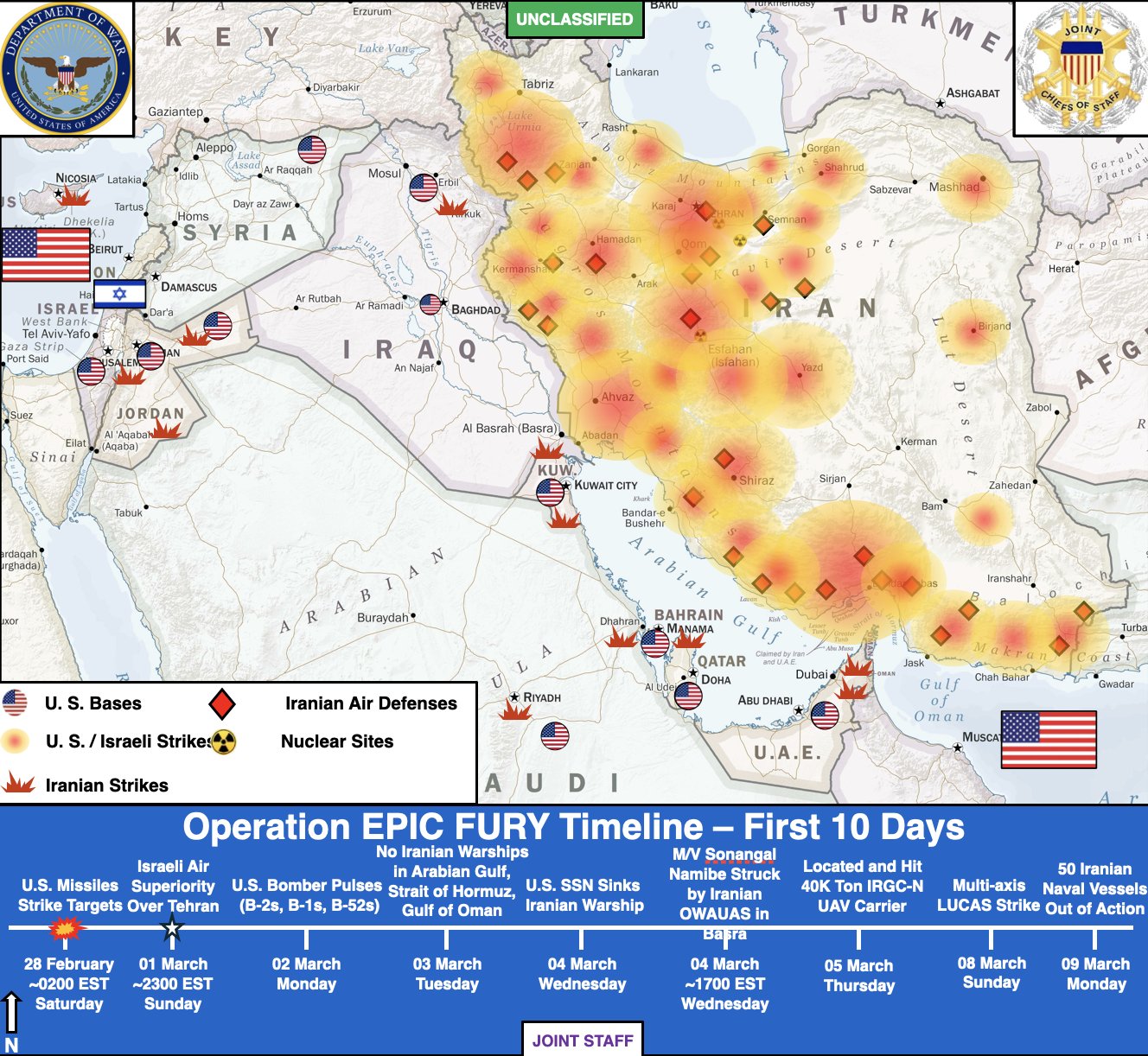
Since operations began on February 28, Iran has blockaded the strait for most commercial shipping and attacked at least 10 vessels attempting to transit the waterway. Shipping through the strait dropped 95% in the first week of March.
Assessment: Confidence: High on the mine-laying activity and CENTCOM response. Mine warfare in the Strait of Hormuz represents a significant escalation beyond missile and drone attacks. Even a limited mining campaign creates disproportionate disruption, as the threat of mines forces commercial vessels to avoid the waterway regardless of the actual number deployed. The destruction of 16 minelayers addresses the delivery capability but does not clear mines already laid.
Gulf Energy Infrastructure Under Siege
Iranian retaliatory strikes have systematically targeted energy infrastructure across the Gulf, forcing shutdowns at some of the region’s largest facilities.
Bahrain: Bahrain’s state-owned Bapco Energies declared force majeure on March 9 after an Iranian drone attack damaged its Sitra refinery, the kingdom’s only refinery with a capacity of 405,000 barrels per day. The Bahrain Ministry of Health confirmed 32 civilian injuries from the attack, including four in serious condition.
A separate Iranian drone attack damaged one of Bahrain’s desalination plants. The Ministry of Interior had previously activated air raid alerts and closed the Shaikh Khalifa bin Salman Bridge.
United Arab Emirates: Abu Dhabi National Oil Company (ADNOC) shut down its Ruwais refinery on March 10 after a drone strike caused a fire in the surrounding industrial zone. The refinery has a processing capacity of approximately 922,000 barrels per day, making it one of the world’s largest. No casualties were reported from the fire.
This adds to the broader UAE toll: 137 missiles and 209 drones across the country, with 4 killed and 112 injured as of March 8 according to the UAE Ministry of Defense.
Saudi Arabia: Saudi Aramco halted operations at its Ras Tanura refinery (550,000 bpd) on March 2 after intercepted drone debris caused a fire. Aramco stated the plant would remain shut for several weeks while exports are rerouted.
Separately, at least two people were killed and 12 injured when a projectile struck a residential area in Al-Kharj Governorate on March 8, near Prince Sultan Air Base. The victims were identified as Bangladeshi nationals by the Bangladesh Ministry of Foreign Affairs.
Qatar: QatarEnergy ceased production of liquefied natural gas and associated products at its Ras Laffan and Mesaieed facilities after Iranian strikes on the industrial cities. Benchmark Dutch and British wholesale gas prices surged approximately 50%, and Asian LNG prices jumped nearly 39%.
Assessment: Confidence: High. The cumulative shutdown of approximately 1.9 million barrels per day of refining capacity across Bahrain, the UAE, and Saudi Arabia, combined with the halt of the world’s largest LNG production operation in Qatar, represents the most significant disruption to Gulf energy production since the 1990-91 Gulf War. Iran’s strategy of targeting energy infrastructure has transformed the conflict from a military engagement into a global economic crisis.
IRGC: ‘Iran Will Determine When War Ends’
The IRGC rejected Trump’s characterization of the war’s timeline on March 10. Spokesperson Ali Mohammad Naini stated: “It is we who will determine the end of the war.” He added that “the equations and future status of the region are now in the hands of our armed forces.”
The IRGC also warned that continued U.S. and Israeli attacks could prompt Tehran to halt oil exports from the entire region.
Iran’s Foreign Minister Abbas Araghchi separately rejected ceasefire calls in a March 8 televised interview, stating: “They have to explain why they started this aggression before we even consider a ceasefire. This is not our war. This is imposed on us.”
Araghchi cited the attack during active negotiations as a reason to reject further talks: “We negotiated twice last year and this year, and then in the middle of negotiations, the US attacked Iran.”
Assessment: Confidence: High. Iran’s public posture remains defiant across both military and diplomatic channels. The IRGC’s threat to halt regional oil exports, combined with the mine-laying campaign, signals a willingness to escalate the economic dimension of the conflict even as military capacity degrades. Araghchi’s statements reveal deep institutional distrust of U.S. negotiating intentions following the February 28 strikes during active diplomatic contacts.
CENTCOM Operational Summary: First 10 Days
CENTCOM released a comprehensive summary of the first 10 days of Operation Epic Fury (February 28 through March 9). The campaign has struck more than 5,000 targets across Iran using over 30 platform types, according to official CENTCOM releases and the Hegseth-Caine press briefing on March 10.
Target categories included command and control centers, IRGC headquarters buildings, IRGC intelligence sites, integrated air defense systems (IADS), ballistic missile sites, naval vessels and submarines, anti-ship missile positions, military communications infrastructure, and ballistic missile and drone manufacturing facilities.
Specific strike locations include military airfields near Shiraz, ballistic missile facilities near Mashhad, anti-ship missile batteries near Bushehr, and the naval base at Jask.
Air platforms employed include B-1B Lancer, B-2 Spirit, and B-52H Stratofortress bombers; F-15, F-16, F/A-18, F-22, and F-35 fighters; A-10 attack aircraft; EA-18G Growler electronic warfare aircraft; and MQ-9 Reaper, LUCAS, and U-2 Dragon Lady reconnaissance platforms.
Naval assets include nuclear-powered aircraft carriers, guided-missile destroyers, and submarines. Ground-based fires include M142 High Mobility Artillery Rocket Systems (HIMARS).
CENTCOM Commander Admiral Brad Cooper stated the combined force has achieved air dominance over Iran and destroyed 90% of Iran’s missile capability. More than 30 Iranian ships have been confirmed destroyed, with the total damaged or sunk exceeding 50.
Assessment: Confidence: Moderate. CENTCOM’s figures represent the coalition’s own accounting and have not been independently verified at this scale. However, the breadth of platforms employed and the sustained tempo are consistent with the claimed target count.
The 90% missile capability destruction claim is contradicted by Iran’s continued launches, though the 90% reduction in missile attacks reported by Hegseth on March 10 suggests significant degradation.
Trump Responds to New Supreme Leader and Nuclear Claims
President Trump stated he is “not happy” with Iran’s selection of Mojtaba Khamenei as supreme leader, adding “I don’t believe he can live in peace.” Trump framed the preemptive strike favorably, stating that “when we attacked them first, we knocked out 50% of their missiles.”
Trump referenced claims that U.S. envoys reported Iran possessing enriched uranium sufficient for 11 nuclear weapons.
The International Atomic Energy Agency (IAEA) has confirmed that Iran’s enriched uranium stockpile is theoretically sufficient to produce at least 10 nuclear devices, though the IAEA has stated there is no evidence Iran is currently building a nuclear weapon.
A significant portion of Iran’s highly enriched uranium is stored in a tunnel complex in Isfahan, which has sustained less damage than the Natanz and Fordow facilities destroyed during the June 2025 strikes.
Assessment: Confidence: High on Trump statements. Moderate on the nuclear claims. The “11 nuclear weapons” claim aligns with IAEA reporting on stockpile size but conflates enrichment capacity with weapons production. Possessing enriched uranium and possessing functional nuclear weapons are distinct capabilities separated by significant technical steps that Iran has not publicly demonstrated.
IRGC Announces Shift to Heavier Missiles
IRGC Aerospace Force Commander General Majid Mousavi announced on March 9, via Iranian state television, that “from this moment on, Iran will not launch a single missile with a warhead lighter than one ton.”
Mousavi stated these munitions have “greater range and a much wider area of destruction” and indicated that the “wavelength” and intensity of missile launches will increase.
The announcement was followed by action: the IRGC launched approximately 10 missiles with one-ton warheads against targets in Israel, according to IRGC statements carried by Russian state media.
Assessment: Confidence: Moderate. Mousavi’s statement signals that despite CENTCOM’s claim of destroying 90% of missile capability, Iran retains operational capacity to launch heavier, longer-range weapons. The shift to heavier warheads may reflect both escalatory intent and a forced adaptation as lighter missile stocks are depleted or destroyed.
B-52H Bombers Join Expanding Air Campaign; NATO Intercepts in Turkey
Three U.S. Air Force B-52H Stratofortress bombers arrived at Royal Air Force Fairford in the United Kingdom on March 9, flying from Minot Air Force Base, North Dakota.
The arrival brought the total strategic bomber presence at the British base to 11 aircraft: eight B-1B Lancers and three B-52Hs.
The United Kingdom initially denied use of its bases for Operation Epic Fury when the campaign launched February 28. The UK government reversed this position on March 5, after an Iranian drone, assessed by security officials to have been fired by Hezbollah from Lebanon, struck the British RAF Akrotiri base in Cyprus.
The Akrotiri attack also prompted Greece to deploy four F-16s and naval vessels to Cyprus, and France announced a carrier strike group deployment. Turkey simultaneously deployed six F-16 fighters and air defense systems to Northern Cyprus on March 9.
NATO air and missile defense forces have intercepted two Iranian ballistic missiles in Turkish airspace since the conflict began: the first on March 4 over Hatay province and the second on March 9 over Gaziantep province. No casualties resulted from either incident. Turkey’s Ministry of National Defense warned that “all necessary steps will be taken with determination” against airspace threats.
Assessment: Confidence: High. The British reversal on basing access represents a significant expansion of the coalition’s strike capacity. Iranian retaliatory strikes have expanded the coalition rather than deterring it.
Kuwait: 234 Missiles and 422 Drones Since February 28
Kuwait’s Ministry of Foreign Affairs reported that 234 missiles and 422 drones have struck or targeted Kuwaiti territory since the conflict began on February 28. Four Kuwaiti military and security personnel have been killed.
Targets struck include the U.S. Embassy compound, Kuwait International Airport, fuel storage depots, and the Social Security building, according to the Kuwaiti government statement. Six U.S. soldiers were also killed in Iranian strikes on U.S. facilities in Kuwait, and 67 Kuwaiti Army service members were wounded.
A friendly fire incident on March 2 resulted in three U.S. F-15E Strike Eagles being shot down by Kuwaiti air defenses, though all six crew members ejected safely.
Assessment: Confidence: High on Kuwaiti government figures. The targeting of civilian infrastructure alongside military facilities indicates either deliberate escalation in Iran’s target selection or expanding inaccuracy as stockpiles are depleted.
U.S. Casualties: 7 Killed in Action, approximately 140 Wounded
The Pentagon disclosed on March 10 that approximately 140 U.S. service members have been wounded since the start of Operation Epic Fury, including eight who suffered severe injuries.
Of the 140 wounded, 108 have returned to duty, according to Pentagon spokesman Sean Parnell. The wounded figure is significantly higher than the 18 previously reported in earlier Pentagon updates.
Seven U.S. service members have been killed in action. The seventh was identified on March 8-9 as Army Sgt. Benjamin Pennington, 26, of Glendale, Kentucky. Pennington was wounded on March 1 during an Iranian strike at Prince Sultan Air Base, Saudi Arabia, and subsequently died of his wounds.
Full Report & Analysis
The full report includes expert analysis and risk assessment.
Full Report & Analysis →