CENTCOM: Over 5,500 Targets Struck, Iran Launches 37th Attack Wave Across Gulf States, Strikes Commercial Vessels in Strait of Hormuz
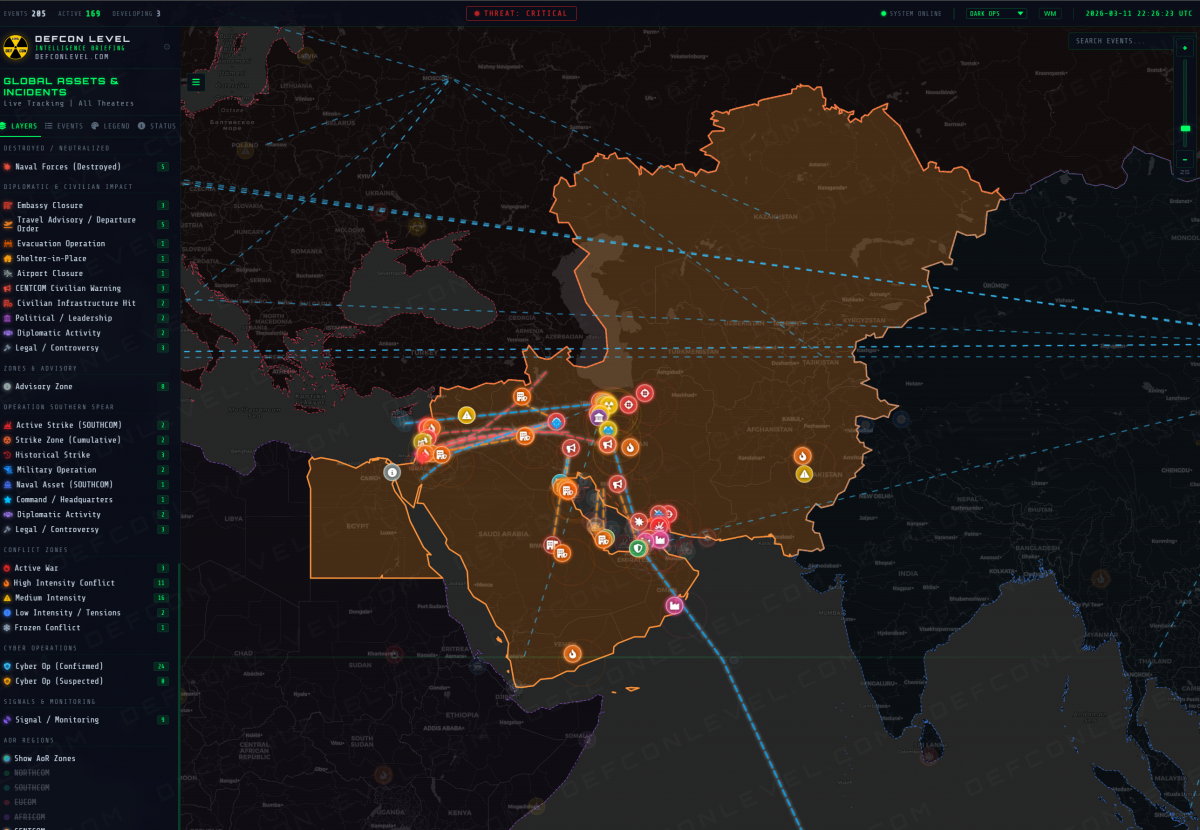
MIDDLE EAST - U.S. Central Command (CENTCOM) Commander Admiral Brad Cooper announced on March 11 that U.S. forces have struck more than 5,500 targets inside Iran and destroyed over 60 Iranian naval vessels since Operation Epic Fury began on February 28. Cooper confirmed the elimination of all four Soleimani-class guided missile catamarans, stating: “That’s an entire class of Iranian ships now out of the fight.”
The update came on a day of significant escalation across multiple fronts. Iran’s Islamic Revolutionary Guard Corps (IRGC) launched what Iranian state media Tasnim described as the heaviest wave of attacks since the war began, striking targets in Kuwait, Saudi Arabia, Bahrain, Qatar, and the United Arab Emirates (UAE).
At least three commercial vessels were hit by projectiles in or near the Strait of Hormuz, with the IRGC claiming responsibility for two of the attacks.
Separately, the Department of War (DoW) confirmed the identity of Chief Warrant Officer 3 Robert M. Marzan, 54, of Sacramento, California, the sixth soldier killed in the March 1 drone strike at Port Shuaiba, Kuwait, bringing the total U.S. combat deaths in Operation Epic Fury to seven.
CENTCOM Commander Update: Campaign Progress
Admiral Cooper’s video update, released via CENTCOM’s social media
accounts on March 11, provided the most comprehensive public accounting
of Operation Epic Fury’s results to date.
According to Cooper, U.S. forces have struck more than 5,500 targets inside Iran, including over 60 Iranian naval vessels. Operations on March 10 involved “strike waves nearly every hour from different locations,” according to Cooper. The destruction of all four Soleimani-class warships represents the elimination of Iran’s most advanced naval platforms.
Delivered to the IRGC Navy in 2022, these guided missile catamarans were the first Iranian warships equipped with vertical launch systems capable of firing medium-range surface-to-air missiles.
Cooper also confirmed the destruction of a large ballistic missile manufacturing facility by U.S. bombers. He stated that U.S. combat power “is building” while Iranian combat power “is declining.”
CENTCOM confirmed the use of artificial intelligence tools in targeting operations. Cooper stated: “Humans will always make final decisions on what to shoot and what not to shoot, and when to shoot.”
Assessment: The elimination of the Soleimani-class fleet removes Iran’s most capable surface-to-air naval defense platform, further degrading Iran’s ability to contest U.S. naval operations in the Persian Gulf and Strait of Hormuz. The 5,500-target figure represents an acceleration from the 1,700 targets reported on Day 1, averaging over 450 targets per day across the first 12 days of operations. Cooper’s emphasis on hourly strike waves from multiple directions suggests U.S. forces are operating with sufficient air superiority to sustain continuous pressure across Iran’s territory.
Strait of Hormuz: Three Vessels Hit, IRGC Claims Responsibility
At least three commercial vessels were struck by projectiles in or near the Strait of Hormuz on March 11. The Thailand-flagged bulk carrier Mayuree Naree (IMO 9323649), operated by SET-listed Precious Shipping Plc, suffered the most severe damage.
According to the Royal Thai Navy, two projectiles struck the Mayuree Naree above the waterline at approximately 8:15 a.m. local time, triggering explosions at the stern and in the engine room and igniting a fire.
The vessel had departed Khalifa Port in the UAE bound for Kandla, India. The Royal Navy of Oman rescued 20 of the 23 Thai crew members. Three crew members remained unaccounted for as of March 11.
Two additional vessels sustained damage: the Japan-flagged container ship One Majesty, which suffered minor damage approximately 25 nautical miles northwest of Ras Al Khaimah in the UAE, and the Marshall Islands-flagged Star Gwyneth, which sustained hull damage approximately 50 nautical miles northwest of Dubai. Crews on both vessels were reported safe.
The IRGC claimed responsibility for striking two vessels: the Liberian-flagged Express Rome, which the IRGC described as “Israeli-owned,” and the Mayuree Naree. The IRGC stated both vessels were “hit by Iranian projectiles and stopped after ignoring the warnings of the IRGC naval forces.”
The relationship between the Express Rome and the three vessels identified by the United Kingdom Maritime Trade Operations (UKMTO) remains unclear from available reporting.
According to the UKMTO, 17 incidents have affected vessels in the Persian Gulf, Strait of Hormuz, and Gulf of Oman between February 28 and March 11, including 13 attack reports and four reports of suspicious activity.
Assessment: The IRGC’s claim that it struck vessels for “ignoring warnings” is consistent with the March 2 IRGC declaration that it would attack any ship attempting to transit the Strait of Hormuz. The targeting of a Thai-flagged vessel with no apparent connection to the U.S.-Israel coalition broadens the threat beyond belligerent-associated shipping. The 17 incidents in 12 days confirm that commercial transit through the strait remains hazardous, with implications for global energy markets and supply chains. The three missing crew from the Mayuree Naree remain an active search and rescue concern.
DoW Confirms Seventh U.S. Casualty
The Department of War announced on March 11 that Chief Warrant Officer 3 (CW3) Robert M. Marzan, 54, of Sacramento, California, has been positively identified by the medical examiner as the sixth soldier killed in the March 1 unmanned aircraft system (UAS) attack at Port Shuaiba, Kuwait. Marzan had previously been listed as “believed to be deceased.”
Iran’s 37th Attack Wave: Gulf States Targeted
Iran launched its 37th wave of retaliatory attacks on March 11, targeting U.S. military facilities and Gulf state infrastructure across five countries. The IRGC claimed it fired four missiles at U.S. forces headquarters, including two targeting Camp Arifjan in Kuwait.
Kuwait: Kuwait’s National Guard reported intercepting eight drones targeting the country. The IRGC separately claimed firing missiles at Camp Arifjan, the largest U.S. military installation in Kuwait and a primary logistics and command hub for U.S. operations in the Middle East.
Saudi Arabia: Saudi Arabia’s Ministry of Defense reported destroying five drones heading toward the Shaybah oilfield and intercepting two additional drones over the Eastern Province.
Bahrain: Drone strikes wounded dozens of people including children in the Sitra industrial area near Manama. A separate strike caused a fire at the Ma’ameer industrial facility.
According to Bahraini authorities, at least one woman was killed and eight people were injured when a drone struck a residential building.
Qatar: Qatar’s military intercepted incoming missiles. Residents in Doha reported hearing several explosions.
UAE: The UAE Ministry of Defense stated it scrambled fighter jets to intercept drones and loitering munitions while air defense systems engaged ballistic missiles. Two drones fell near Dubai International Airport, wounding four people.
CENTCOM Issues Civilian Warning on Iranian Ports
CENTCOM issued a press release on March 11 warning civilians that Iran’s government is using civilian ports along the Strait of Hormuz to conduct military operations that threaten international shipping.
CENTCOM stated that Iranian naval forces have positioned military vessels and equipment within civilian ports serving commercial maritime traffic.
The warning urged civilians in Iran to “immediately avoid all port facilities where Iranian naval forces are operating.” CENTCOM specifically addressed Iranian dockworkers, administrative personnel, and commercial vessel crews, advising them to avoid Iranian naval vessels and military equipment.
CENTCOM stated that “civilian ports used for military purposes lose protected status and become legitimate military targets under international law.” The statement added that while the U.S. military “cannot guarantee civilian safety in or near facilities used by the Iranian government for military purposes,” American forces “will continue taking every feasible precaution to minimize harm to civilians.”
Assessment: The civilian warning serves dual purposes: it provides legal notice ahead of potential strikes on Iranian port infrastructure and frames future strikes within the international law of armed conflict.
The language about protected status directly references the principle of distinction under international humanitarian law, establishing that Iran’s co-location of military assets in civilian ports is the proximate cause of any resulting civilian harm.
This warning may signal an expansion of U.S. targeting to include Iranian port facilities that have thus far not been struck.
Official Statements
Admiral Brad Cooper, CENTCOM Commander, March 11: “We also took out the last of four Soleimani-class warships. That’s an entire class of Iranian ships now out of the fight.” Cooper added that U.S. combat power “is building” while Iranian combat power “is declining.” On AI use in targeting: “Humans will always make final decisions on what to shoot and what not to shoot, and when to shoot.”
U.S. Central Command (CENTCOM), March 11 (Press Release): “CENTCOM urges civilians in Iran to immediately avoid all port facilities where Iranian naval forces are operating. Iranian dockworkers, administrative personnel, and commercial vessel crews should avoid Iranian naval vessels and military equipment.”
Department of War, March 11: “The Department of War confirmed the death of an Army Reserve Soldier who was supporting Operation Epic Fury. Chief Warrant Officer 3 Robert M. Marzan, 54, of Sacramento, Calif., previously listed as believed to be deceased, has been positively identified by the medical examiner.”
Islamic Revolutionary Guard Corps (IRGC), March 11: “The Israeli-owned Express Rome ship, flying the Liberian flag, and the container ship Mayuree Naree, were hit by Iranian projectiles and stopped after ignoring the warnings of the IRGC naval forces.”
Royal Thai Navy, March 11: Confirmed a Thai cargo ship came under attack while sailing in the Strait of Hormuz. Twenty crew members were rescued by the Royal Navy of Oman; three remained unaccounted for.
Saudi Arabia Ministry of Defense, March 11: Reported destroying five drones heading toward Shaybah oilfield and intercepting two drones over the Eastern Province.
UAE Ministry of Defense, March 11: Stated it scrambled fighter jets to intercept drones and loitering munitions while air defense systems engaged incoming ballistic missiles.
Kuwait National Guard, March 11: Reported intercepting eight drones targeting the country.
Full Report & Analysis
The full report includes expert analysis and risk assessment.
Full Report & Analysis →