NATO Intercepts Second Iranian Missile Over Turkey as Saudi Arabia Condemns Attacks and Nations Expand Evacuations
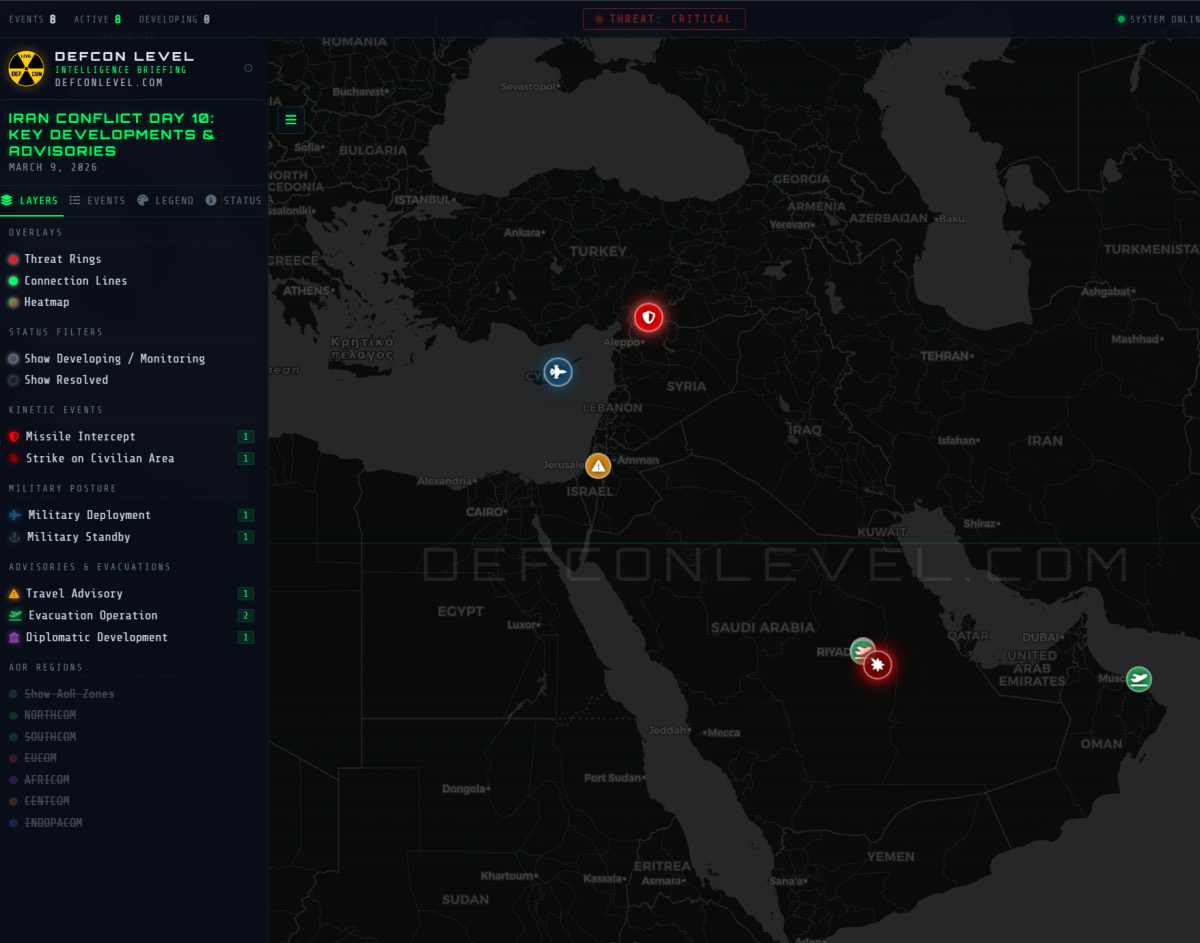
MIDDLE EAST / EASTERN MEDITERRANEAN - North Atlantic Treaty Organization (NATO) air and missile defense forces intercepted a ballistic missile launched from Iran after it entered Turkish airspace on March 9, the second such incident in five days.
Debris from the intercepted munition fell on uninhabited land in Gaziantep province, according to Turkey’s Ministry of National Defense. No casualties or infrastructure damage were reported.
The intercept occurred as Turkey simultaneously deployed six F-16 fighter aircraft and air defense systems to the Turkish Republic of Northern Cyprus. Saudi Arabia’s Ministry of Foreign Affairs issued its strongest condemnation to date of Iranian attacks on the Kingdom and Gulf Cooperation Council (GCC) member states, while explicitly denying Iranian claims that Saudi aircraft had participated in offensive military operations. Iran’s Foreign Ministry spokesperson rejected any discussion of a ceasefire.
On the ground, a military projectile struck a residential location in Al-Kharj Governorate, Saudi Arabia on March 8, killing two Bangladeshi nationals and injuring 12 others.
Multiple nations continued to expand evacuation operations, with the United States broadening departure options from Israel, and Singapore and Japan deploying military and chartered aircraft to extract citizens from Saudi Arabia and the wider region.
NATO Intercepts Second Iranian Missile Over Turkish Airspace, U.S., Singapore, and Japan Expand Departures
A ballistic munition launched from Iran entered Turkish airspace and was intercepted by allied NATO air and missile defense elements operating in the Eastern Mediterranean, according to a press release from Turkey’s Ministry of National Defense (Milli Savunma Bakanligi) dated March 9.
Debris from the munition fell on empty land in Gaziantep province in southeastern Turkey. The ministry confirmed no loss of life, injuries, or property damage resulted from the incident.
This is the second time NATO defenses have intercepted an Iranian missile in Turkish airspace since the conflict began on February 28. The first incident occurred on March 4, when a missile was intercepted and debris fell in Hatay province, also in southeastern Turkey.
Turkish officials assessed that the March 4 missile was likely aimed at a target in Cyprus and veered off course, according to multiple reports at the time. Iran denied firing any missile toward Turkish territory after the March 4 incident; no specific Iranian response to the March 9 intercept has been publicly identified at the time of this report.
Turkey’s Ministry of National Defense stated that the country “attaches great importance to good neighborly relations and regional stability” but warned that “all necessary steps will be taken with determination and without hesitation against any threat directed at our territory and airspace.” The ministry added that “compliance with Turkey’s warnings in this regard is in everyone’s interest.”
Assessment: Confidence: Moderate. Two Iranian missiles entering Turkish airspace within five days, regardless of intent, creates a direct NATO Article 5 consideration.
Turkey is a NATO member state, and repeated violations of its airspace by Iranian munitions test the threshold at which the alliance formally treats these incidents as attacks on a member rather than errant projectiles.
Turkey’s response pattern, combining defensive intercepts with the forward deployment of combat aircraft to Northern Cyprus, indicates Ankara is preparing for the possibility that these incidents are not accidental.
Turkey Deploys F-16s and Air Defense Systems to Northern Cyprus
Turkey deployed six F-16 fighter aircraft and air defense systems to the Turkish Republic of Northern Cyprus (TRNC) on March 9, according to a separate press release from the Ministry of National Defense.
The deployment was described as “part of the phased approach to enhancing the security of the Turkish Republic of Northern Cyprus in light of recent developments in our region.” The jets arrived at Ercan (Tymbou) airport.
The move came after Greece deployed four F-16s and naval vessels to the region in preceding days. A drone attack on Cyprus was also reported in the broader context of the conflict. Turkey’s ministry stated that “additional measures will continue to be taken based on further developments, if deemed necessary.”
Assessment: Confidence: High. The deployment signals Turkey is hardening its forward military posture in the Eastern Mediterranean. The explicit framing as a “phased approach” indicates further deployments may follow.
The simultaneous Greek and Turkish military movements to Cyprus add a secondary layer of tension to the already volatile regional situation, although both NATO allies are responding to the same Iranian threat rather than to each other.
Saudi Arabia Condemns Iranian Attacks, Denies Military Participation
Saudi Arabia’s Ministry of Foreign Affairs issued a statement on March 9 reiterating what it called the Kingdom’s “firm condemnation of the Iranian attacks against the Kingdom and the member states of the Gulf Cooperation Council, as well as a number of Arab, Islamic, and friendly countries, which cannot be accepted or justified under any circumstances.”
The Kingdom stated it “retains its full right to take all necessary measures to safeguard its security, sovereignty, and the safety of its citizens and residents, and to deter aggression.”
The statement directly addressed Iranian claims that Saudi fighter jets and refueling aircraft had departed the Kingdom to participate in the war. Saudi Arabia denied this, stating that the aircraft in question “conduct defensive patrols to monitor and protect the airspace of Saudi Arabia and Gulf Cooperation Council countries from Iranian missiles and drones.”
The ministry described Iran’s claims as “baseless” and stated that Iran “has not reflected [the Iranian President’s] statement in practice,” referring to the Iranian President’s earlier declaration that Iran had no plans to attack neighboring countries.
Saudi Arabia warned that the continued Iranian attacks represent “further escalation which will have grave impact on the relations, currently and in the future.” The statement concluded that Iran’s actions “do not reflect wisdom or the interest of avoiding a wider escalation in which Tehran would be the biggest loser.”
Assessment: Confidence: High. Saudi Arabia is drawing a sharp distinction between defensive air patrols, which it acknowledges, and offensive military participation, which it denies. The language about a “grave impact on the relations” and Iran being “the biggest loser” represents an escalation in Saudi diplomatic rhetoric.
Combined with earlier reporting that Saudi Foreign Minister Prince Faisal bin Farhan warned on March 7 that additional strikes would be met with a “decisive military response,” Saudi Arabia appears to be progressively lowering its threshold for direct military engagement while maintaining the position that it has not yet crossed that line.
Iran Rejects Ceasefire
Iran’s Foreign Ministry spokesperson Esmail Baghaei stated that as long as attacks continue, there is “no point to talk about anything but defense and retaliation against enemies,” when asked about the possibility of a ceasefire, according to Iran’s Students News Network (SNN) as cited by Reuters on March 9.
The statement is consistent with remarks by Iran’s Foreign Minister Abbas Araghchi on March 8, who told NBC News that Iran needed “to continue fighting for the sake of our people and our security” and rejected calls for an unconditional ceasefire.
Assessment: Confidence: High. Both senior Iranian diplomatic figures have now publicly rejected ceasefire discussions. Combined with President Trump’s demand for Iran’s “unconditional surrender,” there is currently no visible diplomatic off-ramp.
Both sides have positioned themselves in ways that make initiating negotiations politically costly for their respective leaderships.
Two Killed, Twelve Injured in Al-Kharj Residential Strike
A military projectile struck a residential location in Al-Kharj Governorate, Saudi Arabia on March 8, killing two Bangladeshi nationals and injuring 12 others (11 Bangladeshi and one Indian national), according to Saudi civil defense authorities and a press release from Bangladesh’s Ministry of Foreign Affairs dated March 9.
The two victims were identified as Mr. Bacchu Miah of Katiadi, Kishorganj and Mr. Mosharraf Hossain of Shakhipur, Tangail, according to the Bangladesh Ministry of Foreign Affairs.
The injured were receiving treatment at local hospitals. Bangladesh Embassy officials in Riyadh visited the injured and were coordinating with Saudi authorities regarding repatriation of remains.
Al-Kharj Governorate hosts Prince Sultan Air Base, a major Saudi military installation. The initial Saudi civil defense report misidentified one victim as Indian before correcting the toll to two Bangladeshi nationals killed.
Bangladesh’s Ministry of Foreign Affairs “strongly condemns all such attacks that result in the loss of innocent lives” and called on “all parties concerned to exercise maximum restraint.”
Assessment: Confidence: High. The Al-Kharj strike demonstrates the expanding civilian toll of Iranian attacks on Gulf states. The location struck housed foreign workers employed by a maintenance and cleaning company, not military personnel.
The presence of large foreign worker populations across GCC states means that Iranian strikes on areas near military installations carry significant risk of civilian casualties among third-country nationals, as this incident illustrates.
Evacuation Operations: United States, Singapore, and Japan Expand Departures
The U.S. Embassy Jerusalem issued Security Alert Update 1 on March 9, expanding departure options for American citizens in Israel, the West Bank, and Gaza. Ben Gurion Airport is open for limited commercial flights, with Israeli carriers Israir, El Al, Arkia, and Air Haifa operating select routes.
The Department of State is organizing limited assistance flights from Ben Gurion Airport; Americans who registered through the crisis intake form will be contacted as seats become available.
For Americans unable to fly, the embassy outlined overland routes to Taba, Egypt, where commercial options remain available. Shuttle service from Taba to Sharm El Sheikh Airport is operating, and the land crossing to Egypt at Taba is open 24 hours.
U.S. Embassy Cairo advised all travelers to carry at least $85 USD (cash) per person to cross at Taba, as ATMs at the crossing are unreliable. A bus service is also available for U.S. citizens departing via the Jerusalem or Tel Aviv areas.
The embassy warned that Americans who choose not to depart “should be prepared to shelter in place in a secure location within your residence or another safe building. Have a supply of food, water, medications, and other essential items.”
U.S. citizens can register through the crisis intake form at mytravel.state.gov or contact 202-501-4444 from abroad and 888-407-4747 domestically.
Singapore’s Ministry of Defense announced on March 9 that the Republic of Singapore Air Force (RSAF) will deploy an A330 Multi-Role Tanker Transport (MRTT) aircraft for the assisted departure of Singaporean citizens from Riyadh, Saudi Arabia on March 10. A second flight from Saudi Arabia is planned for March 12, according to the ministry.
The flights also cover citizens from Brunei, Indonesia, Malaysia, and South Korea, according to the Singapore Ministry of Foreign Affairs.
Japan’s Chief Cabinet Secretary Minoru Kihara announced on March 9 that the government planned to operate government-chartered flights from Riyadh, Saudi Arabia and the Gulf region to transport Japanese nationals who wish to depart.
Kihara’s statement referenced planned flights from Riyadh and Dubai, although reporting indicates Japanese nationals in the United Arab Emirates (UAE) traveled overland to Muscat, Oman, where chartered flights to Japan departed.
Japan Self-Defense Forces (SDF) transport aircraft remain on standby in the Maldives to respond if military evacuation becomes necessary. A total of 518 Japanese nationals have been evacuated from the region since the conflict began on February 28, according to Japanese government reporting.
Assessment: Confidence: High. The geographic breadth of evacuation operations, spanning Israel, Saudi Arabia, the UAE, and the broader Gulf, reflects how the conflict has disrupted civilian life well beyond the primary combatant nations.
The involvement of military transport aircraft from multiple countries (Singapore RSAF, Japan SDF on standby) indicates that commercial aviation options remain severely constrained.
The U.S. Embassy’s detailed shelter-in-place guidance for Americans who cannot depart signals that Washington expects the security situation may persist or worsen before improving.
Official Statements
Turkey’s Ministry of National Defense (March 9): Confirmed NATO air and missile defense forces intercepted a ballistic munition launched from Iran in Turkish airspace. Debris fell in Gaziantep. “All necessary steps will be taken with determination and without hesitation against any threat directed at our territory and airspace.”
Turkey’s Ministry of National Defense (March 9): Announced deployment of six F-16 fighter aircraft and air defense systems to the Turkish Republic of Northern Cyprus as “part of the phased approach to enhancing the security” of the TRNC.
Saudi Arabia’s Ministry of Foreign Affairs (March 9): Condemned Iranian attacks on the Kingdom and GCC states. Denied Saudi aircraft participated in offensive operations, stating they conduct defensive patrols. Warned of “grave impact on the relations, currently and in the future.”
Iran Foreign Ministry spokesperson Esmail Baghaei (March 9): “No point to talk about anything but defense and retaliation against enemies,” rejecting ceasefire discussion.
Bangladesh’s Ministry of Foreign Affairs (March 9): Confirmed two Bangladeshi nationals killed and others injured in Al-Kharj. “Strongly condemns all such attacks” and calls on “all parties concerned to exercise maximum restraint.”
U.S. Embassy Jerusalem (March 9): Security Alert Update 1 expanding departure options. Ben Gurion Airport open for limited commercial flights. Overland routes to Egypt available. Shelter-in-place guidance issued.
Singapore Ministry of Defense (March 9): RSAF A330 MRTT deploying to Riyadh for assisted departure on March 10, second flight March 12.
Japan Chief Cabinet Secretary Minoru Kihara (March 9): Government-chartered flights from Riyadh and the Gulf region for Japanese nationals. SDF aircraft on standby in the Maldives. 518 nationals evacuated since February 28.
U.S. Department of State (March 2): Issued “DEPART NOW” advisory for American citizens in more than a dozen Middle Eastern countries and territories. Directed citizens to depart using available commercial transportation.
U.S. Department of State (March 8): Reported more than 32,000 Americans have safely returned from the Middle East since February 28. Nearly two dozen charter flights completed. Waived reimbursement requirement for assisted travel.
U.S. Embassy Riyadh (March 8): Ordered non-emergency U.S. government employees to depart Saudi Arabia due to sustained missile and drone threats.
U.S. Virtual Embassy Iran (March 9): Advised Americans to leave Iran by land if safe. Warned Iranian government may restrict departures. Noted U.S. nationals face “significant risk of questioning, arrest, and detention.”
Air Force General Dan Caine, Chairman of the Joint Chiefs of Staff: Confirmed U.S. military making C-17 cargo aircraft available to assist civilian departures from the Middle East.
Massachusetts Congressional Delegation (March 5): Letter to Secretary of State Rubio describing “complete failure” to help American citizens evacuate. Cited delayed evacuation orders and confusing State Department messaging.
Full Report & Analysis
The full report includes expert analysis and risk assessment.
Full Report & Analysis →