Maritime Security Digest: February 28 to March 7, 2026
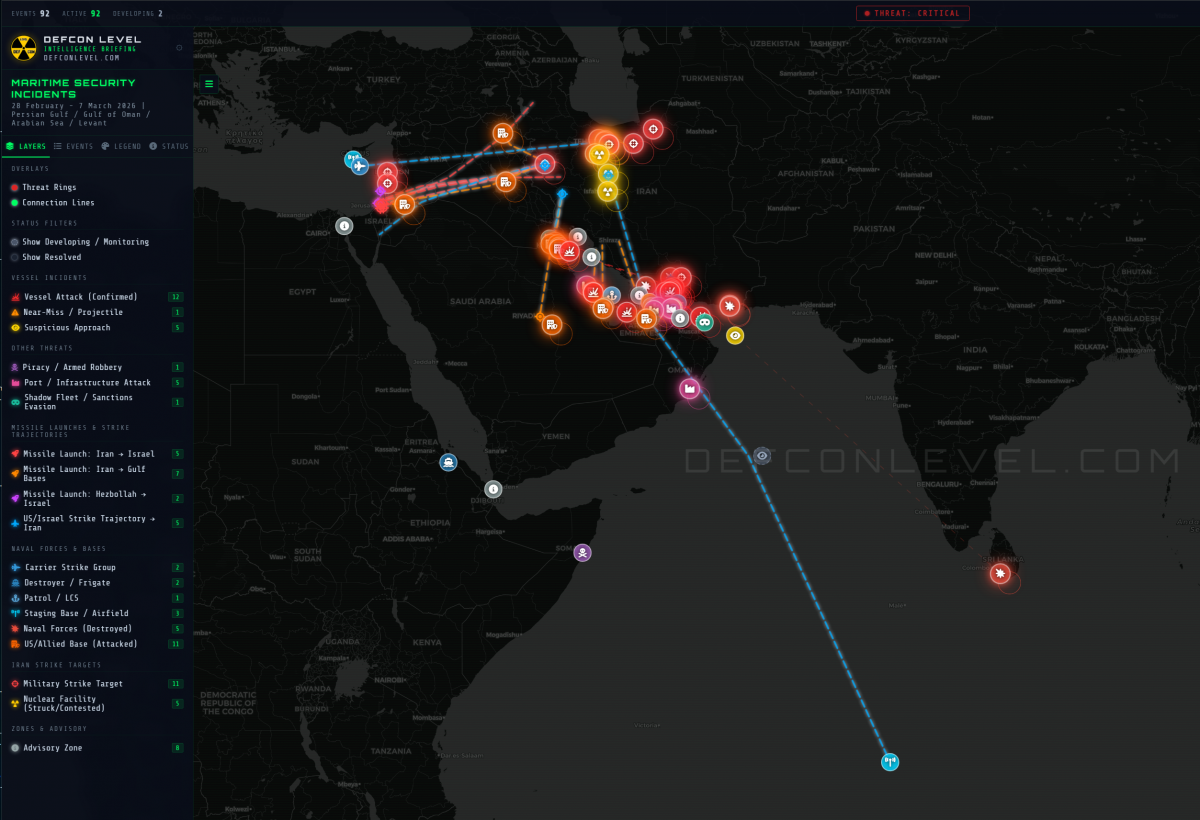
PERSIAN GULF / GULF OF OMAN / ARABIAN SEA: Hundreds of vessels remain stranded on both sides of the Strait of Hormuz for a seventh consecutive day as of March 7, with at least 200 tankers, LNG carriers, and cargo ships anchored off Saudi Arabia, Iraq, and Qatar.
A UAE salvage tug was struck by two missiles on March 6 while heading to assist a disabled container ship, with all 8 crew feared dead.
China is in talks with Iran to negotiate safe passage for oil and gas shipments through the strait, according to Israeli and Gulf diplomatic sources.
The Joint Maritime Information Centre (JMIC) threat level remains CRITICAL. MARAD Advisory 2026-001A, which was set to auto-expire March 7, has been updated and remains active.
At least 13 commercial vessels have been attacked, struck, or targeted across the Persian Gulf, Gulf of Oman, and UAE coastal waters since February 28, when the United States and Israel launched Operation Epic Fury against Iranian military infrastructure.
At least three crew members and one port worker have been killed across multiple vessel incidents, one worker was injured at Duqm Port, and eight more are feared dead on the salvage tug Mussafah 2.
Iran’s Islamic Revolutionary Guard Corps (IRGC) declared the strait closed on March 2 and threatened any vessel attempting transit. Daily Hormuz transits collapsed from an average of 138 (according to JMIC historical data) to 5 on March 4.
Leading maritime insurers have canceled war risk coverage for Persian Gulf transits. The insurance market, rather than the military threat alone, has shut down commercial traffic.
Very Large Crude Carrier (VLCC) freight rates hit an all-time high of $423,736 per day on March 3, up 94% from February 28.
Situation at a Glance
Vessels targeted: 13+ since February 28 (confirmed attacks with damage, near-misses, and suspicious approaches)
Maritime casualties: 4 confirmed killed (1 crew on MKD VYOM, 1 shipyard worker at Port of Bahrain, 2 crew on SKYLIGHT), 1 disputed (LCT AYEH: reported killed by some sources, hospitalized and stable by others), 8 feared dead (Mussafah 2 salvage tug), 1 worker injured at Duqm Port, 10+ injured across vessel incidents
Overall conflict casualties (as of Mar 6): 1,300+ Iranian killed (Red Crescent, Human Rights Activists in Iran); 6 U.S. service members killed (Shuaiba Port, Kuwait); 12 killed in Israel from Iranian missile/drone strikes (including 9 at Beit Shemesh); 217+ killed in Lebanon from Israeli strikes; 87+ killed in IRIS Dena torpedoing off Sri Lanka
Maritime Threat level: CRITICAL (JMIC): “attack considered almost certain”
Hormuz status: IRGC-declared closed; transits collapsed from 138/day to 5 on March 4, down to 2 on March 6 (94-99% reduction)
Stranded vessels: 200+ anchored off Gulf producers; some estimates cite 3,200 ships caught in Hormuz paralysis (Windward)
GNSS interference: 1,100+ vessels affected by GPS jamming; 44 injected signal zones and 92 denial areas across Persian Gulf
Insurance: War risk cover canceled by leading insurers; premiums had surged from 0.125% to 0.2%-1.0% of hull value
VLCC rates: All-time high $423,736/day on March 3 (up 94%)
Oil impact: Approximately 15 million barrels/day of crude removed from seaborne trade (one-third of global seaborne crude)
Iranian Navy: 30+ warships destroyed (Admiral Brad Cooper, CENTCOM, March 5; progressive count: 9 on March 1 according to President Trump, 20+ on March 3, 30+ on March 5), including IRIS Shahid Bagheri (41,000-ton drone carrier, first drone carrier combat loss in naval history)
Iranian missile/drone output: Iran fired 500+ ballistic and naval missiles and approximately 2,000 drones since February 28 (Admiral Brad Cooper, CENTCOM). By March 5, Iranian ballistic missile attacks had dropped approximately 90%, attributed to U.S. B-2 strikes on buried launchers and destruction of solid-fuel missile production facilities at Shahroud and Semnan
Gulf and regional base attacks: Iran struck U.S./allied bases across the Gulf, Jordan, and Saudi Arabia with missiles and drones. UAE absorbed 165 ballistic missiles, 2 cruise missiles, and 541 drones. Kuwait intercepted 97 ballistic missiles and 283 drones. Jordan intercepted 13 missiles and 36 drones targeting Muwaffaq Salti Air Base. Saudi Arabia intercepted three ballistic missiles targeting Prince Sultan Air Base on March 6. 6 U.S. soldiers killed at Shuaiba Port, Kuwait (March 1). Camp Arifjan SATCOM radomes destroyed. 3 U.S. F-15E Strike Eagles shot down over Kuwait by Kuwaiti F/A-18 in friendly fire incident (all 6 crew safe). Iraqi Shia militias (Kata’ib Hezbollah, Saraya Awliya al-Dam) launched drone/missile attacks on U.S. bases at Erbil and Baghdad
IRGC claimed hit on U.S. destroyer: IRGC announced Ghadr-380 and Talaieh missiles struck an Arleigh Burke-class destroyer in the Arabian Sea under “Operation True Promise 4.” Satellite imagery shows fire on a warship. U.S. Navy has NOT confirmed the hit. Assessment: UNVERIFIED
Lebanon front: Hezbollah entered the war on March 2, firing 210+ missiles into Israel (UNIFIL, as of March 5). Israel struck Beirut’s Dahiyeh, killing Hezbollah intelligence chief Hussein Makled and 217+ in Lebanon. IDF ground forces entered southern Lebanon on March 3. UN peacekeepers under fire: 2 Ghanaian soldiers critically injured March 6 (Ghana Armed Forces)
Active advisories: MARAD 2026-001A (Hormuz/Gulf, updated March 7), MARAD 2026-001 (Iranian Illegal Boarding/Detention/Seizure), 4 UKMTO advisories (March 1-4), MARAD 2025-012 (Red Sea)
Diplomatic: China reportedly negotiating with Iran for safe passage of oil/gas shipments through Hormuz
Key Incidents
Incidents below are listed chronologically. I&W tags: [WARNING] = attack imminent or under way. [CONFIRMING] = validates previous assessment. [HOLDING] = persistent condition, no change.
[HOLDING] Feb 17: Piracy, Yemeni-flagged dhow off Garmaal, Somalia. Suspected pirate attack on the dhow SAYTUUN-2 off Garmaal, Eyl, northern coast of Puntland. Armed robbery at sea, Feb 17-22. Crew belongings stolen; vessel vacated by pirates Feb 22. EUNAVFOR Atalanta confirmed and investigated. Source: EUNAVFOR Atalanta, 16 February 2026; MSCIO Alert 02/26.
[WARNING] Feb 28 - Mar 1: Attack on Athe Nova (Honduran-flagged, asphalt/bitumen tanker, IMO 9188116). Struck by two IRGC-claimed drones while transiting the Strait of Hormuz. Caught fire. Vessel managed to exit the chokepoint into the Gulf of Oman despite the fire. Source: IRGC statement (Iranian state media); MSCIO.
Assessment: This is one of the earliest confirmed attacks on commercial shipping following the launch of Operation Epic Fury. The IRGC’s public claim of responsibility, rare for attacks on merchant vessels, followed the broader pattern of deterrent signaling that preceded the formal closure declaration on March 2. (Moderate confidence: IRGC claim via Iranian state media; independent vessel damage assessment not published.)[WARNING] Mar 1: Near-miss on OCEAN ELECTRA (Liberia-flagged, MR2 oil products tanker, IMO 9402782). Projectile detonation approximately 35 nautical miles west of Sharjah, UAE. No physical damage to hull. No crew injuries. Vessel continued voyage toward Al-Hamriya Port, Dubai. Greek-owned (Antlia Navigation Ltd., managed by Oceangold Tankers Inc.). Source: JMIC Advisory Update 002; MSCIO Alert 05/26; Greek City Times, 02 March 2026. (Note: JMIC advisory listed this vessel as IMO 9591466, Panamax bulk carrier. Registry-confirmed identity is IMO 9402782, oil products tanker. JMIC IMO appears to be a data entry error referencing GUO YUAN 28, a Chinese bulk carrier.)
Note: JMIC assessed that all non-US/Israeli vessels attacked in the region had “no clear or obvious operational or political association” making them viable targeting candidates, confirming indiscriminate threat to all commercial shipping regardless of flag or affiliation.[WARNING] Mar 1, 0805 UTC: Attack on HERCULES STAR (Gibraltar-flagged, oil products tanker, IMO 9916135). Struck approximately 17 nautical miles northwest of Mina Saqr, UAE, at 26.22N, 055.93E. On-board fire extinguished by crew. No injuries. Vessel continued under own power. Source: MSCIO Alert 05/26, 01 March 2026. (Note: JMIC advisory listed IMO 9295531, which is PEYTON LYNN C, a container ship. Registry-confirmed IMO for HERCULES STAR is 9916135.)
[WARNING] Mar 1, 0940 UTC: Attack on MKD VYOM (Marshall Islands-flagged, crude oil tanker, IMO 9284386). Struck above the waterline by suspected uncrewed surface vehicle (USV) approximately 44 nautical miles northwest of Muscat, Oman. Explosion triggered engine-room fire. One crew member killed. Vessel remained afloat as of March 2. Source: UKMTO Advisory 008-26, 02 March 2026.
Assessment: The strike on a crude tanker under way in the Gulf of Oman, well outside the Strait of Hormuz, confirms that Iranian targeting extends beyond the chokepoint into open-water transit lanes. This widens the threat corridor and complicates rerouting options for vessels attempting to bypass Hormuz via Omani waters. (Moderate confidence: single UKMTO advisory, no independent damage assessment published.)[WARNING] Mar 1: Attack on SKYLIGHT (Palau-flagged, tanker, IMO 9330020). US-sanctioned bunker tanker attacked while anchored approximately 5 nautical miles north of Khasab Port, Oman, at the northern tip of the Musandam Peninsula. Fire on board. Four of 20 crew initially reported injured (15 Indian nationals, 5 Iranian nationals). Entire crew evacuated. On March 4, Omani Coast Guard recovered remains in the burned captain’s room; two Indian crew members confirmed killed: Captain Ashish Kumar (37, from Bihar) and Dalip Singh (24, from Rajasthan). Vessel linked to Iran’s shadow fleet, anchored since February 22. Source: JMIC Advisory Update 002, 01 March 2026; Omani Coast Guard via Indian Embassy, 04 March 2026.
Assessment: Targeting a vessel at anchor rather than in transit is a significant pattern shift that emerged from the first day of the crisis. Anchorages near Khasab and Fujairah, previously considered safer alternatives to transit, offer no meaningful risk reduction. The delayed confirmation of fatalities (bodies found three days after the attack in burned compartments) raises the possibility that initial casualty reports from other vessels may also be understated. (Moderate confidence: JMIC confirmed attack; crew fatalities confirmed by Omani Coast Guard and Indian Embassy.)[WARNING] Mar 2, 0257 UTC: Attack on STENA IMPERATIVE (U.S.-flagged, chemical/oil products tanker, IMO 9666077). Struck by multiple projectiles while berthed at Salman Industrial City, Port of Bahrain. One shipyard worker killed by debris. Two others seriously injured. Source: UKMTO Advisory 003-26/002, 01 March 2026 (updated).
Assessment: Targeting a U.S.-flagged vessel in port is a direct escalation matching IRGC statements threatening U.S.-linked assets across the Gulf. Port-based attacks carry higher collateral risk to civilian infrastructure and third-country nationals. (Moderate confidence: U.S. flag confirmed by MARAD; weapon and attribution not independently verified.)[WARNING] Feb 28 - Mar 2 (date disputed): Attack on LCT AYEH (UAE-flagged, landing craft). Struck by explosive shrapnel from explosion near Zirku Island, Abu Dhabi, close to ADNOC oil terminal. Vessel owned by Khalid Faraj Shipping. One Indian Able Seaman reported killed (disputed: at least one source reports the crew member was hospitalized and stable). Crew rescued by UAE authorities on March 2. Source: MSCIO; Windward, 05 March 2026.
Assessment: The proximity to ADNOC’s Zirku Island terminal shows the risk extends to energy infrastructure support vessels, not just tankers in transit. The disputed attack date (ranging from February 28 to March 2 across sources) illustrates the fog-of-war reporting challenges in the early hours of the crisis. (Low confidence: attack date and exact weapon type unconfirmed; casualty disputed across sources.)[CONFIRMING] Mar 3, 2220 UTC: Attack on Libra Trader (Marshall Islands-flagged, VLCC, IMO 9562673). Explosion near vessel approximately 10 nautical miles east of Fujairah, UAE. Debris from unknown projectile found on deck; minor damage to funnel. Source: UKMTO, 03 March 2026.
[CONFIRMING] Mar 3 (late): Attack on MV Gold Oak (Panama-flagged, bulk carrier). Struck by projectile 7 nautical miles east of Fujairah, UAE. Damage to steel plating. No fire or water ingress. Source: MSCIO, 03 March 2026.
[WARNING] Mar 4, 1109 UTC: Attack on Safeen Prestige (Malta-flagged, 1,740-TEU containership, IMO 9593517). Hit by projectile above the waterline approximately 2 nautical miles north of Oman while eastbound through the Strait of Hormuz. Engine-room fire. Crew abandoned ship. Source: MSCIO Alert 09/26, 04 March 2026.
Assessment: First confirmed strike on a containership during this crisis. Container vessels carry higher-value cargo and more complex insurance arrangements than tankers. If container lines suspend Hormuz routing, the alternative is the 10-14 day Cape of Good Hope diversion already in use for Red Sea avoidance. (High confidence: MSCIO confirmed; vessel identity verified via Malta Ship Registry.)[HOLDING] Mar 4: Near-miss on MSC Grace (containership). Splash from projectile near vessel approximately 20 nautical miles west of Dubai. No damage reported. Source: MSCIO.
[CONFIRMING] Mar 4, 2240 UTC: Attack on SONANGOL NAMIBE (Bahamas-flagged, Suezmax crude tanker, IMO 9325049). Master reported “a large explosion on the port side” affecting a cargo tank approximately 30 nautical miles southeast of Mubarak Al Kabeer, Kuwait. Water ingress from likely hull breach; initial reports of oil in water were later assessed as ballast water discharge (UKMTO update). No fire. Crew safe, no injuries. Small craft observed departing the area immediately after the explosion. Vessel had been stationary since February 26. Source: UKMTO Advisory 013-26, 04 March 2026.
Assessment: This is the northernmost incident in the crisis, extending the threat zone deep into the central Arabian Gulf near Kuwait. The use of a small craft rather than a missile or drone resembles IRGC Navy (IRGCN) fast-attack tactics from the 1987-88 Tanker War. If confirmed as deliberate, it confirms Iranian ability to threaten shipping across the full length of the Gulf, not just at the Hormuz chokepoint. (Low confidence: cause not confirmed; small craft sighting from crew report only.)[WARNING] Mar 6: Attack on MUSSAFAH 2 (UAE-flagged, salvage tug). Struck by two missiles approximately 18 nautical miles from Khasab, Oman, while heading to assist the disabled containership Safeen Prestige (which had been adrift since March 4). IMO reported at least 4 killed and 3 severely injured; other sources report all 8 crew feared dead. Vessel owned by AD Ports Group (Abu Dhabi Ports), 134 gross tons. AIS went dark after departing Mina Zayed port. UKMTO received third-party reports and stated the incident was being investigated. Source: UKMTO; Maritime Executive; Seatrade Maritime, 06 March 2026.
Assessment: Targeting a rescue/salvage vessel is a severe escalation. If confirmed as deliberate, it would violate longstanding maritime norms protecting vessels engaged in rescue operations and would deter future salvage attempts, leaving disabled vessels adrift as navigational hazards in the strait approaches. The attack also raises the risk calculus for any vessel approaching the Hormuz area, not just transiting vessels. (Low-Moderate confidence: attack confirmed by multiple maritime security sources; crew status reported as feared dead but not officially confirmed; weapon type and attribution unconfirmed.)
Note: The tanker Sea La Donna (IMO 9380532) was initially reported as a casualty but was later cleared by JMIC as no longer considered impacted. GPS spoofing indicators were present.
March 5-7: No new attacks on commercial transiting vessels confirmed since March 4. The Mussafah 2 salvage tug was the most recent confirmed attack (March 6). Hormuz transits remained at approximately 5 per day.
Two oil product tankers turned away from the strait approaches on March 6, according to Argus Media. MARAD Advisory 2026-001A was updated on March 7, extending its coverage. The primary constraint on traffic is now insurance availability rather than active attacks.
Port and Infrastructure Attacks
Dubai International Airport (DXB), UAE (Feb 28): World’s busiest international airport by passenger volume. Iranian drone struck Terminal 3 concourse in the early morning hours of March 1 local time. Four staff injured. Emergency evacuation of concourse. Second strike hit early on March 1, with smoke visible over the city. All flights in and out of both Dubai airports suspended. Part of a barrage of 165 ballistic missiles, 2 cruise missiles, and 541 drones across the UAE, according to UAE Ministry of Defense. Fires and debris also hit the Burj Al Arab hotel and the Palm Jumeirah residential area. Source: Dubai Airports authority; UAE Ministry of Defense.
Jebel Ali Port, UAE (Mar 1): Debris from aerial interception caused fire at the port. DP World confirmed operations resumed at 1800 local time with enhanced security. Source: DP World statement.
Duqm Port, Oman (Mar 1-2): Two UAV strikes reported. One worker injured. Port operational following attacks. Source: JMIC Advisory Update 002; UKMTO.
Ras Tanura Refinery, Saudi Arabia (Mar 2): Saudi Aramco shut the 550,000 barrel-per-day refinery after debris from two intercepted Iranian drones fell on the facility at 0704 local time. Saudi Ministry of Defense later stated “no damage” and “no disruption to supplies,” though Argus Media reported “limited damage” from intercepted drone debris and Aramco had initially shut the facility (disputed: the shutdown-then-no-damage sequence has not been independently reconciled). Source: Saudi Ministry of Defense, Saudi Ministry of Energy; Argus Media.
Fujairah Oil Industry Zone, UAE (Mar 3): Debris from a downed Iranian drone struck a fuel storage tank, causing a fire that was contained. No casualties. Source: Fujairah Civil Defence.
Assessment: The strike on Dubai International Airport is the most commercially significant infrastructure hit of the crisis. DXB handled 92 million passengers in 2024, serving as the primary hub for Emirates Airlines and a transit point for global air cargo.
The airport closure, combined with Kuwait airport damage and Qatar airspace restrictions, shut down civilian aviation across the Gulf simultaneously.
This has cascading effects on maritime crew rotation, ship chandlery, spare parts delivery, and maritime legal/insurance services based in Dubai. (High confidence: Dubai Airports authority confirmed damage and suspension; UAE Ministry of Defense confirmed missile/drone count.)
Gulf Military Operations: Attacks on U.S./Allied Bases
Iran launched 500+ ballistic and naval missiles and approximately 2,000 drones against targets across the Gulf and Israel since February 28, according to Admiral Brad Cooper (CENTCOM, March 5).
The following attacks on military installations directly affect the security environment for maritime operations in the Persian Gulf and Gulf of Oman.
Shuaiba Port, Kuwait (Mar 1): 6 U.S. soldiers killed. Iranian drone struck a tactical operations center at Shuaiba civilian port, killing six U.S. Army Reserve soldiers from the 103rd Sustainment Command (Expeditionary), headquartered in Des Moines, Iowa. Identified: Major Jeffrey O’Brien, Captain Cody Khork, SFC Noah Tietjens (42, Nebraska), SFC Nicole Amor (39, Minnesota), SGT Declan Coady (20, Iowa), and CW3 Robert Marzan (54, California). The soldiers had relocated from Camp Arifjan to Shuaiba hoping to evade incoming strikes; the operations center offered minimal overhead protection. A U.S. Army Central Command memo stated that Iranian intelligence appeared to have surveilled the location beforehand. Deadliest single attack on U.S. forces in the conflict. Source: CENTCOM; U.S. Army.
Camp Arifjan, Kuwait (Mar 1-2): SATCOM radomes destroyed. Twelve Iranian drones struck Camp Arifjan in two waves. Satellite imagery shows clustered impacts with deliberate targeting of six strategic satellite communication (SATCOM) radomes, degrading U.S. command communications across the Gulf. Camp Arifjan is the primary U.S. Army logistics hub in Kuwait. Source: satellite imagery analysis; U.S. Army.
Ali al-Salem Air Base, Kuwait (Feb 28+): targeted. One of four U.S. bases explicitly named by the IRGC as targets. Also hosted Italian soldiers. Part of a barrage of 97 ballistic missiles and 283 drones targeting Kuwait, according to the Kuwaiti government. Source: IRGC statement; Kuwaiti government.
Al Udeid Air Base, Qatar (Mar 3): ballistic missile hit. Iranian ballistic missile struck the base; a second missile was intercepted. No U.S. casualties reported. Qatar Air Force shot down two Iranian Su-24 tactical bombers approaching the base, Qatar’s first aerial combat engagement. Al Udeid is the largest U.S. military facility in the Middle East (approximately 10,000 personnel) and serves as CENTCOM forward headquarters. Qatar intercepted 65 ballistic missiles and 12 drones in the initial barrage (Feb 28-Mar 1), plus an additional 10 drones and 2 cruise missiles on March 4. Source: Qatar Defense Ministry; CENTCOM.
Naval Support Activity (NSA) Bahrain / U.S. 5th Fleet HQ (Feb 28+): targeted. Initial barrage of 45 missiles and 9 drones targeted the facility (Feb 28; later totals rose to 78 missiles and 143 drones). A Shahed drone struck a tower near 5th Fleet headquarters (footage confirmed). Several residential buildings in Manama hit. Iran also targeted the Israeli embassy in Bahrain on March 6. Source: CENTCOM.
Al Dhafra Air Base, UAE (Feb 28+): targeted. U.S. Air Force base near Abu Dhabi targeted as part of a barrage of 165 ballistic missiles, 2 cruise missiles, and 541 drones against the UAE, according to UAE Ministry of Defense. Hosts F-35 fighters and reconnaissance aircraft. UAE air defenses intercepted the majority of threats. At least one civilian killed in Abu Dhabi from falling interceptor debris. Source: CENTCOM; UAE Ministry of Defense.
U.S. bases in Iraq: Erbil and Baghdad (Mar 1-5): militia drone/missile attacks. Iraqi Shia militias (Kata’ib Hezbollah, Saraya Awliya al-Dam, Harakat Hezbollah al-Nujaba) launched multiple waves of drone and missile attacks on the U.S. base at Erbil International Airport and Camp Victoria at Baghdad International Airport. The Islamic Resistance in Iraq (IRI) claimed 29 operations using “dozens of drones and missiles” in 24 hours on March 5 (unconfirmed). Kata’ib Hezbollah stated it aims to “drag the U.S. into a long war of attrition” to remove all American presence from Iraq. Source: IRI statements; FDD Long War Journal.
Muwaffaq Salti Air Base, Jordan (Feb 28+): attacked. Royal Jordanian Air Force base at Azraq in eastern Jordan, hosting U.S. forces and F-16 Fighting Falcons. Targeted by 13 Iranian ballistic missiles and 36 drones. Jordan stated it intercepted all threats with Patriot and NASAMS batteries, though satellite imagery suggests some impacts near THAAD radar positions. No casualties reported. Jordan is not a party to the conflict but hosts U.S. military assets under a bilateral defense agreement. Source: Jordanian Armed Forces; CENTCOM.
Prince Sultan Air Base, Saudi Arabia (Mar 6): targeted. Major U.S. Air Force base at Al Kharj, 80 km south of Riyadh. Hosts F-15E Strike Eagles, F-35A Lightning IIs, Patriot batteries, and Terminal High Altitude Area Defense (THAAD). On March 6, the Saudi Ministry of Defense confirmed intercepting three ballistic missiles targeting “a base south of the capital,” consistent with Prince Sultan Air Base. Saudi Arabia is not a party to the conflict but has intercepted all Iranian missiles and drones targeting its territory. Source: Saudi Ministry of Defense; CENTCOM.
Friendly fire incident, Kuwait (Mar 1): Three U.S. Air Force F-15E Strike Eagles were shot down over Kuwait by a Kuwaiti F/A-18 Hornet in a friendly fire incident at 2303 ET. All six aircrew (three pilots, three weapons systems officers) ejected safely and were recovered. The aircraft were misidentified during a complex battle environment involving Iranian aircraft, ballistic missiles, and drones simultaneously. Under investigation by CENTCOM and Kuwaiti authorities. Source: CENTCOM.
Assessment: The destruction of Camp Arifjan’s SATCOM radomes is directly relevant to maritime security: U.S. naval forces in the Persian Gulf depend on these facilities for command, control, and coordination of maritime operations.
Degraded communications reduce the effectiveness of naval escort, maritime domain awareness, and coordination between CENTCOM and deployed carrier strike groups. The concentration of attacks on logistics and communications infrastructure, rather than frontline combat forces, suggests Iranian targeting priorities include disrupting the U.S. ability to sustain naval operations in the Gulf. (Moderate confidence: satellite imagery analysis; CENTCOM confirmed casualties.)
The Iraqi militia attacks on Erbil and Baghdad add a third threat vector to maritime security planning: in addition to Iranian direct strikes and IRGC asymmetric naval operations, Iran-backed proxy forces can threaten the overland supply lines and air logistics that sustain U.S. naval deployments in the Gulf.
If militia attacks intensify on logistics hubs, sustainment of naval operations becomes the limiting factor rather than the naval threat itself. (Moderate confidence: militia claims corroborated by explosion reports; operational impact on naval sustainment is assessed.)
Choke-point Status
Strait of Hormuz / Persian Gulf: CLOSED (IRGC-declared) / CRITICAL (JMIC).
The IRGC declared the strait closed on March 2 and threatened any vessel attempting transit. Daily transits collapsed from 138 (JMIC historical average for all vessels) to 5 on March 4 and 2 on March 6; Windward tracking of cargo and tanker vessels showed a decline from 70-80 daily crossings to 7 on March 2, 4 on March 3, 5 on March 4, and 2 on March 6, a 94-99% reduction from normal operations. As of March 7, at least 200 vessels remain stranded on both sides; broader estimates cite 3,200 ships (Windward) caught in the Hormuz paralysis. Significant GNSS interference continues: 1,100+ vessels affected within 24 hours of the first strikes, with 44 injected signal zones and 92 denial areas detected across the Persian Gulf, including false AIS signals positioning ships at airports and nuclear facilities. MARAD Advisory 2026-001A directs U.S.-flagged vessels to maintain 30-nautical-mile standoff from U.S. military vessels. UKMTO issued four advisories in March covering the Strait of Hormuz, Central Arabian Gulf, Gulf of Oman, and Southern Arabian Gulf.
Assessment: The closure removes approximately 15 million barrels per day of crude from global seaborne trade, roughly one-third of all seaborne crude. OPEC’s spare pipeline capacity of approximately 4 million barrels per day (primarily Saudi east-west pipelines and UAE pipelines to Fujairah) cannot compensate for more than a fraction of the lost volume. The China-Iran safe passage talks, if successful, could create a two-tier transit system where Chinese-linked vessels operate under Iranian protection while Western-linked shipping remains blocked. This would fragment the global oil market along geopolitical lines. If the closure persists beyond 7-10 days, strategic petroleum reserve drawdowns become likely. (High confidence: transit data from vessel tracking platforms; IRGC closure statement from multiple official channels; China-Iran talks from Israeli and Gulf diplomatic sources.)
Historical precedent: The 1980-88 Tanker War saw over 450 attacks on commercial shipping in the Gulf over seven years (283 by Iraq, 168 by Iran), with insurance premiums rising to 5% of hull value. The current crisis has already produced more concentrated attacks (10+ vessels in 6 days) than any comparable period during that war, and the IRGC’s explicit closure declaration has no precedent since the 1980 outbreak of the Iran-Iraq War.
Alternative reading: IRGC closure enforcement may prove selective rather than absolute. Iran depends on Gulf exports for its own revenue, and the reported China-Iran talks suggest Tehran is already seeking exceptions for key trading partners. If attacks cease against non-Western-flagged vessels and Chinese tankers begin transiting in the next 48-72 hours, this would confirm selective enforcement rather than total blockade.Bab el-Mandeb / Southern Red Sea: ELEVATED.
Two senior Ansar Allah (Houthi) officials stated on February 28 that the movement would resume missile and drone attacks on Red Sea shipping. CMA CGM suspended Suez Canal transits indefinitely and rerouted via the Cape of Good Hope. Bab el-Mandeb crossings spiked to 21 on March 4, a sharp increase from single-digit crossings the previous day, suggesting some vessels are attempting this route as an alternative to Hormuz. No confirmed attacks on commercial shipping since the resumption threat. MARAD Advisory 2025-012 remains active.Suez Canal: RESTRICTED.
Transit volumes declining: 23 crossings on March 4, down 53% from the previous day and well below the 7-day average of 38 crossings, as carriers reroute away from both Red Sea and Persian Gulf. Cape of Good Hope recorded 87 transits on March 4 as the primary diversion route. Suez Canal Authority has not issued closure notices. No incidents at the canal.Strait of Malacca / Singapore Strait: NORMAL.
No incidents in current reporting window. ReCAAP ISC baseline monitoring continues.Panama Canal: NORMAL.
No security incidents. Standard draft restrictions and slot allocations.
Naval Force Tracker
CSG-3 (USS Abraham Lincoln, CVN-72): Operating in U.S. Central Command (CENTCOM) area of responsibility since January 26. Carrier Air Wing 9 embarked (F-35C, F/A-18E/F Super Hornets, EA-18G Growlers, E-2D Advanced Hawkeyes). Escorts: USS Frank E. Petersen Jr., USS Spruance, USS Michael Murphy (all Arleigh Burke-class destroyers). Source: CENTCOM.
CSG-12 (USS Gerald R. Ford, CVN-78): Deployed to CENTCOM area of responsibility. Largest U.S. naval deployment to the region since Operation Iraqi Freedom in 2003. Source: CENTCOM.
USS McFaul (DDG-74) and USS Mitscher (DDG-57): Arleigh Burke-class destroyers operating in the Strait of Hormuz. Source: CENTCOM.
USS Canberra (LCS-30), USS Tulsa (LCS-16), USS Santa Barbara (LCS-32): Littoral combat ships operating in the Persian Gulf. Source: CENTCOM.
USS Delbert D. Black (DDG-119): Arleigh Burke-class destroyer operating in the Red Sea. Source: CENTCOM.
USS Roosevelt (DDG-80) and USS Bulkeley (DDG-84): Operating in the Mediterranean Sea. Source: CENTCOM/EUCOM.
USS Charlotte (SSN-766, Los Angeles-class attack submarine): Fired two Mark 48 torpedoes at IRIS Dena (Moudge-class frigate) approximately 40 nautical miles off southern Sri Lanka on March 4; one torpedo struck the vessel. First U.S. torpedo kill since World War II. Approximately 180 crew aboard; 87 confirmed dead, 61 missing, 32 rescued by Sri Lankan Navy. Sri Lanka also evacuated the crew of a second Iranian vessel in the area. Source: CENTCOM, 05 March 2026; Sri Lanka Navy.
IRIS Shahid Bagheri (drone carrier): DESTROYED, Persian Gulf. Iran’s 41,000-ton drone and helicopter carrier, the largest vessel in the Iranian Navy, struck during the opening strikes of Operation Epic Fury on February 28. CENTCOM confirmed the strike on March 2 and released infrared footage on March 5 showing the vessel on fire. Commissioned only one year earlier. First combat loss of a drone carrier in naval history. Source: CENTCOM, 05 March 2026.
IRIS Dena torpedoed off Sri Lanka (see above).
IRGC claimed strike on U.S. destroyer, Arabian Sea (DISPUTED). The IRGC announced a “powerful strike” on an Arleigh Burke-class destroyer and a nearby logistics tanker more than 600 km from Iranian territory, using Ghadr-380 medium-range ballistic missiles and Talaieh cruise missiles under “Operation True Promise 4.” Satellite imagery shows a fire on a warship in the Arabian Sea. However, the low resolution of available imagery cannot confirm whether the fire resulted from a missile impact or an unrelated cause. The U.S. Navy has not confirmed the hit. Separately, a U.S. destroyer intercepted an Iranian missile heading toward Turkey. Source: IRGC statement; satellite imagery analysis. Status: UNVERIFIED.
Iranian Navy: effectively destroyed. Admiral Brad Cooper stated on March 5 that U.S. forces had destroyed over 30 Iranian warships during Operation Epic Fury, up from the initial CENTCOM report of 17 warships and one submarine on March 2-4. Satellite imagery confirmed fires, sunken vessels, and destroyed infrastructure at three naval bases:
Bandar Abbas: IRIS Sahand, Sabalan, Zagros sunk; IRIS Makran (forward base ship, Iran’s first) burning at berth; Kilo-class submarine sunk at dock.
Konarak Naval Base: IRIS Jamaran (hull 76), IRIS Bayandor (81), IRIS Naghdi (82) sunk, plus a Moudge-class frigate, two Hendijan-class patrol boats. Satellite imagery confirms all three frigates sunk.
Chabahar: Jamaran-class corvette (a small warship) sunk at pier.
The Iranian Navy has been effectively destroyed as a conventional force. Remaining maritime threat is entirely asymmetric: IRGC Navy fast attack craft, shore-based anti-ship missiles, naval mines, and armed drones. Source: CENTCOM; Admiral Brad Cooper, 05 March 2026; satellite imagery.
Assessment: The destruction of Iran’s conventional navy is the most decisive naval outcome since the Falklands War in 1982. Over 30 warships destroyed in seven days eliminates Iran’s ability to project conventional naval power beyond its coastline.
However, the remaining threat to commercial shipping is almost entirely asymmetric: IRGC Navy fast attack craft, shore-based anti-ship cruise missiles, naval mines, and armed drones operate independently of the conventional fleet.
The IRGC’s claimed destroyer hit, if confirmed, would demonstrate that asymmetric assets can threaten even advanced surface combatants.
The two-carrier presence (Lincoln and Ford) provides overwhelming conventional superiority but cannot simultaneously cover the full Persian Gulf, Gulf of Oman, and Arabian Sea against dispersed asymmetric threats. (High confidence: CENTCOM confirmed 30+ warships destroyed; satellite imagery consistent with strikes at Bandar Abbas, Konarak, Chabahar.)
Shipping and Insurance Impact
The insurance market has effectively closed the Strait of Hormuz to commercial traffic independently of the military situation. Leading insurers canceled war risk coverage for Persian Gulf transits beginning March 1-2, according to the Lloyd’s Market Association.
War risk premiums: Surged from 0.125% to 0.2%-1.0% of hull value per transit before cancellation. For a VLCC valued at $120 million: approximately $240,000-$1,200,000 per transit, up from $150,000.
VLCC freight rates: All-time high of $423,736/day on March 3 (up 94% from February 28). Source: Baltic Exchange.
Brent crude: Rose from $73.15/barrel (February 27) to $79.11/barrel (March 2), then surged to $92.65/barrel (March 7) as the Strait of Hormuz closure halted Gulf oil flows - a roughly 27% weekly gain, the largest for Brent since April 2020 (WTI crude surged 35%, the largest weekly gain in futures trading history dating back to 1983). Hormuz normally carries approximately 15 million barrels/day. Iraq and Kuwait have begun cutting output.
Stranded vessels: 200+ anchored off Gulf producers (Saudi Arabia, Iraq, Qatar); broader estimates cite 3,200 ships (Windward) caught in Hormuz paralysis.
Rerouting cost: Cape of Good Hope diversions add 10-14 days and approximately $1-2 million in fuel costs per voyage for Gulf-to-Europe routes.
U.S. government response: The Development Finance Corporation (DFC) announced political risk insurance and guarantees for maritime trade through the Gulf. This does not cover physical damage or crew injury, which remain uninsured.
Assessment: Even if the military situation stabilizes, reinsurers will require a sustained period of zero incidents before reinstating war risk coverage, creating a lag between any ceasefire and resumed shipping.
The DFC proposal addresses political risk but leaves the physical damage layer uninsured. VLCC rates will remain at or above record levels as long as Hormuz remains closed.
The China-Iran safe passage talks could create a parallel insurance pathway through Chinese state-backed underwriters, effectively splitting the maritime insurance market along geopolitical lines. (High confidence: Lloyd’s Market Association cancellation confirmed; VLCC rate data from Baltic Exchange.)
Causal chain: IRGC closure declaration + attacks on 13+ vessels including salvage tug (factual) -> insurers cancel war risk cover (factual) -> vessel operators unable to obtain coverage for Gulf transit (factual) -> transit collapse, 200+ vessels stranded (factual) -> VLCC rates hit all-time high, Brent crude rises ~27% to $92.65/barrel by March 7 (factual) -> salvage tug attacked, deterring rescue operations (factual) -> disabled vessels left adrift as navigational hazards (assessed) -> projected: consumer fuel price increases in importing nations within 1-2 weeks (assessed).
Watchlist
MARAD Advisory 2026-001A updated (March 7): Advisory was updated and remains active as of March 7, confirming continued U.S. assessment of elevated threat. Watch for further upgrades or geographic expansion.
China-Iran safe passage outcome: If successful, watch for first Chinese-linked tanker transit of Hormuz under Iranian protection. This would confirm selective enforcement and fragment global oil supply chains.
Houthi attack resumption: Ansar Allah officials threatened renewed Red Sea attacks on February 28. First confirmed strike would activate dual-chokepoint crisis (Hormuz + Bab el-Mandeb closed simultaneously), leaving Cape of Good Hope as the sole major East-West maritime route.
Insurance market response to DFC: If the U.S. political risk insurance offer attracts underwriters for the physical damage layer, some U.S.-linked vessels may attempt Hormuz transit. Watch for the first insured commercial transit.
Pezeshkian neighbor-halt credibility: Iranian President Pezeshkian announced a halt to strikes on neighbors (March 7), but Iranian forces struck a UAE air base shortly after. If the halt holds for Gulf states, it could reduce the threat to vessels at anchor near UAE/Oman ports while IRGC asymmetric operations in the strait itself continue independently. If it does not hold, the statement is purely rhetorical. Watch for a 24-48 hour pattern to determine whether IRGC targeting of Gulf-state territory actually stops.
IRGC enforcement pattern: No new attacks on transiting vessels since March 4, but the Mussafah 2 salvage tug was struck March 6. If transit attacks do not resume while Chinese negotiations continue, it suggests Iran is preserving asymmetric assets for selective use. The targeting of rescue operations may be intended to deter salvage companies from operating in the strait area, compounding the insurance blockade.
Mussafah 2 crew confirmation: IMO reported at least 4 killed and 3 severely injured; some sources report all 8 feared dead. Watch for AD Ports Group or UAE authorities to issue a definitive statement.
Iranian missile capacity trajectory: CENTCOM reports a 90% drop in Iranian ballistic missile attacks by March 5, attributed to strikes on launchers and production facilities. If the reduction holds, the risk of anti-ship ballistic missile attacks in the Strait of Hormuz decreases proportionally. However, IRGC asymmetric assets (fast boats, naval mines, cruise missiles, drones) are unaffected by the ballistic missile production shutdown. Watch for IRGC to shift maritime attack methods from missile to mine/drone.
Iraqi militia escalation: Kata’ib Hezbollah and allied groups have declared war on U.S. forces and attacked bases in Erbil and Baghdad. If attacks intensify on logistics hubs, sustainment of U.S. naval operations in the Gulf becomes the constraint. Watch for attacks on Kuwait’s port infrastructure (Shuaiba, Shuwaikh) that supports U.S. naval logistics.
IRGC claimed destroyer hit verification: The IRGC claims to have struck a U.S. Arleigh Burke-class destroyer in the Arabian Sea. If confirmed, this would be the first successful hit on a U.S. warship in decades and would change the risk calculus for naval escort operations. Watch for U.S. Navy response or denial with specifics.
Lebanon/Eastern Mediterranean spillover: Hezbollah has fired 210+ missiles into Israel. No maritime attacks reported in the Eastern Mediterranean, but the risk of attacks on Israeli-linked vessels or energy infrastructure off Lebanon/Cyprus increases as the conflict widens.
Somali piracy seasonal window: Northeast monsoon transition (March-April) historically increases calm-sea boarding opportunities. Naval assets redeployed to Persian Gulf may reduce Horn of Africa counter-piracy patrol coverage.
GNSS jamming expansion: Currently concentrated in Strait of Hormuz approaches. Expansion into Gulf of Oman or Arabian Sea would affect vessels attempting to bypass the strait.
Full Report & Analysis
The full report includes expert analysis and risk assessment.
Full Report & Analysis →