U.S. Strikes Iranian Drone Carrier as Naval Campaign Destroys Over 30 Warships
MIDDLE EAST - U.S. Central Command (CENTCOM) Commander Admiral Brad
Cooper announced on March 5 that American forces struck the Islamic
Revolutionary Guard Corps (IRGC) drone carrier IRIS Shahid Bagheri.
The 42,000-ton converted container vessel is now on fire, according to
Cooper. “U.S. forces aren’t holding back on the mission to sink the
entire Iranian Navy,”
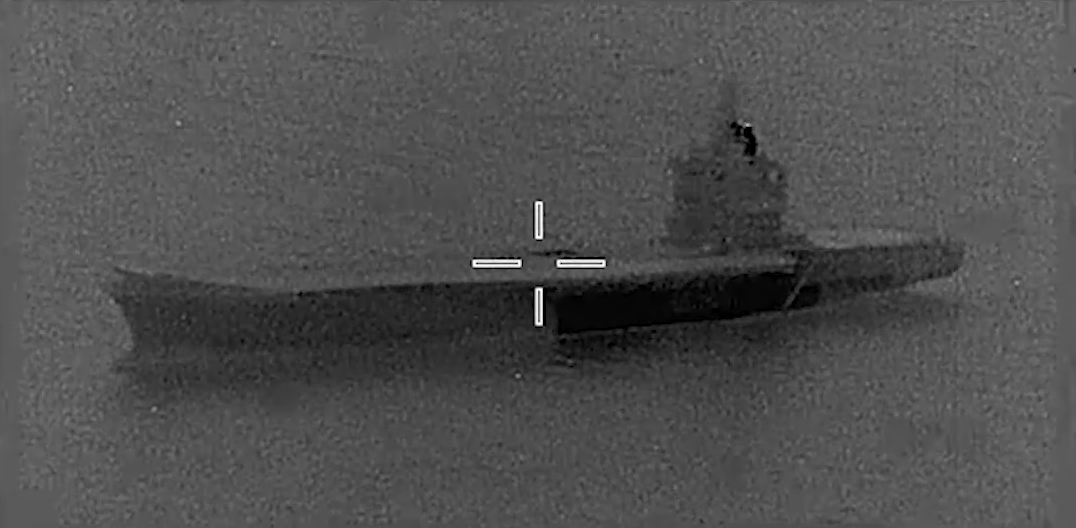
Cooper stated during a press conference at CENTCOM headquarters. “Today, an Iranian drone carrier, roughly the size of a WWII aircraft carrier, was struck and is now on fire.”
The strike comes on Day 6 of Operation Epic Fury, which began February 28 with a coordinated U.S.-Israeli campaign targeting Iran’s military infrastructure, nuclear-related sites, and naval forces. Israel’s parallel operation, designated Roaring Lion, has struck over 2,500 targets with more than 6,000 weapons.
In the last 72 hours alone, American bomber crews hit nearly 200 targets deep inside Iran, including positions around Tehran, with B-2 Spirit stealth bombers dropping dozens of 2,000-pound penetrator munitions on hardened ballistic missile launchers.
The naval campaign has widened. Cooper reported over 30 Iranian warships sunk or destroyed as of March 5, up from 20 confirmed on March 3 and the initial 9 announced by President Trump on March 1.
All 11 Iranian warships stationed east of the Strait of Hormuz were destroyed within the first 48 hours, according to CENTCOM. Iranian ballistic missile launches have fallen 86% from opening-day levels, and one-way attack drone launches have dropped 73%, according to Joint Chiefs Chairman Air Force General Dan Caine.
Casualties have increased on all sides. Six U.S. service members have been killed in action, all at the Shuaiba port facility in Kuwait during an Iranian drone strike. Iran’s semiofficial Tasnim news agency reported 1,230 killed as of March 5, up from the Iranian Red Crescent’s count of 787 on March 4.
Iranian retaliation under Operation True Promise IV has launched approximately 420 missiles across nine countries, killing civilians in Kuwait, the United Arab Emirates, and Bahrain, and striking U.S. military installations across the Gulf.
Operation Epic Fury is the largest direct U.S. military engagement with a state adversary since the 2003 invasion of Iraq. Six American service members are dead. Iran has fired missiles at U.S. forces across nine countries simultaneously.
The Strait of Hormuz remains contested, with Automatic Identification System (AIS) transit traffic down approximately 80%. Iran’s senior leadership was killed in the opening strikes, including Supreme Leader Ayatollah Ali Khamenei on February 28, and an interim council of three officials now holds authority with unclear command stability.
The 86% decline in Iranian ballistic missile launches reflects significant degradation of Tehran’s conventional strike capacity, but the country retains the ability to escalate through asymmetric channels: Strait mining, proxy activation through Hezbollah and the Houthis, and cyber operations.
The destruction of over 30 warships effectively removes Iran’s surface naval threat in the Persian Gulf, but subsurface assets (at least two Kilo-class diesel-electric submarines remain unaccounted for) and coastal anti-ship missile batteries remain operational.
CENTCOM’s stated goal of sinking the entire Iranian navy, combined with White House language about eliminating nuclear capability, leaves limited off-ramps for de-escalation. (High confidence: CENTCOM press releases, Department of War statements, IAEA monitoring data.)
Operational Snapshot: Day 6 (March 5)
Latest Strike: IRIS Shahid Bagheri drone carrier struck and on fire; CENTCOM released video confirmation.
Iranian Naval Losses: Over 30 warships sunk or destroyed (CENTCOM); all 11 warships east of Strait of Hormuz destroyed within first 48 hours.
Air Campaign: Nearly 200 targets struck deep inside Iran in the last 72 hours; over 2,000 targets total since February 28. B-2, B-52H, and B-1B bombers all committed.
Missile Degradation: Iranian ballistic missile launches down 86%; drone launches down 73% (Joint Chiefs).
U.S. Casualties: 6 killed in action at Shuaiba port, Kuwait; 5 seriously wounded; remains of 2 previously unaccounted service members recovered. 3 F-15E Strike Eagles lost to Kuwaiti air defenses (friendly fire); 6 crew recovered stable.
Iranian Casualties: 1,230 killed (Tasnim, March 5); Red Crescent reported 787 killed, 700+ injured as of March 4. Supreme Leader Khamenei, security adviser Shamkhani, IRGC chief Pakpour, Defense Minister Nasirzadeh killed.
Regional Casualties: Kuwait: 1 killed, 32 injured. UAE: 3 killed (foreign nationals), 78 wounded. Bahrain: 3 wounded. Lebanon (Israeli strikes): 31 killed, 149 wounded. Israel: at least 11 killed.
Iranian Retaliation: True Promise IV launched approximately 420 missiles across 9 countries in 6 waves.
U.S. Naval Assets: USS Abraham Lincoln carrier strike group (Arabian Sea); USS Gerald R. Ford carrier strike group (Eastern Mediterranean).
Evacuations: Approximately 9,000 Americans evacuated from 6 countries; 1,600 requesting assistance. Ordered departures from Bahrain and Kuwait; authorized departures from Saudi Arabia.
Force Protection: Force Protection Condition (FPCON) Bravo+ at regional installations; shelter-in-place at multiple embassies.
Nuclear/WMD: No radiological release detected (IAEA); no weapons of mass destruction (WMD) indicators despite strikes near nuclear sites.
IRIS Shahid Bagheri: Iran’s Drone Carrier Destroyed
The IRIS Shahid Bagheri (pennant number C110-4) was Iran’s first and only drone carrier. The IRGC Navy converted the South Korean-built container ship Perarin (IMO: 9209350) between 2022 and 2024, adding a 180-meter angled flight deck with a ski-jump ramp designed for launching unmanned aerial vehicles. Iran commissioned the ship on February 6, 2025, presenting it as a platform for long-range maritime drone operations.
The vessel’s specifications placed it in a category rarely seen outside major navies:
Displacement: 41,978 tons (comparable to a World War II Midway-class carrier)
Length: 240.79 meters
Beam: 32.2 meters
Armament: 8 cruise anti-ship missiles, 8 Kowsar-222 multipurpose missiles, 30mm autocannon, multiple 20mm Gatling-type close-in weapons systems
Aviation: Drone fueling station, flight control tower, medium-range air defense systems, capacity for helicopters and unmanned aerial vehicles
CENTCOM first struck the Shahid Bagheri during the opening hours of Operation Epic Fury on February 28. Cooper’s March 5 announcement confirmed that additional strikes left the vessel on fire. CENTCOM released video showing the ship on fire.
Independent verification of the vessel’s status has not been obtained outside of CENTCOM’s own footage as of March 4, and the precise location of the strike has not been officially disclosed, though reporting places the vessel in or near the Strait of Hormuz at the time of the attacks.
Assessment: The destruction of the Shahid Bagheri removes Iran’s sole platform for projecting unmanned aerial capability from the sea. While the vessel was a converted cargo ship rather than a purpose-built warship, and no confirmed operational drone launches from its deck had been documented, its loss removes Iran’s ability to conduct sustained maritime drone operations beyond the range of coastal launch sites.
The concept of converting a container ship into a drone carrier had drawn interest from military analysts globally as a cost-effective alternative to conventional carriers. Its destruction in its first year of service, before any known combat drone operations, denies both the IRGC a strategic asset and the global defense community data on the platform’s viability. CENTCOM’s decision to strike it during the opening hours of operations confirms it was assessed as a priority threat. (High confidence: CENTCOM video, IRGC commissioning records, open-source vessel specifications.)
Full Report & Analysis
The full report includes expert analysis and risk assessment.
Full Report & Analysis →