U.S. Submarine Sinks Iranian Frigate Off Sri Lanka with Single Torpedo; 101 Crew Missing
ALERT LEVEL: HIGH
INDIAN OCEAN - A U.S. Navy fast attack submarine sank the Iranian frigate IRIS Dena approximately 40 nautical miles south of Galle, Sri Lanka, on March 4, using a single Mark 48 (Mk-48) heavyweight torpedo, according to the Department of War.
The attack killed or left missing the majority of the roughly 180 crew members aboard the Moudge-class frigate, which had been transiting international waters returning to Iran after participating in a multinational naval exercise in India.
Secretary of War Pete Hegseth confirmed the sinking during a Pentagon briefing, calling it “Quiet Death” and describing it as the first torpedo sinking of an enemy ship since World War II. Chairman of the Joint Chiefs General Dan Caine was more precise, specifying the weapon as “a single Mk-48 torpedo to achieve immediate effect” and framing it as the first U.S. submarine torpedo kill since 1945.
The last time any nation’s submarine torpedoed and sank a warship was the British sinking of the Argentine cruiser ARA General Belgrano during the Falklands War in 1982, 44 years ago.
Sri Lankan authorities reported receiving a distress call at approximately 6:00 AM local time. The Sri Lankan Navy dispatched two vessels and one aircraft, rescuing 32 survivors who were transported to Karapitiya Teaching Hospital in Galle. Sri Lankan Foreign Minister Vijitha Herath confirmed 180 crew were aboard. As of the latest reporting, 101 remain missing.
The Torpedo Attack
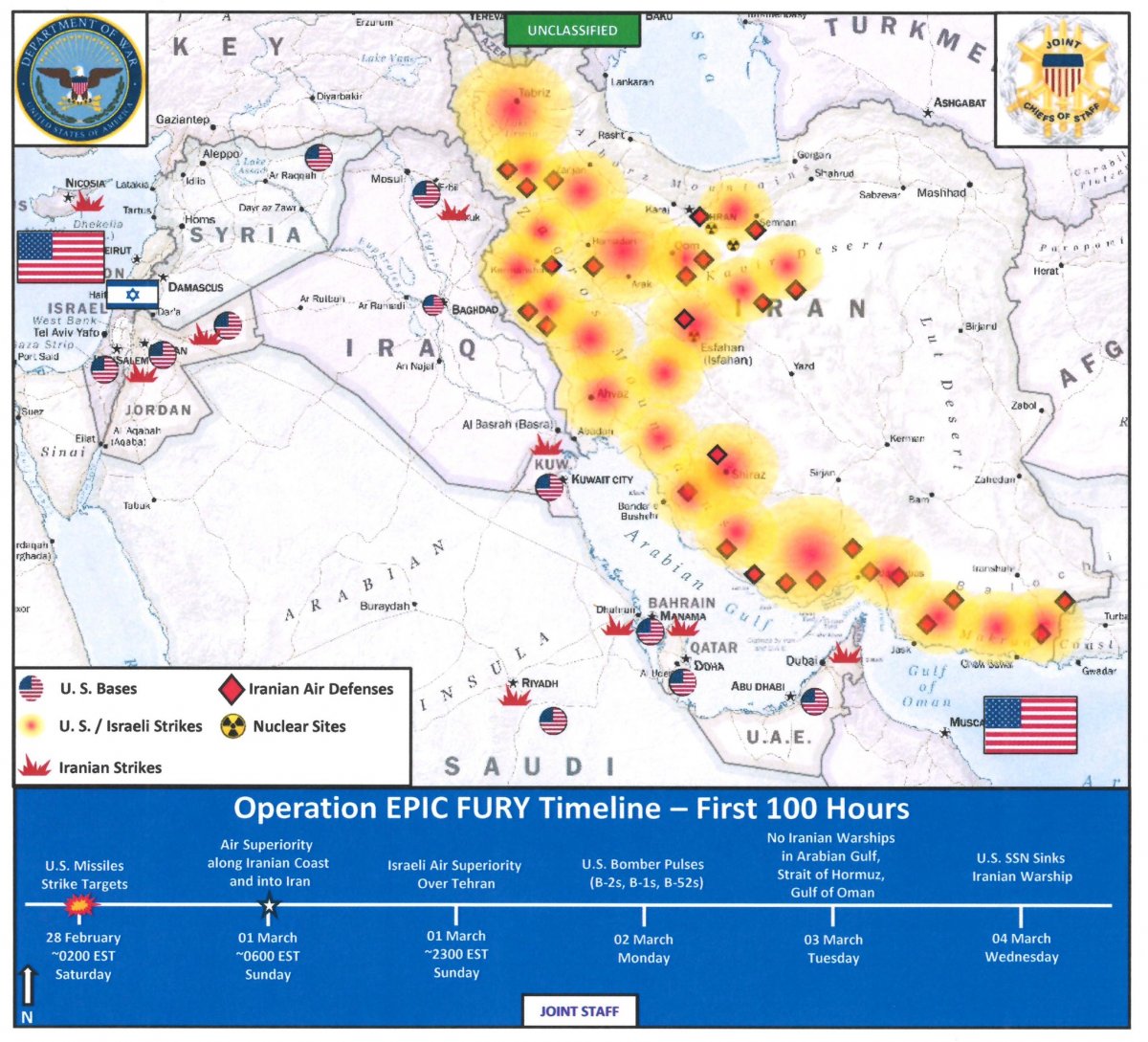
The IRIS Dena was transiting the Indian Ocean in international waters, approximately 2,500 kilometers from the nearest Operation Epic Fury strike area around the Strait of Hormuz, when the torpedo struck.
The Department of War did not identify the submarine’s class, stating only that it was a “fast attack submarine.” The U.S. Navy operates three classes of fast attack submarine: the Virginia-class (SSN-774), Los Angeles-class (SSN-688), and Seawolf-class (SSN-21). The specific boat’s identity was withheld for operational security, as is standard practice.
General Caine described the attack as a demonstration of “America’s global reach,” stating: “To hunt, find and kill an out-of-area deployer is something that only the United States can do at this type of scale.”
The IRIS Dena was not operating in the active combat zone. It was returning from India, apparently under the assumption that international waters far from the Persian Gulf offered safety.
Hegseth framed the kill in historical terms: “In the Indian Ocean, an American submarine sunk an Iranian warship, that thought it was safe in international waters. Instead, it was sunk by a torpedo. Quiet Death.” He added: “Like in that war, back when we were still the War Department, we are fighting to win.”
Assessment: The attack demonstrates U.S. submarine capability to interdict Iranian naval assets well beyond the immediate theater of operations. The IRIS Dena was a lawful military target under international humanitarian law regardless of its distance from the primary combat zone, but its destruction 2,500 kilometers from any active engagement area sends a pointed message: no Iranian warship is safe at any range.
The use of a single Mk-48, the U.S. Navy’s standard heavyweight torpedo designed to break a ship’s keel and cause rapid sinking, was sufficient against a 1,500-ton frigate. The decision to publicly reveal the submarine’s role, rather than allowing ambiguity about the cause of sinking, was a deliberate choice; submarine operations are ordinarily classified precisely because their value lies in uncertainty about where they are. Revealing this trades that uncertainty for deterrent messaging. (Moderate confidence: Department of War briefing, Sri Lankan government statements.)
IRIS Dena: Target Profile
The IRIS Dena (hull number 75) was a Moudge-class frigate, one of Iran’s most modern domestically built surface combatants. Commissioned in June 2021, the 94-meter, approximately 1,500-ton warship was assigned to the Iranian Navy’s Southern Fleet at Bandar Abbas.
Its weapons suite included a 76mm naval gun, Noor-series anti-ship cruise missile launchers, Sayad-2 surface-to-air missiles, two triple 324mm torpedo tubes, and a helicopter landing deck. The Moudge class is derived from the older Alvand-class design and represents the top tier of Iran’s domestically produced naval capability.
The Dena had recently participated in Exercise MILAN 2026 and the International Fleet Review at Visakhapatnam, India, a multinational event involving 86 ships from 74 nations. Iran routinely deployed frigates on long-range Indian Ocean cruises and to international exercises as a show of naval reach and diplomatic engagement. The ship was returning to Iran when the attack occurred.
Assessment: The Dena’s presence at an Indian-hosted naval exercise days before its destruction adds a diplomatic complication for New Delhi, which has maintained a careful balance between its defense relationship with the United States and long-standing ties to Tehran.
Three of four operational Moudge-class frigates have now been confirmed destroyed during Operation Epic Fury: IRIS Jamaran at Konarak Naval Base, IRIS Sahand at Bandar Abbas, and now IRIS Dena off Sri Lanka. The sole surviving ship of the class, IRIS Deilaman, is stationed in the Caspian Sea, where it is geographically isolated from the conflict.
Iran’s most capable domestically built frigate line has been functionally eliminated in under one week. (Moderate confidence: Department of War statements, Indian Navy exercise records, open-source vessel tracking.)
Crew Casualties and Rescue Operations
Sri Lankan Foreign Minister Vijitha Herath confirmed that approximately 180 crew members were aboard the IRIS Dena when the torpedo struck. The Sri Lankan Navy received a distress signal at approximately 6:00 AM local time and dispatched two naval vessels and one maritime patrol aircraft to the area, approximately 40 nautical miles south of Galle.
Rescue teams recovered 32 survivors, who were transported to Karapitiya Teaching Hospital in Galle for medical treatment. At least one rescued sailor subsequently died from injuries. As of the most recent reporting, 101 crew members remain missing. Sri Lanka, which is not a party to the conflict, conducted the rescue under its obligations as the nearest coastal state.
Assessment: The ratio of missing to rescued crew (101 of 180) is consistent with the effects of a heavyweight torpedo strike on a frigate. The Mk-48 is designed to detonate beneath a ship’s keel, creating a gas bubble that breaks the hull’s structural spine and causes rapid flooding from below.
Survival rates in such attacks are historically low: when HMS Conqueror torpedoed the ARA General Belgrano in 1982, 323 of 1,093 crew were killed despite the cruiser being four times the Dena’s displacement.
A 1,500-ton frigate would have far less compartmentalization and damage control margin. Whether Iranian or other rescue assets are en route to the area has not been reported; the distance from Iranian ports (over 3,000 kilometers) limits Tehran’s ability to conduct its own search-and-rescue operations. (Moderate confidence: Sri Lankan government statements, naval weapons analysis, historical torpedo attack data.)
Broader Naval Campaign: DoW Says 20+ Iranian Vessels Destroyed
The Dena sinking is part of a broader campaign against Iran’s navy. General Caine stated during the same briefing that U.S. forces have “destroyed more than 20 Iranian naval vessels, one submarine, and effectively neutralized Iran’s major naval presence in theater.”
This updated a March 1 count from President Trump of nine ships and a March 3 figure from U.S. Central Command (CENTCOM) Commander Admiral Brad Cooper of 17 vessels.
Confirmed losses include multiple frigates at Konarak Naval Base and Bandar Abbas, the Islamic Revolutionary Guard Corps Navy (IRGCN, the paramilitary naval force separate from Iran’s regular navy) drone carrier IRIS Shahid Bagheri, the forward base ship IRIS Makran, and Bayandor-class corvettes (small warships).
At least one Fateh-class coastal submarine was reported damaged and likely mission-killed. Hegseth separately announced the destruction of the IRIS Shahid Soleimani, a catamaran missile corvette commissioned in September 2022 as the lead ship of the IRGCN’s newest class, which he called Iran’s “prize ship.”
Hegseth stated: “The Iranian Navy rests at the bottom of the Persian Gulf. Combat ineffective, decimated, destroyed, defeated. Pick your adjective.” He added: “In fact, last night we sunk their prize ship, the Soleimani. Looks like POTUS got him twice. Their navy, not a factor. It is no more.”
Assessment: If 20+ vessels are confirmed destroyed, Iran has lost the majority of its major surface combatant fleet in under one week. Pre-conflict, Iran operated approximately five to six frigates, two to three corvettes, and a number of missile boats across both its regular navy and the IRGCN.
The loss of the Shahid Soleimani is notable for the IRGCN specifically: it represented Iran’s most modern naval design, with stealth features, a catamaran hull, and vertical launch cells for cruise missiles. The Pentagon has not published a ship-by-ship damage assessment, and independent verification through satellite imagery has confirmed some but not all claimed sinkings.
The combination of port strikes destroying ships at berth (Bandar Abbas, Konarak) and submarine kills at sea leaves Iran with no safe posture for remaining naval assets: ships in port are vulnerable to airstrikes, and ships at sea are vulnerable to submarines.
Full Report & Analysis
The full report includes expert analysis and risk assessment.
Full Report & Analysis →