Iran Strikes US Fifth Fleet in Bahrain as Retaliation Spreads to Five Gulf Nations
MIDDLE EAST - On February 28, the United States and Israel conducted joint airstrikes on Iranian targets, killing Supreme Leader Ayatollah Seyyed Ali Khamenei. The Embassy of the Islamic Republic of Iran in Pakistan confirmed his death.
Iranian state media also acknowledged the death, declaring 40 days of national mourning and seven public holidays. The strikes targeted nuclear facilities, military sites, and leadership compounds, with US officials framing the operation as dismantling Iran’s nuclear program.
Iran retaliated with Operation True Promise 4, launching missiles and drones at US military bases in Bahrain, Qatar, the UAE, Kuwait, and Jordan, as well as Israeli targets.
Explosions occurred in Dubai, Doha, and Tel Aviv, with Iranian forces claiming destruction of key infrastructure and heavy casualties. The attacks disrupted oil shipments and air traffic, injuring civilians in Israel and escalating tensions.
Protests erupted in Tehran and other cities, with celebrations reported in cities including Karaj, reflecting divisions within the population as anti-government protests that began in late December 2025 continued.
The escalation follows heightened conflicts, including Houthi attacks on shipping and Iran’s uranium enrichment activities. US intelligence assessed no active nuclear weapon development, but President Donald Trump cited threats to American interests.
Regional leaders condemned the strikes, while Israeli Prime Minister
Benjamin Netanyahu issued a direct appeal in Persian to Iranian citizens
- addressing Persians, Kurds, Azeris, Ahwazis, and Baluchis by name -
to take to the streets and overthrow the regime.
Key Developments in the Strikes and Retaliation
US and Israeli forces executed over 1,400 strikes across Iran, hitting command centers, air defenses, and nuclear sites such as the Fordow Fuel Enrichment Plant.
Bunker-busting munitions caused severe damage to Iran’s nuclear infrastructure. Satellite photos show Khamenei’s Tehran compound heavily damaged with at least 6 buildings collapsed.
CENTCOM reported no US casualties, with intercepts mitigating Iranian counterattacks. “The President ordered bold action, and our brave Soldiers, Sailors, Airmen, Marines, Guardians, and Coast Guardsmen are answering the call,” stated Adm. Brad Cooper, CENTCOM Commander. Reports indicate Ali Shamkhani, secretary of Iran’s Supreme National Security Council, was also killed in the strikes.
The IRGC reported hits on a US naval base in Kuwait’s Abdallah Mubarak area, destroying infrastructure and inflicting casualties. Attacks also targeted an MSP ship carrying ammunition in the Indian Ocean and an MST-class support ship with fuel. The IRGC pledged continued operations against opposing forces.
Red Crescent reported 201 killed and 747 injured in Iran from the airstrikes. A strike on Shajareh Tayyiba girls’ school in Minab killed 85-118 students according to Iranian judiciary and local officials. Impacts extended to Gulf states, with reports of strikes in populated areas.
In Israel, one woman died and 121 were injured from Iranian missiles, according to Israel’s national emergency medical, disaster, ambulance and blood bank service Magen David Adom.
Iran’s IRGC Aerospace Force claimed it shot down a US MQ-9 Reaper drone in southern Iran using integrated air defense systems, according to Tasnim News Agency.
Defence Blog analysis of photographs released by Iranian state media found the wreckage consistent with a Shahed-136 loitering munition rather than an MQ-9 Reaper. CENTCOM has not confirmed the loss of a drone.
Assessment: The airstrikes mark a direct assault on Iran’s leadership, potentially accelerating internal instability but risking broader warfare. Iran’s retained missile capabilities indicate partial resilience, though degraded defenses expose vulnerabilities. The focus on nuclear sites aligns with US objectives, but dispersed stockpiles may sustain threats.
Iranian Missile Counterattacks and Regional Fallout
Iran initiated Operation True Promise 4, targeting 27 US bases and Israeli facilities with ballistic missiles and drones. Strikes hit the US Fifth Fleet in Bahrain and sites in Qatar and the UAE. Iranian media claimed destruction of key assets and significant American losses.
Attacks affected host nations, with explosions in Dubai and Doha disrupting operations. Missiles reached Tel Aviv, activating air raid systems across Israel. The IRGC characterized these as retaliation for Khamenei’s death and ongoing aggression.
An Iranian drone struck Era Views Tower in Bahrain. Three residential buildings in Manama were damaged by drone strikes and intercepted missile debris. The Breaker residential tower caught fire Saturday evening.
A Sunday morning attack struck the Crowne Plaza Hotel. Bahrain International Airport was damaged Sunday morning and airspace was closed. The Bahrain Defence Force reported intercepting 45 missiles and 9 drones, including Shahed-136 type drones.
Approximately 8,300 US sailors are stationed in Bahrain; military personnel were ordered to evacuate high-rise apartments and schools were canceled for the remainder of the week. One person was killed in Abu Dhabi from intercepted Iranian missile debris.
In Kuwait, a drone struck Kuwait International Airport, causing minor injuries to employees and material damage to the passenger building. Qatar’s Defense Ministry stated it thwarted all incoming attacks per a pre-approved security plan.
In the UAE, intercepted missile debris caused fires at Abu Dhabi’s main port and struck the facade of the Burj Al Arab hotel in Dubai. Dubai International and Zayed International airports sustained minor damage.
Specific bases hit include Al-Dhafra in UAE and Ali al-Salem in Kuwait, where missiles were intercepted. US embassies issued alerts for citizens in Jordan and Pakistan, restricting movements. Texas activated Operation Fury Shield to safeguard infrastructure from potential reprisals.
The IRGC broadcast VHF Channel 16 warnings to commercial ships claiming the Strait of Hormuz is closed. The UK Maritime Trade Operations (UKMTO) issued an advisory stating the broadcasts are not legally binding and do not constitute lawful restriction on navigation under international law.
The US Maritime Administration (MARAD) separately issued advisory 2026-001 for vessels transiting the strait.
Yemen’s Ansar Allah (Houthis) officially resumed missile and drone attacks on US and Israeli-flagged ships in the Red Sea, with leader Abdul Malik al-Houthi declaring solidarity with Iran.
Hezbollah condemned the strikes as a ‘blatant violation of international law’ but stopped short of pledging military retaliation, likely reflecting degraded capabilities from the 2024-2025 Israel-Lebanon conflict.
Assessment: Iran’s widespread retaliation shifts the conflict regionally, targeting US assets in allied territories. Disruptions to shipping and aviation could spike energy prices globally. Vulnerability of Gulf hosts may strain alliances, pressuring them to reconsider US basing.
Iran’s Internet Connection Outage
Iran’s internet connectivity dropped to approximately 1% of normal levels following the strikes, per NetBlocks monitoring. The blackout extends a pre-existing internet shutdown in effect since January 8 that Iran’s government imposed during protest crackdowns.
Officials have stated international access will not be restored until at least late March. The shutdown costs Iran an estimated $35.7 million per day, according to Iran’s Minister of Communications.
Official Statements
Embassy of Islamic Republic of Iran-Islamabad, March 1, 2026: “The Embassy of the Islamic Republic of Iran in Pakistan categorically condemns, in the strongest possible terms, the cowardly, hideous and barbaric terrorist act of targeting the leadership of the Islamic Republic of Iran. Recalling the bravery, resistance, steadfastness, and lifelong devotion of the Supreme Leader, Ayatollah Seyyed Ali Khamenei, to the ideals of independence, dignity, and resistance, we reaffirm our unwavering solidarity with the noble aspirations of the Islamic Revolution and our firm commitment to its enduring principles and emphasize that we will stand by the eternal aspirations of this Great Martyr until our last breath and the last droplet of our blood. Ayatollah Seyyed Ali Khamenei was a great historical figure who, like his Great Ancestor, Imam Hussein (PBUH), was martyred bravely alongside his innocent family at the hands of the most despicable, vicious and coward elements in Karbala and did not surrender and succumb. The blood of the Great Leader of the Islamic Republic of Iran, Ayatollah Seyyed Ali Khamenei, made the ever-green sapling of the Islamic Republic more fertile and resilient. The struggles of this Great Martyr and tireless scholar will forever be recorded in history and will be a model for the free people of the world. It emphasizes that the Islamic Republic of Iran is founded upon strong constitutional institutions and well-established legal mechanisms. Relying on the solid structure established by the great Imams of the Islamic Revolution, relying on the blood of martyrs, in any circumstance, the country will, in full accordance with its Constitution, ensure continuity of leadership and governance with unity, resilience, and steadfast determination and the Islamic Republic of Iran will elect its new leadership and courageously and steadfastly continue on its spiritual and humane path ever after.”
Adm. Brad Cooper, CENTCOM Commander, February 28, 2026: “The President ordered bold action, and our brave Soldiers, Sailors, Airmen, Marines, Guardians, and Coast Guardsmen are answering the call.”
President Donald J. Trump, March 1, 2026: “Iran just stated that they are going to hit very hard today, harder than they have ever hit before. THEY BETTER NOT DO THAT, HOWEVER, BECAUSE IF THEY DO, WE WILL HIT THEM WITH A FORCE THAT HAS NEVER BEEN SEEN BEFORE! Thank you for your attention to this matter! President DONALD J. TRUMP”
Ambassador Waltz, US Mission to UN Security Council, March 1, 2026: “Those who stand with us must know that their security is not negotiable. The safety of our allies is not conditional. It is assured. The bottom line is this: Our allies and partners can count on the United States, and count on President Trump.”
Texas Military Department, March 1, 2026: “AUSTIN, Texas - At the direction of Governor Greg Abbott, the Texas Military Department (TMD) is activating Service Members for Operation Fury Shield - working alongside our state partners to protect our citizens and critical infrastructure from any potential threat of retaliation. TMD will increase patrols at key locations like energy facilities, ports, and the southern border and enhance cybersecurity capabilities. Our steadfast commitment is to serve and protect the people of our great state. For more information, contact the Texas Military Department Public Affairs Office at media@tmd.texas.gov or 512-782-5620”
US Embassy Amman, March 1, 2026: “SECURITY ALERT: U.S. EMBASSY JORDAN (MARCH 1, 2026) Location: Jordan, countrywide Event: Reports indicate missiles, drones, or rockets are in Jordanian airspace. Seek overhead cover and shelter in place immediately. Remain indoors and pay attention to local announcements and alerts. The U.S. Embassy in Jordan will continue to review the situation and provide additional information as needed.”
IRGC Announcement No. 4, March 1, 2026: “In the fifth wave of Operation True Promise4 in the Indian Ocean, the MSP ship, which was carrying ammunition for American vessels, was hit by four drones at the Jebel Ali anchorage and was completely disabled with damage and explosions. The American naval base in the Abdulla Mubarak area of Kuwait was hit by 4 ballistic missiles and 12 drones, and all the infrastructure was destroyed, and a large number of American forces were killed and injured. Also, the MST-class combat support ship, which was carrying fuel for American vessels in the Indian Ocean, was hit by Iranian Qadr 380 missiles. The IRGC Navy, along with the air force, will keep the gates of hell open to enemy units.”
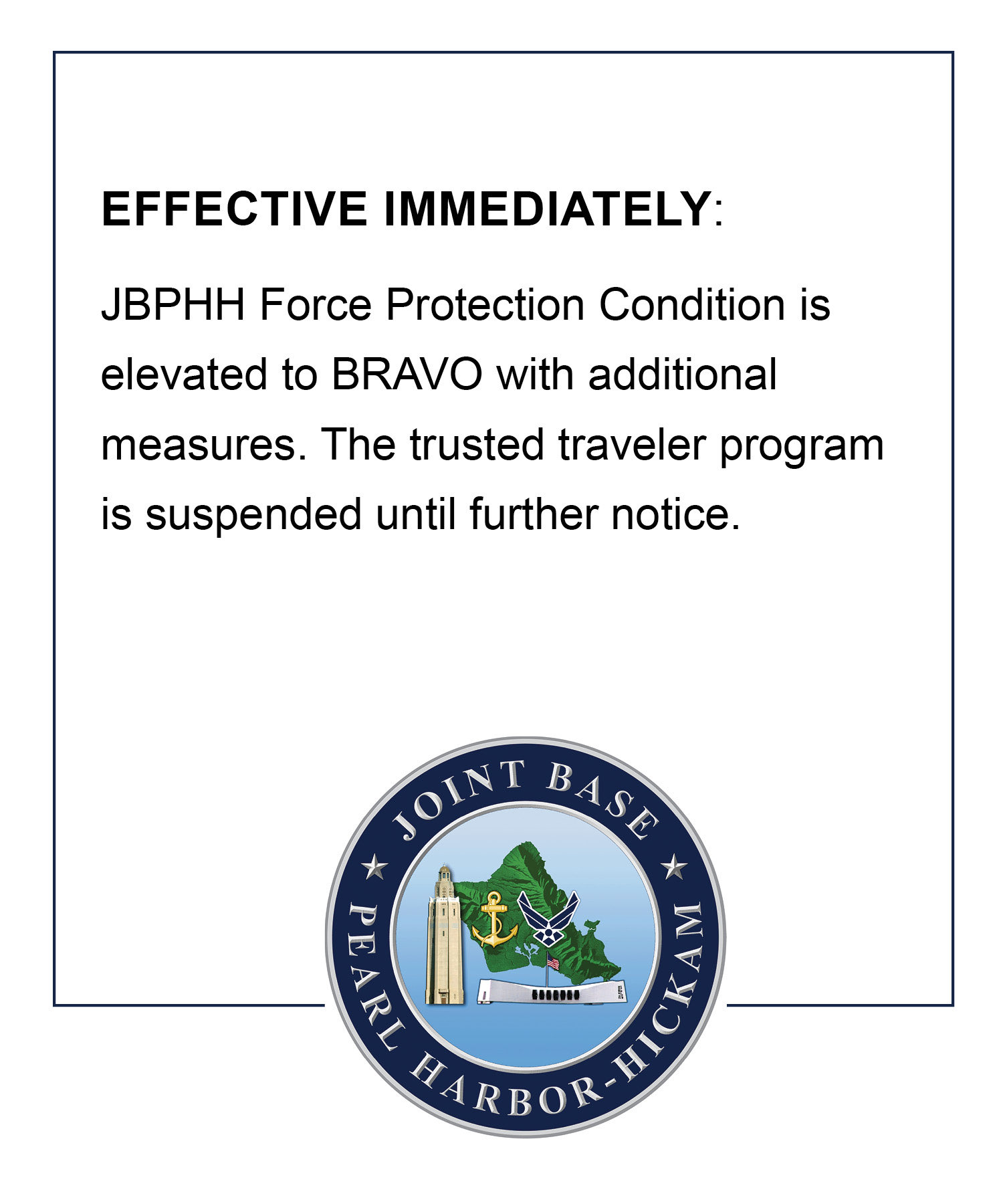
Joint Base Pearl Harbor-Hickam, March 1, 2026: “EFFECTIVE IMMEDIATELY: JBPHH Force Protection Condition is elevated to BRAVO with additional measures. The trusted traveler program is suspended until further notice.”
Israeli Prime Minister Benjamin Netanyahu, February 28, 2026 (evening address, translated from Persian): “In the coming days, we will strike thousands of targets of the terrorist regime. We will create the conditions for the brave people of Iran to free themselves from the chains of tyranny. O citizens of Iran, do not let this opportunity slip away. This is an opportunity that comes only once in every generation. Do not sit idle, because your moment will arrive soon. The moment when you must take to the streets, come to the streets in your millions to finish the job, to overthrow the regime of terror that has embittered your lives. Your suffering and sacrifices will not be in vain. The help you have longed for has now arrived. O citizens of Iran, Persians, Kurds, Azeris, Ahwazis, and Baluchis - Now is the time to unite your forces to overthrow the regime and secure your future.”
Iranian President Masoud Pezeshkian, March 1, 2026: “In his first statement since Khamenei’s death, Pezeshkian declared the strikes a “declaration of open war on Muslims” and stated Tehran views revenge as its “legitimate right and duty,” pledging to do its “utmost to fulfill this duty.” He affirmed “firm determination and unwavering will to continue the path of this great man” and called for “unity and solidarity among officials and the noble people of Iran.”“
IRGC Statement via IRNA, March 1, 2026: “The IRGC vowed to “avenge the blood of the martyrs” killed in the US-Israeli attacks and pledged “the most ferocious offensive operation in the history of the Islamic Republic’s armed forces” against “occupied territories and American terrorist bases."
Full Report & Analysis
The full report includes expert analysis and risk assessment.
Full Report & Analysis →