U.S. Declassifies Seismic Evidence Confirming Lop Nur Nuclear Explosion In 2020
Credit: Nuclear photo shown on social media for illustration purposes only
GLOBAL - U.S. officials have publicly detailed intelligence assessing a
seismic event near China’s Lop Nur nuclear test site on June 22, 2020,
as a low-yield nuclear explosion.
The assessment relies on waveform data from Primary Seismic Station 23
(PS-23) at Makanchi, Kazakhstan, part of the International Monitoring
System, a global network of sensors designed to detect nuclear tests.
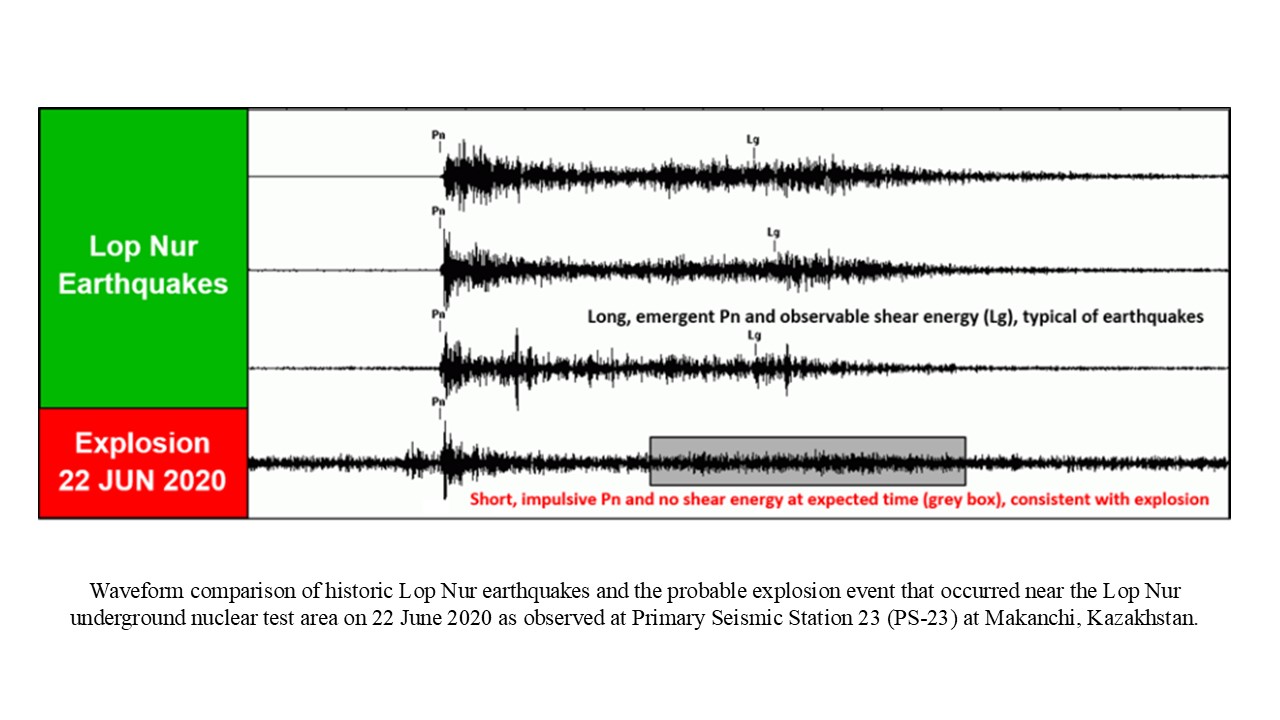
A magnitude 2.75 event was recorded at 09:18 Greenwich Mean Time. Seismic signals showed a short, sharp pressure wave (Pn) - the kind produced by a sudden energy release like an explosion - and no side-to-side shaking energy (Lg) that natural earthquakes normally produce at the expected time.
Historical Lop Nur earthquakes exhibit long, emergent Pn waves and clear Lg shear phases. The 2020 event’s waveform matched explosion signatures in official U.S. comparisons.
U.S. analysts estimate a yield of approximately 10 tons nuclear (or 5 tons conventional equivalent), assuming the blast was fully contained in solid rock - meaning all energy transferred into the ground rather than being absorbed by softer material.
If the test was conducted in a way that dampened the seismic signal (decoupling), the actual yield would be higher than the estimate.
The provided analysis compares the 2020 event with historical Lop Nur earthquakes observed at the same station. Earthquakes display extended, emergent Pn phases followed by distinct Lg shear energy.
The 2020 signal shows a sharp pressure-wave (Pn) onset with absent shaking energy (Lg) - a hallmark of contained underground explosions. This distinction underpins the U.S. explosion classification. Yeaw noted the signals were “indicative of a single fire explosion, not typical of mining explosions.”
Assessment: The waveform data provides strong technical evidence distinguishing the event as an explosion rather than a natural earthquake, consistent with historical Lop Nur test signatures. This level of discrimination using distant IMS stations demonstrates improved U.S. monitoring capabilities for low-yield events. In practical terms, this means even very small underground tests can now be detected from monitoring stations thousands of miles away, limiting the ability of any state to test in secret.
U.S. Assessment of Chinese Nuclear Activities
Yeaw’s statement frames the 2020 event within broader concerns about China’s nuclear posture. Despite Beijing’s claims of a no-first-use policy and moratorium adherence, the U.S. assesses deliberate, unconstrained expansion without transparency or declared endpoint.
At New START’s signing, China held around 200 warheads. Current trajectories project fissile material sufficient for over 1,000 warheads by 2030. Yeaw stated the U.S. believes China “may achieve parity within the next four or five years.”
The Lop Nur site has shown sustained activity, including excavations and year-round operations, raising questions about low-yield testing below international monitoring thresholds. The U.S. views this as part of modernization for new designs, supported by Russian assistance in fissile material production via CFR-600 reactors.
Assessment: The confirmed 2020 test, combined with production trends, indicates China is pursuing a more robust and diversified arsenal beyond minimum deterrence. This expansion occurs without reciprocal transparency, complicating multilateral arms control efforts. Observers should monitor further site activity and fissile output as leading indicators of additional testing or warhead fielding timelines.
Official Statements
- Dr. Christopher Yeaw, Assistant Secretary of State for the Bureau of Arms Control and Nonproliferation, February 23, 2026: “As I indicated last week at the Hudson Institute, a probable explosion was detected near the Lop Nur underground nuclear test area as a magnitude 2.75 seismic event at 09:18 Greenwich Mean Time… It was a probable explosion based upon comparisons between historic explosions and earthquakes. The seismic signals were indicative of a single fire explosion, not typical of mining explosions. The estimated yield of the event was a 10 tons nuclear explosion - or 5 tons conventional equivalent… Under Secretary DiNanno also shared that we know China has conducted nuclear explosive tests and that we know this test on June 22, 2020, was one such yield-producing nuclear test.”
- Mao Ning, Spokesperson, Chinese Foreign Ministry, February 25, 2026: “The U.S. accusation is unsubstantiated and entirely groundless. China has reiterated on multiple occasions that it all along firmly supports the purposes and objectives of the Comprehensive Nuclear-Test-Ban Treaty and honors the moratorium on nuclear testing - a commitment made by the five nuclear-weapons states. Shirking arms control obligations by vilification harms the U.S.’s own reputation. China urges the U.S. to abide by the moratorium on nuclear testing, uphold the global consensus on nuclear test ban, and stop finding false justification for resuming nuclear testing.”
Full Report & Analysis
The full report includes expert analysis and risk assessment.
Full Report & Analysis →