West Bank: U.S. Embassy Jerusalem Reports Checkpoint Closures Through October 3
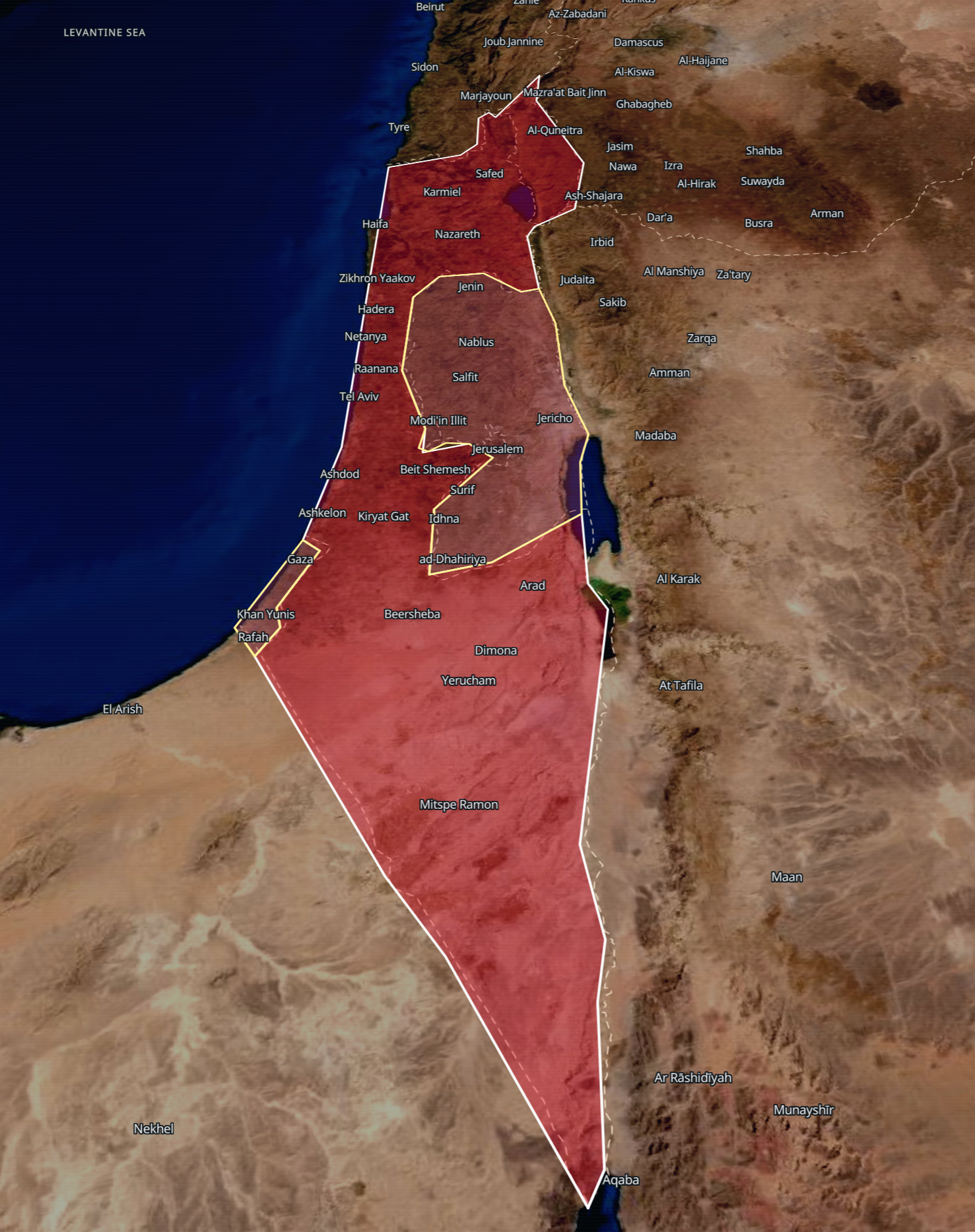
Credit: Map credits: Open Street Map, Modified Copernicus Sentinel data.
WEST BANK — On September 27, U.S. Embassy Jerusalem said checkpoints across the entire West Bank region will be closed from September 27 to October 3, and that there is no regular entry into Israel except for strictly medical and humanitarian reasons.
The embassy said Jerusalem ID holders can still commute and travel freely. It said Arbel permit holders cannot cross checkpoints even by shuttle.
It said exceptions can be considered only for medical and humanitarian reasons. It said more information will be shared if there are any significant changes to that policy.
The U.S. Department of State country advisory for Israel, the West Bank, and Gaza, reissued August 26 with no change to the advisory level, remains Level 3: Reconsider Travel for Israel and for the West Bank, and Level 4: Do Not Travel for Gaza.
The UK Foreign, Commonwealth and Development Office (FCDO) page for Israel and the Occupied Palestinian Territories was still current at September 27 and advises against all travel to Gaza and to named West Bank governorates, and against all but essential travel to most of the remaining West Bank.
Australia’s Department of Foreign Affairs and Trade (DFAT) advises reconsider your need to travel to Israel overall and do not travel to Palestine. Global Affairs Canada, last updated September 24, advises avoid non-essential travel to Israel and avoid all travel to Palestine.
-
U.S. Department of State: Israel, Level 3: Reconsider Travel, due to terrorism and unrest, reissued August 26 with no change to the advisory level. West Bank, Level 3: Reconsider Travel, due to terrorism and unrest, same reissue date. Gaza, Level 4: Do Not Travel, due to terrorism, unrest, and limited health infrastructure. Additional Level 4: Do Not Travel zones inside Israel include areas north of Route 85 to Route 90 (south) to Route 87 due to armed conflict, within 7 miles (11.3 kilometers) of the Gaza Strip due to armed conflict, and within 1.5 miles (2.4 kilometers) of the Israel-Egypt border except at the Taba crossing, also known as the Menachem Begin crossing, due to armed conflict.
-
UK FCDO: Advises against all travel to Gaza and within 500 meters of the Gaza border. Advises against all travel to Tulkarm Governorate, Jenin Governorate, and Tubas Governorate except Route 90. Advises against all but essential travel to the rest of the West Bank except East Jerusalem, Bethlehem Governorate, Ramallah Municipality, Jericho Municipality and areas south of it including the Allenby crossing, Highway 1 between Jerusalem and Tel Aviv and areas south and west of it, and Route 443 and Highway 45. Advises against all travel to named northern Israel and occupied Golan Heights zones. Page still current at September 27. Updated July 22 with information on regional tensions, including strikes and retaliatory attacks by Iran.
-
Australia DFAT: Israel overall, Reconsider your need to travel, updated September 2 and still current at September 28 on the DFAT clock. DFAT also advises do not travel to border areas with Gaza, Lebanon, and Syria. Palestine overall, Do not travel, updated September 14 and still current at September 28, covering Gaza and the West Bank excluding Jerusalem.
-
Global Affairs Canada: Israel, Avoid non-essential travel, last updated September 24. Palestine, Avoid all travel, same update date. Jerusalem, Avoid non-essential travel. Avoid all travel to parts of the Golan Heights east of Highway 98, within 3.1 miles (5 kilometers) of the Lebanon border, and within 6.2 miles (10 kilometers) of the Gaza Strip border.
-
Change History: The U.S. country advisory was reissued August 26 with no change to the Travel Advisory Level. The August 26 text added a health risk indicator for Gaza and updated the advisory summary to state that family members may travel to Israel. The September 27 Embassy Jerusalem product is a local security alert on checkpoint policy, not a change to the Level 3 / Level 4 country ratings. FCDO last substantive update recorded on the page is July 22. DFAT last recorded updates are September 2 for Israel and September 14 for Palestine. Canada last updated September 24.
-
Regional Variations: All four governments rate Gaza above the Israel country figure. The United States and the United Kingdom also break Israel and the West Bank into named higher-risk corridors and governorates. DFAT and Canada use country-level headings plus border-band exclusions. See Regional Breakdown for the zone list.
Security Assessment
The September 27 Embassy Jerusalem alert is a movement-control notice, not a new terrorism incident log. The embassy said checkpoints will be closed across the entire West Bank region through October 3 and that regular entry into Israel is limited to medical and humanitarian cases.
The August 26 U.S. advisory states that during the last year there has been an increase in terrorist attacks in the West Bank, that there has been an increase in violence and Israeli military operations in the West Bank, and that some incidents have resulted in injury or the death of U.S. citizens.
It states that during periods of unrest the Israeli government may restrict access to and within the West Bank. U.S. government employees working in Israel must obtain special authorization for official travel to the West Bank.
Personal travel by those employees and family members is restricted except on Routes 1, 90 to the Allenby Bridge crossing, and 443 at any time, and to Jericho and Bethlehem, including Beit Jala and Beit Sahour, from dawn to midnight, with Checkpoint 300 near Rachel’s Tomb as the only permitted route into Bethlehem for that group.
FCDO states that there has been a heightened state of tension and violent clashes resulting in deaths in the West Bank since the outbreak of conflict in October 2023, that travelers should expect road closures and numerous checkpoints, and that there are no warning sirens or official air raid shelters inside the West Bank outside Israeli settlements.
FCDO states that a traveler cannot travel into or out of the West Bank without passing through at least one Israeli military checkpoint.
Canada, updated September 24, states that tensions and violence remain high in the West Bank and that violent clashes between extremist Israeli settlers and Palestinians occur frequently in several areas. It states that there is a threat of terrorism in Israel and in Palestine.
Embassy Jerusalem’s September 27 actions list tells readers to learn the location of the nearest bomb shelter or other hardened shelter and to download the Home Front Command Red Alert application or similar apps available on devices within Israel for rocket and missile attacks and armed unmanned aerial vehicle (UAV) intrusions.
The same list tells readers to avoid all demonstrations and large gatherings and to avoid areas with a heavy police presence.
On September 26, the official spokesperson of the Yemeni Armed Forces, Staff Colonel Majed Abdullah Al-Nuzaily, said Ansar Allah, which the statement called the Houthi militia, is employing Iranian air-defense weapons converted into loitering missiles launched from Hodeidah Governorate toward international air routes over the southern Red Sea.
The statement said the missiles can loiter for up to 25 minutes, use a heat-seeking guidance system, and can engage any heat source without distinguishing military from civilian targets.
The statement asked the International Civil Aviation Organization (ICAO) and the International Air Transport Association (IATA) to act. No ICAO or IATA public response to that September 26 statement was on those organizations’ public pages in the material reviewed for this report.
On September 27, the Islamic Revolutionary Guard Corps (IRGC) Navy, carried by Islamic Republic News Agency (IRNA) (state-run media), said it had seized a U.S. Remus 600 unmanned underwater vehicle in the Strait of Hormuz and that the strait is closed.
No matching public release was on the U.S. Central Command public-releases list at the time of this report. The capture claim and the U.S. control claim are therefore recorded as opposed party statements, not as a settled fact.
Regional Breakdown
-
Gaza: United States Level 4: Do Not Travel. FCDO advises against all travel. DFAT do not travel. Canada avoid all travel. Canada states Erez is closed and Rafah access is extremely limited. DFAT states there is no sea access to Gaza.
-
West Bank except the named exceptions: United States Level 3: Reconsider Travel, with employee personal-travel limits except Routes 1, 90, and 443 and dawn-to-midnight travel to Jericho and Bethlehem via Checkpoint 300. FCDO advises against all travel to Tulkarm, Jenin, and Tubas governorates except Route 90, and against all but essential travel to most of the remaining West Bank. The September 27 embassy alert closes checkpoints across the entire West Bank region through October 3 for regular entry into Israel.
-
East Jerusalem, Bethlehem Governorate, Ramallah Municipality, and Jericho Municipality: FCDO carves these out of the “all but essential travel” band for the rest of the West Bank. The U.S. employee rule still limits Bethlehem access to Checkpoint 300. Embassy Jerusalem said Jerusalem ID holders can still commute.
-
Israel inside the Level 3 band: United States Reconsider Travel due to terrorism and unrest. DFAT reconsider your need to travel. Canada avoid non-essential travel. FCDO does not advise against all travel to the country as a whole. It advises against all travel, or all but essential travel, only to named northern and border zones.
-
Northern Israel and Golan Heights: United States Do Not Travel north of Route 85 to Route 90 (south) to Route 87. FCDO advises against all travel in a defined band north of Route 89 / Route 91 and within 500 meters of the Alpha Line. Canada advises avoid all travel east of Highway 98 on the Golan and within 3.1 miles (5 kilometers) of the Lebanon border.
-
Gaza periphery inside Israel: United States Do Not Travel within 7 miles (11.3 kilometers) of Gaza. FCDO advises against all travel within 500 meters of the Gaza border. Canada advises avoid all travel within 6.2 miles (10 kilometers).
-
Israel-Egypt border except Taba: United States Do Not Travel within 1.5 miles (2.4 kilometers) except at the Taba / Menachem Begin crossing.
-
Southern Red Sea air routes and Hodeidah Governorate: Named by the Yemeni Armed Forces on September 26 as the launch and loiter zone for the converted air-defense weapons. Not covered by the Israel advisory pages.
-
Strait of Hormuz: Named by the IRGC Navy on September 27 as closed. Not a land-travel zone for Israel, but it is the maritime chokepoint the same regional crisis is using.
Entry Requirements
-
Visa, United Kingdom passport: FCDO states a British citizen can visit Israel without a visa as a tourist and receives permission to stay for up to 3 months. FCDO states that as of January 1, 2025, visitors need an Electronic Travel Authorization (ETA) before arrival, valid for 2 years and covering a visit of 90 days. FCDO entry page used here is the live Israel advice page, still current at September 27. A dated IATA Timatic extract newer than 30 days was not on that page.
-
Passport validity: FCDO states the passport must have an expiry date at least 6 months after the date of arrival for entry to Israel or the Occupied Palestinian Territories.
-
West Bank and Gaza entry control: FCDO states Israeli authorities control entry to the Occupied Palestinian Territories, including by sea to Gaza, and that a passport and Israeli immigration slip are required to cross between Israel and the Occupied Palestinian Territories. Embassy Jerusalem on September 27 superimposed a checkpoint-closure rule through October 3.
-
Palestinian-registry travelers: Canada states that anyone registered in the Government of Israel’s West Bank and Gaza Strip population registries, including Canadian passport holders of Palestinian descent born in the West Bank or Gaza after 1967, is prohibited from entering Israel through Ben Gurion Airport. That line is from the September 24 Canada page.
-
Health certificates: CDC and FCDO list no yellow-fever certificate as required for entry to Israel. Polio vaccination is recommended by CDC, not written as an Israeli entry stamp requirement on the pages used here.
-
Dual nationality: FCDO directs dual nationals to separate dual-national guidance and states that working without proper permission can lead to detention and deportation.
-
U.S., Australian, and Canadian visa rules: The U.S., DFAT, and Canada destination pages used for this report do not reprint a full, dated Timatic matrix for those passports. Differences by passport should be confirmed on the official immigration portal or a current Timatic check before travel.
Emergency Resources
-
U.S. Embassy Jerusalem: 14 David Flusser St., Jerusalem. Telephone +972-2-630-4000. Email JerusalemACS@state.gov. Listed as the contact on the September 27 security alert. The alert itself is evidence the post is issuing services that day.
-
U.S. Embassy Branch Office Tel Aviv: 71 HaYarkon St., Tel Aviv. Telephone +972-3-519-7575. Email TelAvivACS@state.gov. Same September 27 alert.
-
U.S. Department of State Consular Affairs: 888-407-4747 or 202-501-4444. Smart Traveler Enrollment Program (STEP) enrollment is at step.state.gov.
-
British Embassy Tel Aviv: Emergency line +972 (0)3 725 1222, described on the FCDO post page as 24/7. UK number +44 (0)20 7008 5000. The post announced holiday closures including Friday September 25 for Succot Eve, with the help desk remaining available for urgent assistance.
-
British Consulate General Jerusalem: 15 Nashashibi Street, Sheikh Jarrah, Jerusalem. Emergency contact is through the FCDO contact form and the Tel Aviv 24/7 line.
-
Australian Embassy Tel Aviv: Bank Discount Tower, Level 28, 23 Yehuda Halevi St., Tel Aviv 6513601. Switchboard +972 3 6935000. Consular Emergency Centre +61 2 6261 3305, or 1300 555 135 inside Australia. Embassy site current in September.
-
Global Affairs Canada: Registration of Canadians Abroad is the Canadian enrollment channel named on the September 24 advice page. A current Tel Aviv chancery emergency number was not copied from that page into this report.
-
Israeli warning and medical channels named by official U.S. and UK pages: Home Front Command Red Alert application, linked from the September 27 U.S. Embassy alert. FCDO tells readers to follow Home Front Command guidance.
-
Evacuation: No ordered departure is stated on the September 27 Embassy Jerusalem alert. August 26 U.S. text states family members may join U.S. government employees in Israel. Commercial air remains the first exit path the four governments describe when flights run. Medical-evacuation insurance is stated as the traveler’s responsibility on the Canada page.
Official Statements
-
U.S. Embassy Jerusalem, September 27: “The U.S. Embassy Jerusalem has been informed that checkpoints will be closed from September 27, 2026, to October 3, 2026, across the entire West Bank region. This means that there is no regular entry into Israel except for strictly medical and humanitarian reasons. Jerusalem ID holders can still commute and travel freely. However, Arbel permit holders cannot cross checkpoints even by the shuttle. Exceptions can be considered only for medical and humanitarian reasons. More information will be shared if there are any significant changes to this policy. This is provided for your information as you make your own security plans.”
-
IRGC Navy, carried by IRNA (state-run media), September 27: “The Strait of Hormuz was “closed” and that it would continue to respond to “dangerous activities and unauthorized passage through the waterway.””
-
Staff Colonel Majed Abdullah Al-Nuzaily, Official Spokesperson of the Yemeni Armed Forces, September 26: “The terrorist Houthi militia is employing an Iranian air-defense weapons, converted into loitering missiles and using novel technologies and tactics, posing a serious threat to international civil aviation routes and civilian aircraft.”
Full Report & Analysis
The full report includes expert analysis and risk assessment.
Full Report & Analysis →