CENTCOM Completes Strikes on IRGC Targets and Missions Warn of Flight Disruptions
MIDDLE EAST — U.S. Central Command said Tuesday that its forces successfully completed a wave of strikes against Iranian military targets on September 1.
According to the Command, U.S. forces struck Islamic Revolutionary Guard Corps (IRGC) targets including air defense sites, radar systems, maritime assets and facilities, mine laying capabilities, and communications sites.
CENTCOM had earlier said the strikes began at 12:00 p.m. Eastern, which is 4:00 p.m. UTC. The command repeated that the strikes followed recent attempted IRGC attacks on commercial shipping in the Strait of Hormuz and on American service members.
The completion notice said more than 50,000 U.S. service members are currently operating across the Middle East.
In a separate post the same day, before the completion notice, CENTCOM said that as of September 1 U.S. forces enforcing a blockade against Iran had redirected 84 commercial vessels, disabled 3, and boarded 2.
The command identified USS Boxer (LHD 4) in the Arabian Sea on that enforcement mission and separately showed flight operations aboard USS George Washington (CVN 73).
U.S. Mission Saudi Arabia, U.S. Embassy Baghdad and Consulate General Erbil, U.S. Embassy Abu Dhabi, and U.S. Virtual Embassy Iran each posted September 1 security alerts using the same core language: the security environment remains complex with potential for unforeseen escalation, and Americans in the Middle East should exercise heightened vigilance and watch for flight cancellations, airspace closures, and travel disruptions.
The Department of State consular account repeated that language the same afternoon and added that Iran and groups supportive of Iran may target U.S. interests and locations associated with the United States worldwide.
Iranian state-run media described explosions on Qeshm Island, east of Bandar Abbas, and in Konarak and Chabahar. CENTCOM’s completion notice named target classes, not those sites. Virtual Embassy Iran told U.S. citizens not to travel to Iran for any reason and to leave Iran now.
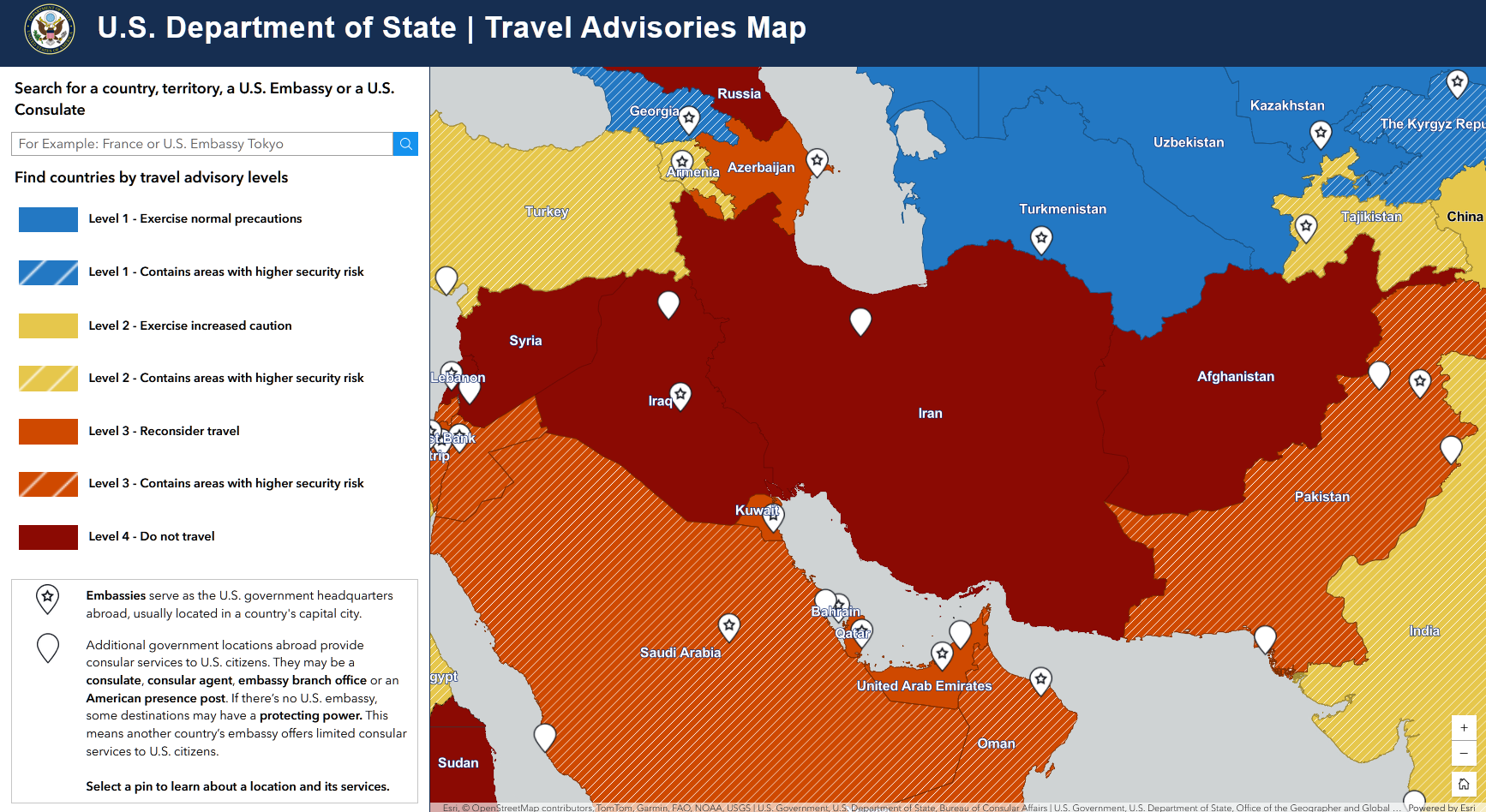
Standing Department of State country advisory levels were not rewritten on September 1. Iran and Iraq remain Level 4: Do Not Travel. The United Arab Emirates and Saudi Arabia remain Level 3: Reconsider Travel on their last posted advisory pages.
Locations Affected
-
Strait of Hormuz, Iran-Oman waters (26.57, 56.25, approximate): CENTCOM cited attempted IRGC attacks on commercial shipping here as a stated reason for the Tuesday strike wave and named maritime assets, facilities, and mine-laying capabilities among the completed target classes.
-
Larak Island, Iran (26.85, 56.36): CENTCOM on August 31 described limited action against IRGC minelaying forces posing an imminent threat in the strait. That Sunday action is the immediate precursor the command tied to Tuesday’s strikes.
-
Qeshm Island, Iran (26.77, 55.77): Iranian state-run media reported explosions, including in Masan village. CENTCOM has not confirmed that site as one of the completed target classes.
-
Bandar Abbas, Iran (27.21, 56.37): Iranian state-run media reported explosions east of the port city. CENTCOM has not confirmed that site.
-
Chabahar, Iran (25.28, 60.65): Iranian state-run media described projectiles at Chabahar and nearby Konarak. CENTCOM has not confirmed those sites.
-
Saudi Arabia, Iraq, United Arab Emirates, and Iran (consular): Named U.S. missions posted matching September 1 security alerts. The Department of State consular hub lists additional Middle East missions on the same regional page.
Latest Developments
-
CENTCOM said it completed the Tuesday strike wave and named the target classes as air defense sites, radar systems, maritime assets and facilities, mine-laying capabilities, and communications sites.
-
CENTCOM earlier announced the start of that wave and published the same-day blockade tally, identifying USS Boxer on the Arabian Sea mission.
-
U.S. Mission Saudi Arabia, U.S. Mission Iraq, U.S. Embassy Abu Dhabi, and Virtual Embassy Iran posted September 1 security alerts on flight cancellations, airspace closures, and targeting of U.S. interests.
-
The Department of State consular account posted the matching regional warning the same afternoon.
-
Virtual Embassy Iran repeated the standing order that U.S. citizens leave Iran now.
-
Iranian state-run media reported explosions at Qeshm, Bandar Abbas, Konarak, and Chabahar. Those site names remain unconfirmed by CENTCOM.
-
Tasnim News Agency (state-run media) said U.S. bases and interests in the region were being targeted by Iranian missiles and drones. CENTCOM has not posted a follow-up confirming incoming fire after the completed wave.
-
The IRGC Public Relations Department, via IRNA (state-run media), said a response had begun and claimed a U.S. MQ-9 shoot-down. CENTCOM has not confirmed that loss.
-
IRGC spokesman Brigadier General Hossein Mohebbi said the United States would regret the new attacks.
-
Iranian President Masoud Pezeshkian told the Shanghai Cooperation Organization summit that Iran would immediately reciprocate if the United States returned to the Islamabad memorandum.
Official Statements
-
U.S. Central Command, September 1: “U.S. Central Command (CENTCOM) forces successfully completed a wave of strikes against Iranian military targets Sept. 1. U.S. forces struck Islamic Revolutionary Guard Corps (IRGC) targets including air defense sites, radar systems, maritime assets and facilities, mine laying capabilities, and communications sites. The strikes follow recent attempted attacks by the IRGC against commercial shipping in the Strait of Hormuz and against American service members. More than 50,000 U.S. service members are currently operating across the Middle East and remain vigilant, lethal, and prepared to continue executing operations directed by the Commander in Chief.”
-
Islamic Revolutionary Guard Corps Public Relations Department, September 1, Islamic Republic News Agency (state-run media): “The valiant combatants of the IRGC have initiated a response that will make the aggressors regret their actions; in the first move, they utilized an advanced aerospace defense system to shoot down the fiftieth advanced MQ-9 drone belonging to the invading US military.”
-
Islamic Revolutionary Guard Corps spokesman Brigadier General Hossein Mohebbi, September 1: “Harsh punishment awaits the aggressors; America will regret its new attacks.” (English rendering of his Persian post: “تنبیه سختی در انتظار متجاوزان است، آمریکا از حملات جدید خود پشیمان خواهد شد.”)
-
U.S. Department of State Consular Affairs, September 1: “Due to tensions in the Middle East, the security environment remains complex with the potential for unforeseen escalation. Americans currently in the Middle East should exercise heightened vigilance and be aware of potential flight cancellations, airspace closures, and travel disruptions. Americans traveling to and from the region should monitor information about airport and airline operations. Iran and groups supportive of Iran may target U.S. interests overseas or at locations associated with the United States and Americans throughout the world, including U.S. businesses and other institutions.”
-
U.S. Central Command, September 1: “Today at 12 p.m. ET, U.S. forces began striking Islamic Revolutionary Guard Corps (IRGC) targets in Iran. The strikes follow recent attempted attacks by the IRGC against commercial shipping in the Strait of Hormuz and against American service members deployed to the region.”
-
U.S. Central Command, September 1: “A U.S. Sailor directs the takeoff of a UH-1Y Venom utility helicopter from the flight deck of USS Boxer (LHD 4) as the amphibious assault ship sails in the Arabian Sea enforcing the U.S. blockade against Iran. As of Sept. 1, U.S. forces have redirected 84 commercial vessels, disabled 3 and boarded 2 to ensure compliance.”
-
U.S. Virtual Embassy Iran, September 1: “Do not travel to Iran for any reason. U.S. citizens should leave Iran now.”
-
U.S. Mission Saudi Arabia, September 1: “Due to tensions in the Middle East, the security environment remains complex with the potential for unforeseen escalation. Americans currently in the Middle East should exercise heightened vigilance and be aware of potential flight cancellations, airspace closures, and travel disruptions.”
-
U.S. Embassy Baghdad and U.S. Consulate General Erbil, September 1: “Due to tensions in the Middle East, the security environment remains complex with the potential for unforeseen escalation. Americans currently in the Middle East should exercise heightened vigilance and be aware of potential flight cancellations, airspace closures, and travel disruptions.”
-
Masoud Pezeshkian, President of Iran, September 1, Mehr News Agency (state-run media): “I say clearly: if the United States returns to its commitments in the memorandum of understanding, the Islamic Republic of Iran will immediately reciprocate.”