U.S. Embassy Alerts on Michoacan Security Forces Elevated Over Roadblock Reports
MEXICO — On July 31, the U.S. Mission to Mexico stated that local security forces in the state of Michoacan have been put on alert due to reports of roadblocks and criminal activity in the state which have the potential to escalate.
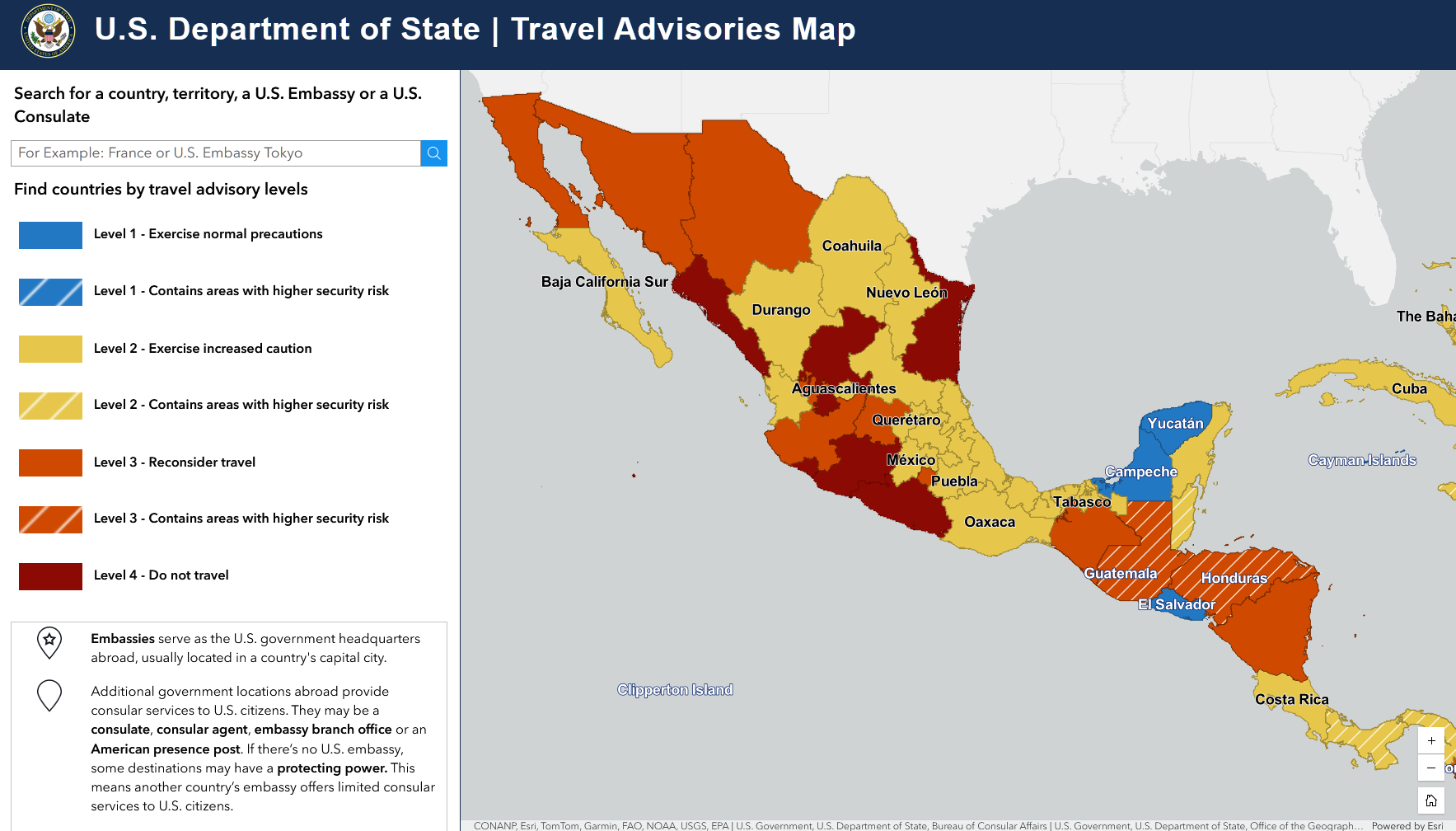
The Mission reminded U.S. citizens that the State Department’s Travel Advisory for Michoacan remains Level 4 – Do Not Travel.
U.S. citizens in the state are advised to avoid areas around law enforcement activity, be aware of their surroundings, minimize unnecessary movements, seek shelter in the event of signs of disturbances, monitor local media for updates, follow the directions of local authorities, avoid crowds, and keep family and friends advised of their location and well-being.
In case of emergency, call 911. The Mission also directed citizens to enroll in the Smart Traveler Enrollment Program and to contact the U.S. Embassy if assistance is needed.
The standing State Department advisory for Michoacan states do not travel due to terrorism and crime.
There is a risk of violence in the state from terrorist groups, cartels, gangs and criminal organizations. Crime and violence are widespread in Michoacan state. U.S. citizens and lawful permanent residents have been victims of kidnapping.
U.S. government employees face travel restrictions within the state, limited to specific highways and areas such as transit on Federal Highway 15D between Mexico City and Guadalajara, travel to Morelia only by air or designated highways, and Lázaro Cárdenas only by air with activities limited to the city center or port areas.
On July 30, Mexican Army Special Forces and the Secretariat of Security and Citizen Protection detained Ramón Ángel Álvarez Ayala, alias “El R1,” in Atotonilco el Alto, Jalisco, along with one other individual.
The Secretariat of Security and Citizen Protection identified El R1 as the leader of a criminal cell linked to the Jalisco New Generation Cartel and as the principal intellectual author who ordered and financed the November 1, 2025, killing of Uruapan mayor Carlos Manzo Rodríguez.
The cell maintained operations in Michoacan municipalities including Apatzingán, Uruapan, Morelia, Álvaro Obregón, Huandacareo, Tacámbaro, and Tzitzio, as well as areas of Jalisco.
The operation formed part of the National Security Strategy and involved coordination with the National Intelligence Center, military and naval intelligence, the Financial Intelligence Unit, the Attorney General’s Office, and the Michoacan state attorney general’s office.
Michoacan security forces activated a maximum alert code following the detention to prevent possible reactions from the Jalisco New Generation Cartel.
The state Public Security Secretariat ordered more than 7,000 Civil Guard agents to remain on alert against criminal reactions such as roadblocks, vehicle burnings, and other attacks.
By instruction of President Claudia Sheinbaum under the Plan Michoacan, the Secretariat of National Defense, National Guard, and Secretariat of the Navy reinforced their presence in Uruapan and across the state of Michoacan. The Secretariat of National Defense also provides escort and protection to Uruapan mayor Grecia Quiroz.
The Michoacan state command center reported multiple roadblocks on July 31, including on Avenida Camelinas and the Periférico Paseo de la República in Morelia, the Jacona-Los Reyes road at the Tocumbo bridge, and the Zamora-Los Reyes road in Tingüindín. Several of these were attributed to protesters. Circulation on the Camelinas and Tocumbo segments was later reported reactivated the same day.
Additional state command center alerts on July 31 covered routine traffic accidents, a fallen tree, and paving work. No state command center alerts on July 31 or into August 1 reported vehicle burnings, cartel-linked blockades, or attacks tied to the El R1 detention.
No official statement from Michoacan state authorities or the Mexican federal government confirming sustained criminal roadblocks, vehicle burnings, or other attacks linked to the El R1 detention has been issued as of August 1.
CAPUFE and National Guard highway reporting for the period contains no confirmed criminal closures in Michoacan on those dates.
Threat Level
MONITORING
-
Local security forces placed on maximum alert in Michoacan after federal capture of CJNG-linked El R1
-
Reports of roadblocks and criminal activity with stated potential to escalate
-
Standing Level 4 – Do Not Travel advisory for the state reaffirmed
-
Federal reinforcement of SEDENA, National Guard, and SEMAR presence across Michoacan under presidential order
-
No confirmed criminal roadblocks, vehicle burnings, or attacks linked to the detention as of August 1
Level rises to ELEVATED if Mexican authorities confirm sustained roadblocks tied to organized crime clashes, vehicle burnings, or other attacks linked to the El R1 detention, or if the U.S. Mission issues a further update.
Level falls to ROUTINE if the reported activity is resolved without further incidents and no additional U.S. Mission or Mexican federal updates appear within 72 hours.
What Happened
-
July 30: Mexican Army Special Forces and the Secretariat of Security and Citizen Protection detained Ramón Ángel Álvarez Ayala, alias “El R1,” leader of a Jalisco New Generation Cartel-linked cell and identified as the principal intellectual author of the November 1, 2025, killing of Uruapan mayor Carlos Manzo Rodríguez, in an operation in Atotonilco el Alto, Jalisco.
-
July 31: Michoacan security forces activated a maximum alert code; the state Public Security Secretariat ordered more than 7,000 Civil Guard agents on alert against possible cartel reactions including roadblocks and vehicle burnings.
-
July 31: By presidential instruction under Plan Michoacan, SEDENA, National Guard, and SEMAR reinforced presence in Uruapan and statewide; protection provided to Uruapan mayor Grecia Quiroz.
-
July 31: U.S. Mission to Mexico issued a security alert stating local security forces in Michoacan have been put on alert due to reports of roadblocks and criminal activity with potential to escalate, and reminded U.S. citizens of the Level 4 – Do Not Travel advisory for the state.
-
July 31: Michoacan state command center reported protest-related roadblocks in Morelia and on the Jacona-Los Reyes and Zamora-Los Reyes corridors; circulation on several of those segments was later reactivated the same day. No command-center alerts reported vehicle burnings or cartel-linked attacks.
Official Statements
-
U.S. Mission to Mexico, July 31: “Local security forces in the state of Michoacan have been put on alert. There are reports of roadblocks and criminal activity in the state which have the potential to escalate. A reminder for U.S. Citizens that the State Department’s Travel Advisory for Michoacan is Level 4 – Do Not Travel.”
-
Omar García Harfuch, Secretary of Security and Citizen Protection, July 31: “The Ministry of National Defense, the National Guard, made an important reinforcement in Uruapan, but not only in Uruapan, throughout the state of Michoacán, in accordance with the order of the President when the Michoacán Plan began. The Ministry of the Navy also maintains a permanent deployment in the state, together with the Ministry of Security and Citizen Protection.”
-
Omar García Harfuch, Secretary of Security and Citizen Protection, July 31: “The investigations made it possible to establish that Ramón Ángel ‘N’ had ordered and financed the homicide of Carlos Manzo. Ramón Ángel ‘N’ is identified as the principal intellectual author of the attack by having direct participation in the decision, planning, and financing of the crime.”
-
Omar García Harfuch, Secretary of Security and Citizen Protection, July 31: “The instruction of the President when she went to Uruapan and said that ‘there would be no impunity’ in this case has been fulfilled. And there are 31 detainees to demonstrate that there will be no impunity in this case, or in any other.”
Full Report & Analysis
The full report includes expert analysis and risk assessment.
Full Report & Analysis →