U.S. Central Command Deploys Three Carrier Strike Groups to Enforce Iranian Blockade as Israel-Lebanon Ceasefire Extended Three Weeks

MIDDLE EAST — U.S. forces have redirected 34 vessels attempting to enter or exit Iranian ports under an expanding blockade enforced by U.S. Central Command.
Three aircraft carrier strike groups (USS Abraham Lincoln, USS Gerald R. Ford, and USS George H.W. Bush) are now operating simultaneously in the region for the first time in decades, supported by over 200 aircraft and 15,000 sailors and Marines.
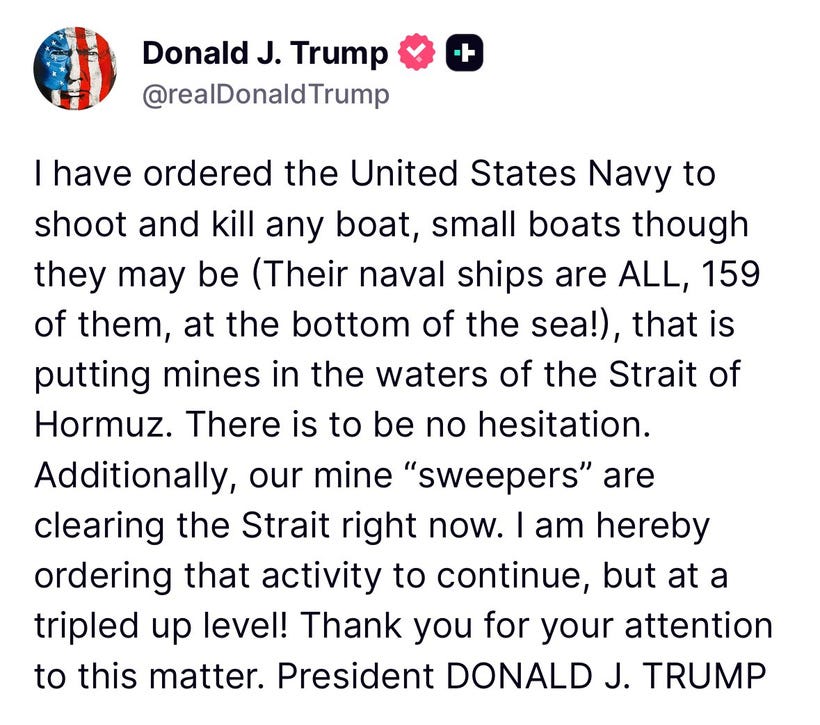
President Trump has directed the Navy to destroy any Iranian boats laying mines in the Strait of Hormuz and ordered mine-sweeping operations at tripled capacity. Rules of engagement authorize destruction of Iranian fast boats that threaten shipping or lay mines.
The ceasefire between Israel and Lebanon has been extended by three weeks, while Iran’s foreign minister conducts talks in Pakistan on regional developments.
The briefing from Secretary of War Pete Hegseth and Chairman of the Joint Chiefs of Staff Gen. Dan Caine on April 24 detailed 55 days of operations since major combat began, including the interdiction of the motor vessel Touska and two very large crude carriers in the Indo-Pacific and Indian Oceans.
Iranian Foreign Minister Abbas Araghchi arrived in Islamabad on April 24 for meetings with Pakistani leadership on regional peace and stability.
Blockade Enforcement and Maritime Interdictions
U.S. Central Command stated on April 24 that the blockade against ships entering or exiting Iranian ports continues, with U.S. forces having redirected 34 vessels to date.
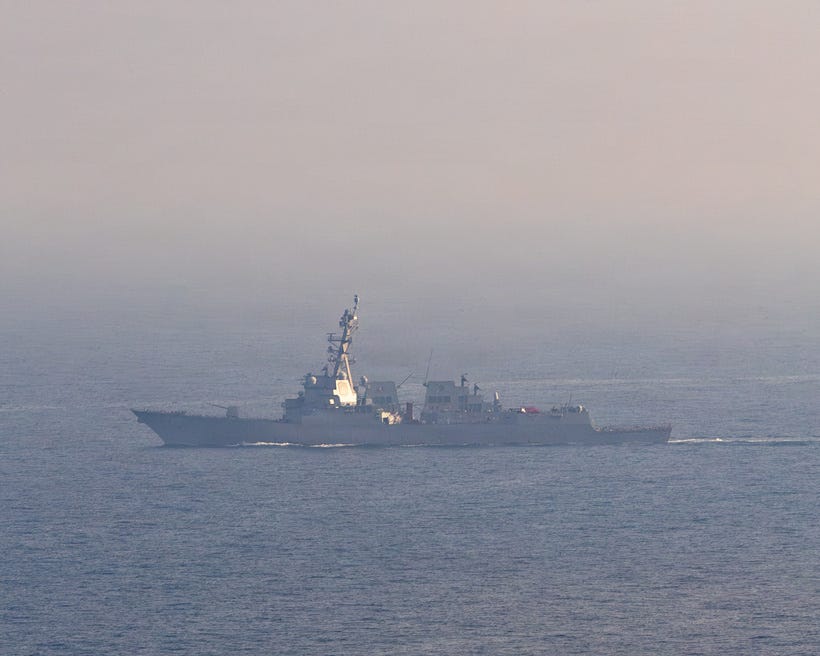
Secretary of War Pete Hegseth said every ship the United States believes meets its criteria (Iranian ships or those traveling to and from Iranian ports) has been turned around. Non-Iranian vessels continue to transit, including overnight passages.
Gen. Dan Caine reported that on April 19 the motor vessel Touska, a 965-foot container ship, ignored multiple warnings over six hours before U.S. Navy forces fired warning shots and then nine inert rounds into its engine room at approximately 9:00 a.m. Eastern Time, disabling the vessel. U.S. Marines boarded via helicopter fast-rope infiltration and took custody. The ship and crew remain in U.S. custody.
On April 20 and April 22, U.S. Indo-Pacific Command interdicted the motor tanker Tifani and the stateless motor tanker Majestic X, both very large crude carriers transporting sanctioned Iranian oil, at the request of the Department of Justice. Both vessels and their crews are in U.S. custody.
Documented Interdictions (April 19–22, 2026)
-
Motor vessel Touska (April 19): 965-foot container ship; engine disabled with nine inert 5-inch rounds; boarded by U.S. Marines via helicopter fast-rope; vessel and crew in U.S. custody.
-
Motor tanker Tifani (April 20): Very large crude carrier (VLCC) carrying sanctioned Iranian oil; secured in the Indo-Pacific by U.S. forces and law enforcement; Navy control team assumed command.
-
Stateless motor tanker Majestic X (also known as The Panics) (April 22): Very large crude carrier (VLCC); secured in the Indian Ocean; bridge secured and vessel in U.S. custody.
Assessment: The 34-vessel redirection total and the three documented interdictions establish a clear enforcement pattern that has reduced attempted breaches after the initial high volume.
Continued global dark fleet seizures demonstrate the blockade’s reach beyond the immediate theater. If redirection numbers remain stable above 30 vessels per week, the economic pressure on Iranian port activity will compound.
Carrier Strike Group Deployment and Force Posture
U.S. Central Command stated that for the first time in decades, three aircraft carrier strike groups are operating in the Middle East simultaneously: USS Abraham Lincoln (CVN 72), USS Gerald R. Ford (CVN 78), and USS George H.W. Bush (CVN 77).
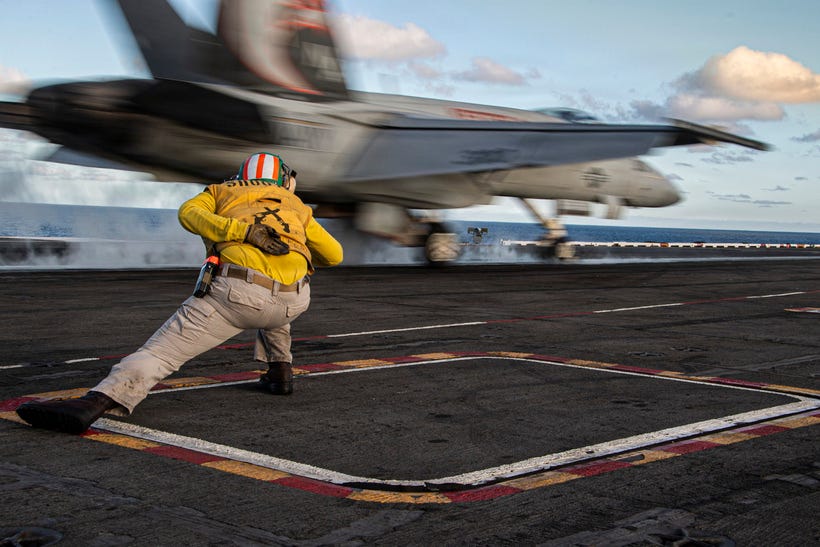
The groups include over 200 aircraft and 15,000 sailors and Marines, representing three times the strike group firepower previously available in the theater. This marks the first time three carriers have operated together in CENTCOM since 2003.
Carrier Air Wing Composition (200+ Aircraft Total)
-
F/A-18E/F Super Hornet — multi-role strike fighter
-
EA-18G Growler — electronic warfare aircraft
-
F-35C Lightning II — stealth strike fighter
-
E-2C/D Hawkeye — airborne early warning aircraft
-
C-2A Greyhound — carrier onboard delivery aircraft
-
MH-60S/R Sea Hawk — multi-role helicopter
-
CMV-22B Osprey — carrier onboard delivery aircraft
Destroyer Escort Force (12 Ships)
-
USS Spruance (DDG-111)
-
USS Michael Murphy (DDG-112)
-
USS Donald Cook (DDG-75)
-
USS Mahan (DDG-72)
-
USS Winston S. Churchill (DDG-81)
-
USS Frank E. Petersen (DDG-121)
-
USS Mason (DDG-87)
-
USS Ross (DDG-71)
-
USS Bainbridge (DDG-96)
-
Plus three additional Arleigh Burke-class destroyers assigned to the strike groups
Assessment:The simultaneous presence of three carrier strike groups provides unmatched multi-domain coverage across air, surface, and subsurface domains in the CENTCOM area of responsibility. The detailed air wing and destroyer composition supports the blockade and mine-clearance operations while deterring escalation.
If Iranian fast-boat activity increases near the Strait of Hormuz, the carrier air wings can provide persistent overwatch; track daily flight operations and destroyer transits via official CENTCOM releases for indicators of heightened alert status.
Rules of Engagement and Mine Clearance Operations
President Trump said that he has ordered the United States Navy to shoot and kill any boat or small boat putting mines in the waters of the Strait of Hormuz, with no hesitation. He added that Iranian naval ships are all at the bottom of the sea and directed mine sweepers to clear the Strait at a tripled-up activity level.
Secretary of War Pete Hegseth said commanders have clear rules of engagement: if Iran places mines or threatens American commercial shipping or forces, U.S. forces will shoot to destroy, consistent with operations against drug boats in the Caribbean.
Assessment: The explicit shoot-to-kill authorization and tripling of mine-sweeping capacity remove ambiguity in response thresholds and accelerate clearance timelines. The claim of complete destruction of larger Iranian naval ships contrasts with the ongoing use of fast attack vessels for asymmetric operations.
Israel-Lebanon Ceasefire Extension and Regional Diplomacy
President Trump stated that the United States is going to work with Lebanon to help it protect itself from Hezbollah and that the ceasefire between Israel and Lebanon will be extended by three weeks. He noted plans to host Israeli Prime Minister Benjamin Netanyahu and Lebanese President Joseph Aoun in the near future.
On April 24, an Iranian delegation headed by Foreign Minister Abbas Araghchi arrived in Islamabad. The delegation was received by Pakistani Deputy Prime Minister/Foreign Minister Senator Mohammad Ishaq Dar and Chief of Army Staff and Chief of Defence Forces Field Marshal Asim Munir.
During the visit, the Iranian Foreign Minister will hold meetings on the latest regional developments and ongoing efforts for regional peace and stability.
Official Statements
-
U.S. Central Command, April 24, 2026: “The blockade against ships entering or exiting Iranian ports continues. To date, U.S. forces have redirected 34 vessels.”
-
U.S. Central Command, April 24, 2026: “For the first time in decades, three aircraft carriers are operating in the Middle East at the same time. Accompanied by their carrier air wings, the USS Abraham Lincoln (CVN 72), USS Gerald R. Ford (CVN 78) and USS George H.W. Bush (CVN 77) include over 200 aircraft and 15,000 Sailors and Marines.”
-
President Donald J. Trump, Truth Social, April 24, 2026: “I have ordered the United States Navy to shoot and kill any boat, small boats though they may be (Their naval ships are ALL, 159 of them, at the bottom of the sea!), that is putting mines in the waters of the Strait of Hormuz. There is to be no hesitation. Additionally, our mine ‘sweepers’ are clearing the Strait right now. I am hereby ordering that activity to continue, but at a tripled up activity level!”
-
President Donald J. Trump, Truth Social, April 24, 2026: “The United States is going to work with Lebanon in order to help it protect itself from Hezbollah. The Ceasefire between Israel and Lebanon will be extended by THREE WEEKS.”
-
Ministry of Foreign Affairs, Government of Pakistan, April 24, 2026: “An Iranian delegation headed by the Foreign Minister of Islamic Republic of Iran H.E. Abbas Araghchi arrived in Islamabad today... During the visit, the Iranian Foreign Minister will hold meetings with Pakistan’s senior leadership to discuss the latest regional developments as well as ongoing efforts for regional peace and stability.”
Full Report & Analysis
The full report includes expert analysis and risk assessment.
Full Report & Analysis →