Trump Orders U.S. Navy Blockade of Strait of Hormuz After Islamabad Nuclear Talks Fail
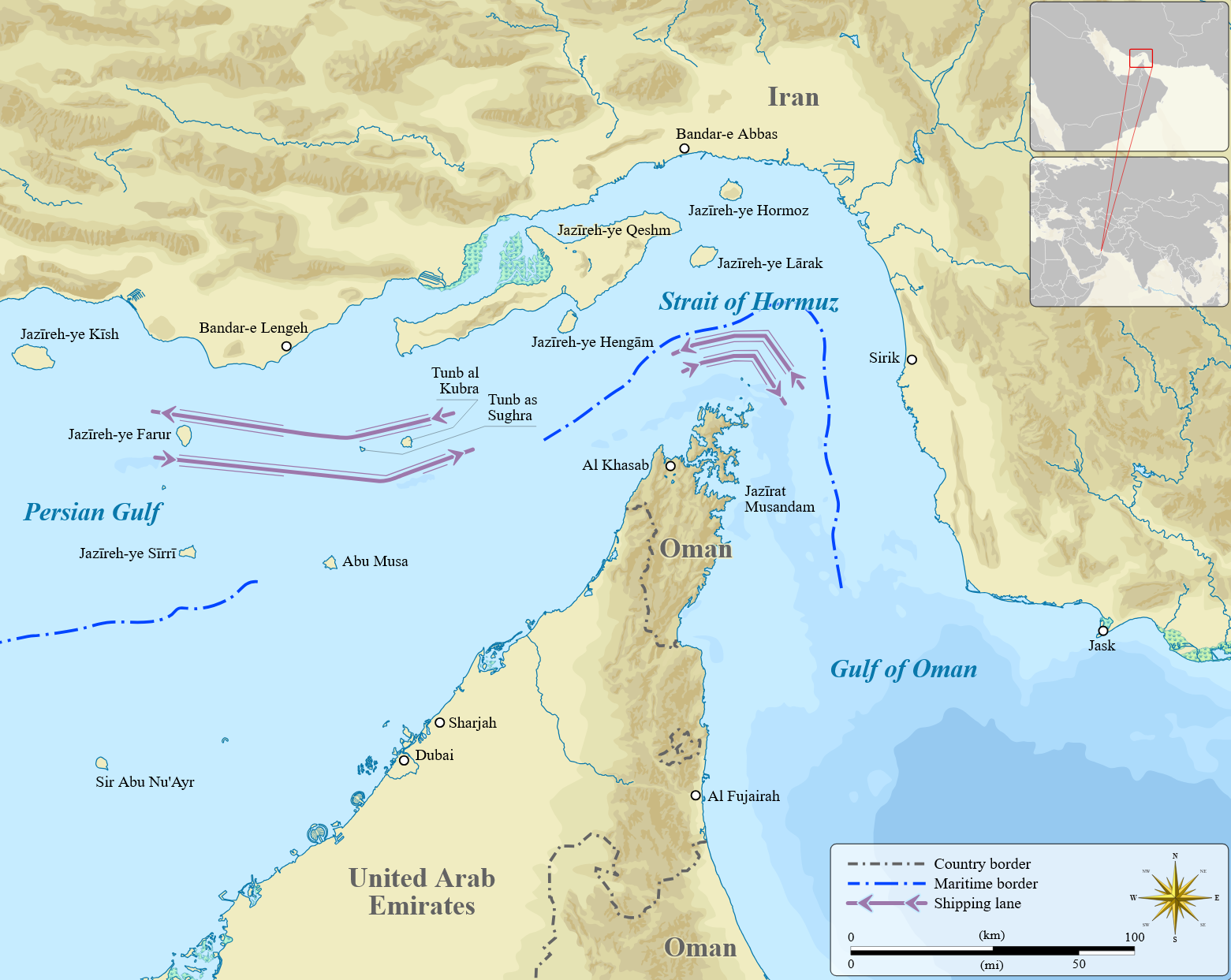
Strait of Hormuz shipping lanes between the Persian Gulf and Gulf of Oman.
MIDDLE EAST — U.S. President Donald Trump ordered an immediate U.S. Navy blockade of the Strait of Hormuz on April 12 after 21 hours of direct talks with Iran in Islamabad ended without agreement on the nuclear issue.
Trump stated, “Effective immediately, the United States Navy, the Finest in the World, will begin the process of BLOCKADING any and all Ships trying to enter, or leave, the Strait of Hormuz.”
Trump directed the Navy to interdict every vessel in international waters that has paid a toll to Iran and to destroy mines laid by Iranian forces.

The first direct high-level in-person engagement between the United States and Iran since the 1979 Islamic Revolution ended without agreement after 21 continuous hours of negotiations at the Islamabad Serena Hotel in Pakistan.
U.S. Vice President JD Vance, who led a U.S. delegation of approximately 300 members, said the American side had presented “a very simple proposal, a method of understanding that is our final and best offer.”
Iran’s delegation of approximately 70 members was led by Parliament Speaker Mohammad Bagher Ghalibaf, not Foreign Minister Abbas Araghchi. Iran’s Foreign Ministry spokesman Esmail Baghaei stated, “the talks did not reach an agreement,” attributing the failure to “unreasonable demands” by the American side.
More than 800 vessels remain trapped in the Persian Gulf with approximately 20,000 civilian seafarers aboard, according to the International Maritime Organization. Iran has been collecting ad-hoc transit tolls of up to $2 million per ship, according to maritime industry source gCaptain.
U.S. Negotiating Position and Nuclear Requirements
The core U.S. demand centered on Iran’s nuclear program. Vance stated, “The simple fact is that we need to see an affirmative commitment that they will not seek a nuclear weapon, and they will not seek the tools that would enable them to quickly achieve a nuclear weapon.”
Washington brought a 15-point framework to the table covering Iran’s enriched uranium stockpile, ballistic missile capability, sanctions relief, and the reopening of the Strait of Hormuz. Vance added that the U.S. had made its red lines clear and that the proposal represented its “final and best offer.”
The U.S. delegation included Special Envoy Steve Witkoff, Presidential Adviser Jared Kushner, National Security Adviser Andrew Baker, and Asian Affairs Adviser Michael Vance.
Security measures in Islamabad included more than 10,000 police and security personnel, a sealed Red Zone, and public holidays announced for April 9 and 10.
Assessment: The framing of the U.S. proposal as a “final and best offer” leaves limited diplomatic space for further negotiation within the existing two-week ceasefire window that began April 8. The 15-point framework’s inclusion of enriched uranium and ballistic missiles alongside Hormuz reopening links military, nuclear, and economic issues into a single package that Iran has publicly rejected as beyond the scope of any single agreement.
U.S. Navy Blockade: Trump’s Post-Talks Order
Within hours of the talks ending, Trump issued the blockade order via Truth Social. He framed the action as a response to Iranian “WORLD EXTORTION,” stating, “Leaders of Countries, especially the United States of America, will never be extorted.”
Trump directed the Navy to “seek and interdict every vessel in International Waters that has paid a toll to Iran,” adding, “No one who pays an illegal toll will have safe passage on the high seas.”
He also ordered the destruction of mines laid by Iranian forces in the strait, stating, “Any Iranian who fires at us, or at peaceful vessels, will be BLOWN TO HELL!”
Trump said, “The Blockade will begin shortly. Other Countries will be involved with this Blockade. Iran will not be allowed to profit off this Illegal Act of EXTORTION.”
According to Trump, Iran’s military position is degraded. “Their Navy is gone, their Air Force is gone, their Anti Aircraft and Radar are useless, Khomeini, and most of their ‘Leaders,’ are dead, all because of their Nuclear ambition,” he said.
Trump added that U.S. forces are fully prepared and that the military would “finish up the little that is left of Iran.”
Assessment: The blockade order transforms the U.S. posture from diplomatic pressure to direct military enforcement at the Strait of Hormuz. The directive to interdict toll-paying vessels and destroy mines requires active naval operations in waters where Iran’s IRGC currently controls transit. The inclusion of allied nations and the stated readiness for further military action indicate the U.S. is prepared for confrontation if Iran resists the interdiction operations.
Full Report & Analysis
The full report includes expert analysis and risk assessment.
Full Report & Analysis →