U.S. Forces Rescue Downed F-15E Crew Member Inside Iran as Hormuz Deadline Approaches
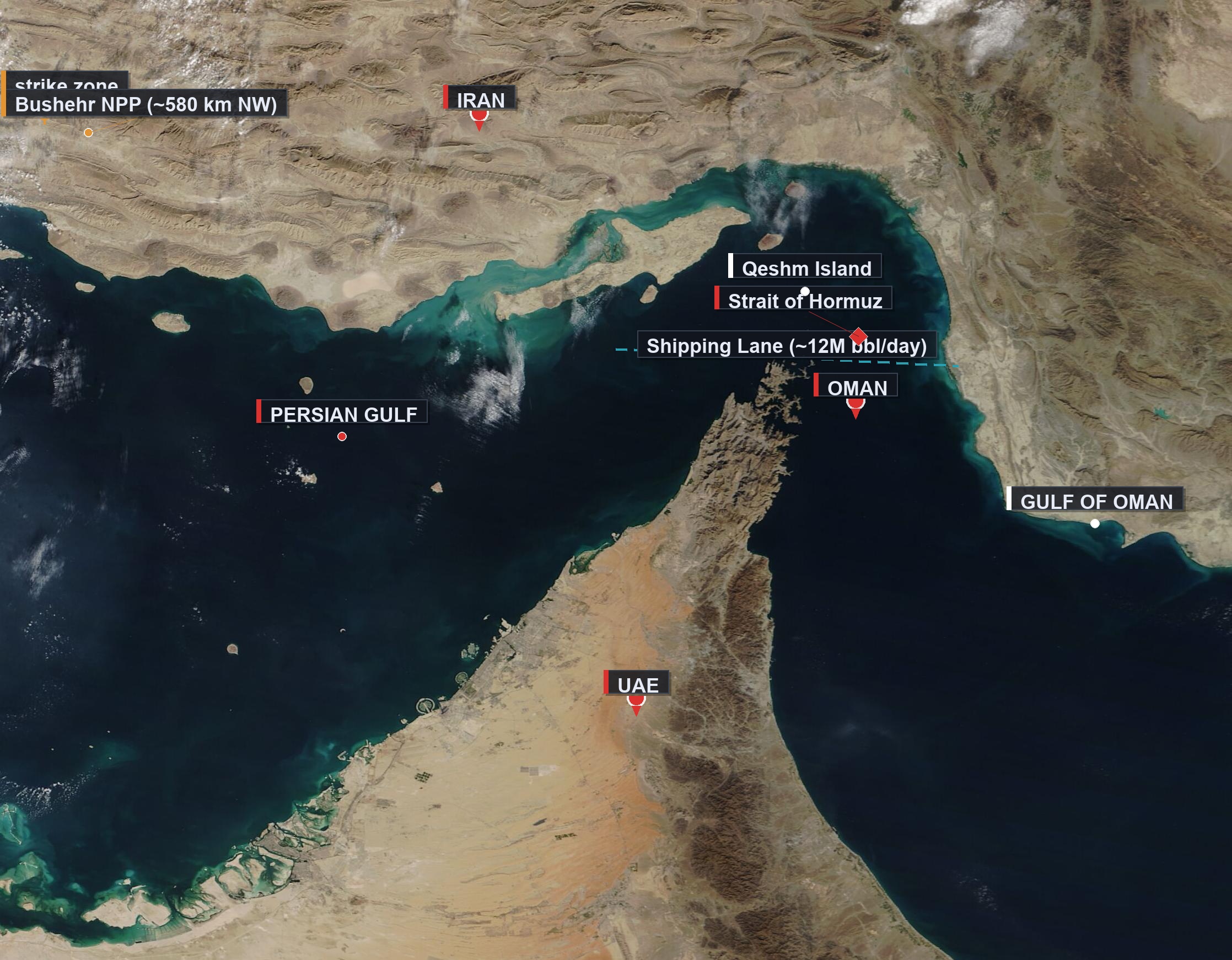
Strait of Hormuz, between Iran and the Arabian Peninsula Credit: NASA MODIS
MIDDLE EAST — U.S. forces extracted a weapons systems officer from inside Iran on April 5 after the crew member evaded capture for approximately two days following the shootdown of an F-15E Strike Eagle on April 3, according to Air and Space Forces Magazine. President Trump announced the rescue on Truth Social, calling it “one of the most daring Search and Rescue Operations in U.S. History” and stating the crew member was “now SAFE and SOUND.”
The rescue operation involved dozens of aircraft, with U.S. Air Force fighters striking Iranian forces during the extraction, according to the same reporting. No Americans were killed in the operation, according to Trump.
Trump’s 48-Hour Ultimatum To Open Strait of Hormuz, Projectile Strikes Near Iran’s Bushehr Nuclear Power Plant
The rescue came as President Trump’s 48-hour ultimatum to Iran to open the Strait of Hormuz or reach a ceasefire deal approaches its approximately April 6 deadline.
On Saturday, a projectile struck within 350 meters of the reactor at Iran’s Bushehr Nuclear Power Plant (NPP), killing one physical protection staff member and damaging a site building, according to an International Atomic Energy Agency (IAEA) statement. The IAEA said no increase in radiation levels was detected. Saturday’s strike is the fourth such incident near the facility since the U.S.-Israeli military campaign against Iran began on February 28.
Iran’s military command issued a public response to the ultimatum, and Iranian Foreign Minister Abbas Araghchi said continued strikes on Bushehr could produce radioactive fallout reaching Gulf Cooperation Council (GCC) capitals. No substantive progress has been reported from indirect negotiations conducted through Pakistan, Egypt, and Turkey over the past ten days.
The convergence of the fourth nuclear facility strike, the F-15E rescue operation, and the expiring deadline defines the immediate threat picture: Iran has threatened to fully close the Strait of Hormuz if the United States strikes its power infrastructure, while U.S. and allied forces have been conducting military operations to reopen the strait since March 19. United Kingdom assets have been conducting defensive missions across the region for five consecutive weeks
Fourth Strike Near the Bushehr Reactor
The IAEA stated Saturday that Iran informed the agency a projectile struck close to the premises of the Bushehr NPP, with the point of impact approximately 350 meters from the reactor building. One member of the site’s physical protection staff was killed by a projectile fragment, according to the IAEA statement.
A building on site was affected by shockwaves and fragments. No increase in radiation levels was reported.
IAEA Director General Rafael Mariano Grossi said that NPP sites and nearby areas must never be attacked, noting that auxiliary site buildings may contain vital safety equipment. The statement added that maximum military restraint was necessary to avoid the risk of a nuclear accident and that the seven pillars for ensuring nuclear safety and security during a conflict must be adhered to.
Saturday’s incident is the fourth time a projectile has struck near the Bushehr site since the conflict began on February 28. Iran attributed all four strikes to U.S. and Israeli forces. Neither the U.S. Department of Defense nor Israeli authorities have publicly attributed responsibility for Saturday’s strike.
Assessment: Four strikes near a single nuclear site within five weeks establishes a pattern of recurring proximity engagement with nuclear infrastructure. The 350-meter distance from the reactor building is the closest reported impact to date; no previous strike distance from the reactor itself has been verified at this specificity. The absence of radiation release across four incidents does not establish that future strikes at comparable distances would produce the same outcome, as the IAEA seven-pillars framework identifies auxiliary safety systems as a distinct risk category even when the reactor core is not directly struck.
Russia Evacuates Bushehr Workers
Russia, which co-constructed the Bushehr facility and participates in its operation, announced the evacuation of 198 workers from the site following the Saturday strike.
No Russian government statement on attribution, the operational status of the plant, or Russia’s continued participation in Bushehr operations had been issued as of Saturday.
Russia’s operational role at the facility means the removal of 198 workers reduces available on-site technical personnel. Neither Iranian nor Russian authorities have publicly stated whether the facility continued operating following the Saturday strike or whether the evacuation is temporary.
Assessment: Russia’s worker evacuation is the first documented action by a third-party state with a direct operational role at the facility to physically remove personnel in response to strikes. This removes a layer of implicit deterrence: a Russian fatality at the site would have carried distinct escalatory weight. The evacuation reduces that deterrent effect going forward.