NORAD Increases Arctic Posture as Russian Tu-142s Probe Alaskan and Canadian Air Defense Zones
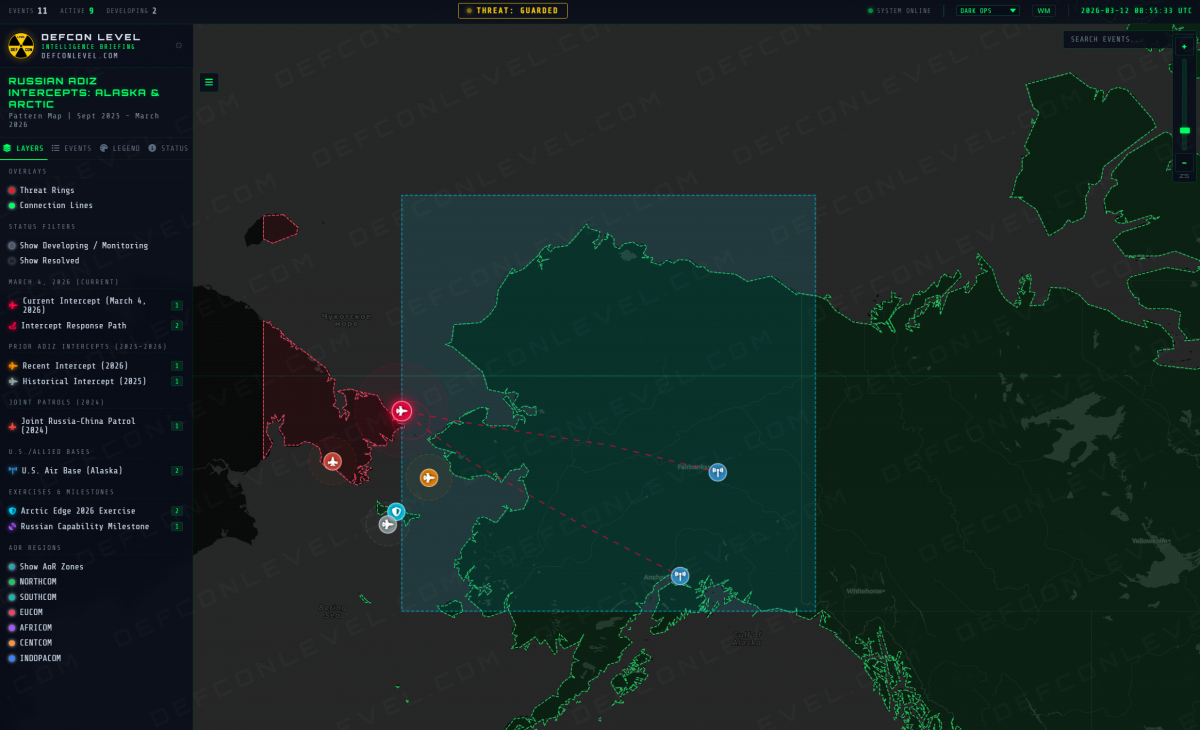
NORTH AMERICA / ARCTIC - On March 4, the North American Aerospace Defense Command (NORAD) detected, tracked, and intercepted two Russian Tu-142 maritime reconnaissance aircraft operating in both the Alaskan and Canadian Air Defense Identification Zones (ADIZ).
Twelve U.S. and Canadian aircraft scrambled to monitor and escort the Russian planes, which remained in international airspace throughout.
The intercept marks the third documented Russian ADIZ penetration since September 2025 and coincided with Arctic Edge 2026, a joint NORAD-NORTHCOM homeland defense exercise running February 23 through March 13 across Alaska and Greenland.
On March 9, NORAD announced it is increasing the posture of its forces in Alaska and Canada to support the U.S. Navy’s Operation ICE CAMP 2026, a three-week under-ice submarine operation in the Beaufort Sea. NORAD will conduct air patrols throughout the operation to reinforce Arctic security.
“That means watching every mile of Arctic sky, sea, and ice with discipline and vigilance and responding when necessary. We have the watch,” stated General Gregory M. Guillot, NORAD commander.
Situation at a Glance
March 4: Two Russian Tu-142 “Bear-F” aircraft entered both Alaskan and Canadian ADIZ over international airspace north of Alaska.
NORAD response: 12 aircraft scrambled: 2 F-35A Lightning II, 2 F-22 Raptor, 2 Royal Canadian Air Force CF-18 Hornet, 4 KC-135 Stratotanker, 1 E-3 AWACS, 1 RCAF CC-150 tanker.
Airspace status: Russian aircraft did not enter U.S. or Canadian sovereign airspace.
Pattern: Third ADIZ intercept in six months (September 2025, February 2026, March 2026), with increasing aircraft diversity and operational complexity.
Context: Intercept occurred during Arctic Edge 2026, a NORAD/NORTHCOM multi-domain exercise focused on cruise missile defense in the Arctic.
Russian capability milestone: On January 9, a Tu-142MK completed the Russian Navy’s first in-flight refueling near the North Pole during a 30-hour sortie.
NORAD posture increase: On March 9, NORAD announced increased force posture in Alaska and Canada to support Operation ICE CAMP 2026, a U.S. Navy under-ice submarine operation (three-week operation beginning March 7).
The Intercept
NORAD detected two Tu-142 long-range anti-submarine warfare (ASW) aircraft operating in the Alaskan ADIZ on March 4. The Tu-142, designated “Bear-F” by NATO, is a four-engine turboprop maritime patrol aircraft with a range exceeding 12,000 kilometers, capable of extended operations over open ocean.
NORAD launched a combined force of 12 aircraft to positively identify, monitor, and intercept the Russian aircraft. The response included fifth-generation F-35A Lightning II and F-22 Raptor fighters alongside Royal Canadian Air Force CF-18 Hornets, reflecting the binational nature of NORAD’s air defense mission.
Four KC-135 Stratotankers from Alaska provided aerial refueling support, while an E-3 Sentry Airborne Warning and Control System (AWACS) aircraft coordinated the intercept. The Royal Canadian Air Force contributed two CF-18 fighters and one CC-150 Polaris tanker aircraft.
The Russian aircraft transited through both the Alaskan and Canadian ADIZ but remained in international airspace at all times. They did not enter American or Canadian sovereign territory.
Assessment: The deployment of both F-35As and F-22s for a two-aircraft intercept is notable. NORAD typically responds to ADIZ penetrations with a smaller fighter contingent. The 12-aircraft response likely reflects the concurrent Arctic Edge 2026 exercise, which had assets pre-positioned for cruise missile defense training from Eielson Air Force Base. The Russian Tu-142s may have been monitoring this exercise activity.
What to Watch
Whether Russia sends Tu-142s or other specialized reconnaissance aircraft on future ADIZ flights (shift from strategic signaling to tactical collection). Monitor NORAD press releases.
Any joint Russia-China ADIZ flights in 2026, which would mark an escalation from the July 2024 precedent. Monitor NORAD and Indo-Pacific Command statements.
Russian Arctic air operations during the remainder of Arctic Edge 2026 (exercise runs through March 13). Monitor Alaskan NORAD Region announcements.
NORAD posture and air patrol activity during Operation ICE CAMP (three-week operation through late March). Any Russian ADIZ incursions during the operation would test NORAD’s ability to maintain both defensive patrols and intercept responses simultaneously. Monitor NORAD and Alaskan NORAD Region announcements.
NATO Arctic Sentry developments and whether the alliance establishes a more permanent northern air policing posture. Monitor NATO Allied Air Command.
Official Statements
NORAD, March 5, 2026: “NORAD detected and tracked two Russian TU-142 military aircraft operating in the Alaskan and Canadian Air Defense Identification Zones (ADIZ) on March 4, 2026. NORAD launched two U.S. Air Force F-35A, two F-22, four KC-135, one E-3 and two Royal Canadian Air Force CF-18 and one CC-150 to positively identify and intercept the Russian aircraft.”
NORAD, March 5, 2026: “The Russian aircraft remained in international airspace and did not enter American or Canadian sovereign airspace. This Russian activity in the Alaskan and Canadian ADIZ occurs regularly and is not seen as a threat.”
NORAD, February 20, 2026 (regarding February 19 intercept): “This kind of activity in the Alaskan ADIZ occurs regularly and is not seen as a threat.”
General Gregory M. Guillot, NORAD Commander, March 9, 2026: “NORAD’s mission is to ensure no threat approaches North America undetected. That means watching every mile of Arctic sky, sea, and ice with discipline and vigilance and responding when necessary. We have the watch.”
Alaskan NORAD Region and Alaskan Command, March 9, 2026: “NORAD is increasing its posture in Alaska. The Alaskan NORAD Region remains vigilant to ensure no threat approaches North America undetected.”
Vice Admiral Richard Seif, Commander, Submarine Forces (on ICE CAMP 2026): “The Arctic is a critical region for national security and global stability.”
Full Report & Analysis
The full report includes expert analysis and risk assessment.
Full Report & Analysis →