CENTCOM Issues Civilian Warning to Iran; U.S. Closes Three Embassies; Allied Evacuations Expand Across Gulf (March 7-8, 2026)
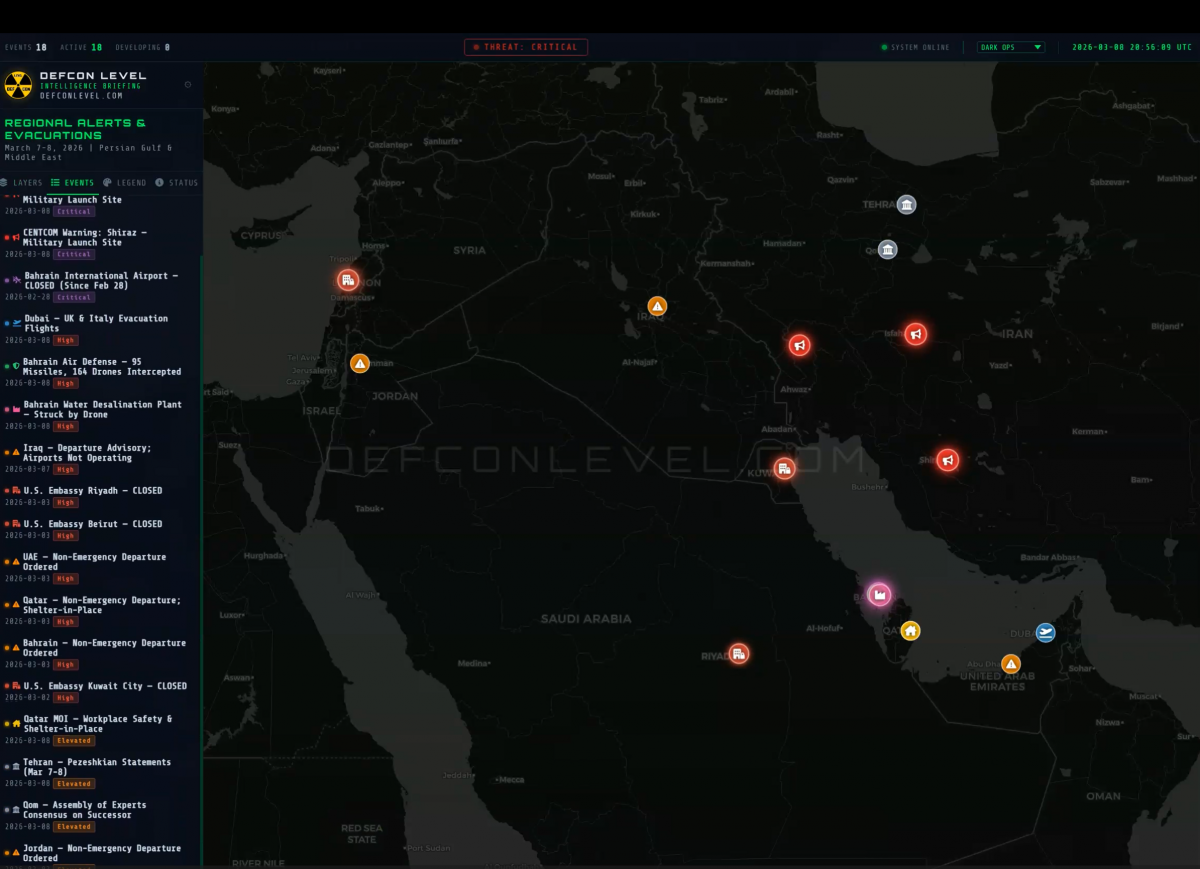
MIDDLE EAST - U.S. Central Command (CENTCOM) issued a safety warning to civilians in Iran on March 8, naming the cities of Dezful, Esfahan, and Shiraz as locations where Iranian forces are using populated areas to launch drones and ballistic missiles.
The warning, issued in English and Farsi, urged Iranian civilians to stay at home.
Separately, the U.S. State Department closed its embassies in Saudi Arabia, Kuwait, and Beirut and ordered non-emergency departure of personnel from six countries, while the UK government chartered flights from Dubai to evacuate British nationals.
This report covers regional alerts, travel advisories, evacuations, and official statements from all parties during March 7-8, 2026, Day 9 of Operation Epic Fury.
Situation at a Glance
CENTCOM civilian warning (Mar 8): Named Dezful, Esfahan, and Shiraz as military launch sites; urged Iranian civilians to stay home. Issued in English and Farsi.
U.S. embassy closures: Saudi Arabia, Kuwait, and Beirut embassies closed. State Dept urged Americans to depart 15 Middle East countries.
UK evacuations (Mar 8): Charter flights from Dubai for 138,000+ British nationals seeking assistance. “Do Not Travel” advisory for UAE.
Italy evacuations: Hundreds evacuated from UAE so far; approximately 30,000 Italian citizens reside in the country.
Bahrain: International airport closed since February 28. Air defenses have intercepted 95 missiles and 164 drones total (Bahrain Defence Force, Mar 8).
Qatar: Shelter-in-place via National Alert System. Ministry of Interior (MOI) issued workplace safety procedures and evacuation route guidance.
Iran - Pezeshkian (Mar 7): Apologized to neighbors, pledged to halt strikes on neighboring countries. Walked back statement March 8, calling it “misinterpreted by the enemy.”
Iran - Assembly of Experts (Mar 8): Reported “majority consensus” on Khamenei successor; name not announced. Some obstacles remain.
Bahrain MOI (Mar 8): Reported Iranian drone struck a water desalination plant, causing material damage.
Conflict day: Day 9 of Operation Epic Fury (began February 28).
CENTCOM Civilian Safety Warning to Iran (March 8)
CENTCOM issued a formal safety warning to civilians in Iran on March 8 from Tampa, Florida, stating that “the Iranian regime is using heavily populated civilian areas to conduct military operations, including launching one-way attack drones and ballistic missiles.”
The statement named three cities (Dezful, Esfahan, and Shiraz) as locations where Iranian forces are using “heavily populated civilian areas” to launch attacks. The warning stated that locations used for military purposes “lose their protected status and could become legitimate military targets under international law.”
CENTCOM urged “all civilians in Iran to stay at home” and stated that the Iranian regime “is knowingly endangering innocent lives.”
Admiral Brad Cooper, Commander of CENTCOM, stated: “Iran’s terrorist regime is blatantly disregarding civilian lives by attacking Gulf partners while compromising the safety of their own people.”
The warning was issued simultaneously in English and Farsi via CENTCOM’s Farsi account, which stated: “Places used for military purposes lose their protected status and can become legitimate military targets under international law.”
Assessment: The CENTCOM warning serves dual purposes: establishing a legal framework under International Humanitarian Law (IHL) for potential future strikes near populated areas, and communicating directly with Iranian civilians in their language. Whether it signals imminent targeting of the named cities or functions primarily as a legal and deterrent measure remains unclear.
The naming of specific cities is unusual for CENTCOM public communications and the Farsi-language component represents a deliberate effort to reach Iranians directly. Whether the named cities face imminent targeting or the warning functions primarily as a legal framework will be a key indicator of escalation trajectory in the coming days.
U.S. Embassy Closures and Departure Orders
The U.S. State Department suspended all civilian consular services at its embassies in Saudi Arabia, Kuwait, and Beirut (Lebanon) as of early March, following Iranian drone attacks on diplomatic facilities.
The embassy in Kuwait City was struck on March 2 (confirmed by U.S. Embassy Kuwait Security Alert), the embassy in Riyadh was struck on March 3 (confirmed by Saudi Ministry of Defense), and the Dubai consulate was targeted on the same day.
The State Department ordered non-emergency departure of government personnel and family members from six countries: UAE, Qatar, Kuwait, Iraq, Jordan, and Bahrain. It urged all American citizens to immediately depart 15 countries: Bahrain, Egypt, Iran, Iraq, Israel, West Bank/Gaza, Jordan, Kuwait, Lebanon, Oman, Qatar, Saudi Arabia, Syria, UAE, and Yemen.
The U.S. Embassy in Baghdad posted detailed departure guidance noting that Baghdad International Zone is closed, airports are not currently operating, and Americans should consider overland routes to Kuwait, Saudi Arabia, or Turkey.
The embassy noted that land border crossings with Iran are closed. The Embassy in Doha and the Embassy in Jerusalem both stated they could not guarantee the ability to help Americans depart.
President Donald Trump stated that approximately 9,000 Americans had been evacuated from the region, a figure echoed by Secretary of State Marco Rubio.
UK and Allied Evacuations
The UK government opened a booking portal on March 8 for British nationals in Dubai to access government-chartered flights. The UK Foreign, Commonwealth and Development Office (FCDO) issued a “Do Not Travel” advisory for the UAE.
An estimated 138,000 British nationals in the UAE region contacted UK authorities seeking assistance, according to the UK government travel update.
The UK government stated it is “prioritising those who are most vulnerable” and warned travelers not to proceed to Dubai Airport without confirmation of a seat.
Three earlier charter flights had been organized, including one from Muscat that landed in London nearly 24 hours behind schedule. Prime Minister Keir Starmer described it as the “biggest [evacuation] of its kind.”
Italy’s Foreign Minister Antonio Tajani confirmed evacuations of Italian citizens from the UAE before the Italian Senate. Approximately 30,000 Italian citizens reside in the UAE.
As of March 8, hundreds had been evacuated: a first group of 98 departed for Rome via Oman, a second group of approximately 200 students flew from Dubai to Milan, and over 300 tourists were routed through Muscat to Rome and Milan.
Trump responded to the UK’s consideration of sending aircraft carriers to the Middle East: “That’s OK, Prime Minister Starmer, we don’t need them any longer - But we will remember. We don’t need people that join Wars after we’ve already won!”
Gulf State Emergency Measures
Qatar: The Qatar Ministry of Interior issued a press release directing all government ministries, semi-government entities, and private sector organizations to adhere to security and safety procedures in the workplace.
The MOI instructed citizens and residents to “exercise caution and vigilance and to comply with the official instructions” issued through the National Alert System, including remaining in safe areas or inside buildings when alerts are issued.
The MOI emphasized the readiness of emergency exits, evacuation routes, and designated assembly points, and provided a hotline (2355633-2355585) for safety-related inquiries.
The U.S. Embassy in Doha maintained shelter-in-place for all remaining emergency personnel.
Bahrain: Bahrain International Airport has remained closed since February 28, with all commercial flights suspended due to airspace closure following Iranian attacks. The airport itself was targeted by an Iranian drone, causing material damage but no casualties. Gulf Air stated its next operational update was scheduled for March 9.
The Bahrain Ministry of Interior reported on March 8 that “Iranian aggression indiscriminately attacked civilian targets and caused material damage to a water desalination plant following a drone attack.”
Iraq: The U.S. Embassy in Baghdad noted that airports are not operating and the Baghdad International Zone is closed. Americans were directed to overland routes through Kuwait, Saudi Arabia, or Turkey. Land border crossings with Iran are closed.
What to Watch
Whether CENTCOM’s naming of Dezful, Esfahan, and Shiraz leads to strikes near those cities or remains a deterrent warning. Monitor centcom.mil for follow-up statements.
Assembly of Experts announcement of Khamenei’s successor and whether the new leader changes Iran’s posture.
Bahrain International Airport reopening timeline; Gulf Air next update scheduled March 9.
U.S. embassy reopening timelines in Saudi Arabia, Kuwait, and Beirut via state.gov.
Whether Iran continues targeting civilian infrastructure (desalination plants, airports) in Gulf states despite Pezeshkian’s stated pledge.
Sustainability of Gulf state air defense interceptor inventories under continued high-volume attacks.
Official Statements
CENTCOM (Adm. Brad Cooper), March 8: “Iran’s terrorist regime is blatantly disregarding civilian lives by attacking Gulf partners while compromising the safety of their own people.”
CENTCOM Farsi account, March 8: “US forces are urging civilians in Iran to stay home. The Iranian regime is knowingly endangering innocent lives by using densely populated civilian areas for military operations, including launching one-way attack drones and ballistic missiles.”
Bahrain Ministry of Interior, March 8: “Iranian aggression indiscriminately attacked civilian targets and caused material damage to a water desalination plant following a drone attack.”
Iranian President Masoud Pezeshkian, March 7: “I should apologize to the neighboring countries that were attacked by Iran, on my own behalf.” Pledged to halt strikes on neighbors unless attacks originated from their territory.
Iranian President Masoud Pezeshkian, March 8: Stated his March 7 remarks were “misinterpreted by the enemy that seeks to sow division among neighbours.” Called neighboring countries “brothers.”
Iranian FM spokesperson Esmaeil Baghaei: Called the conflict an “unjust war imposed on our nation” and stated Iran has “no problem with the American people.”
Ali Larijani (Supreme National Security Council), Iran: “We do not welcome the war, but aggressors should be punished.”
President Trump, March 7 (Truth Social + Shield of Americas Summit): Called Iran “THE LOSER OF THE MIDDLE EAST.” “Today Iran will be hit very hard!” Stated “complete destruction and certain death” under consideration. At Summit: “We knocked out their air force, we knocked out their communications, and all telecommunications has gone.”
President Trump, March 6 (Truth Social, defense meeting): Defense companies agreed to “quadruple Production of the ‘Exquisite Class’ Weaponry.” U.S. has “a virtually unlimited supply of Medium and Upper Medium Grade Munitions.”
Qatar Ministry of Interior (press release): Directed adherence to security procedures, exercise of “caution and vigilance,” compliance with National Alert System, readiness of evacuation routes and assembly points.
UK Government Travel Update, March 8: Charter flights from Dubai; “Do Not Travel” advisory for UAE; prioritizing most vulnerable.
Full Report & Analysis
The full report includes expert analysis and risk assessment.
Full Report & Analysis →